Abou Shivan could only stare at Othman Hospital in the Kurdish-majority Ashrafieh neighbourhood of Aleppo in Syria. Once considered the best medical centre in the area, the building, next to his mini market, stood in tatters, its windows shattered and walls riddled with bullet holes and blackened by soot. “What a shame,” a resident said, as he walked behind the stunned shop owner.
The hospital was hit during heavy clashes last week between the Syrian army and Kurdish fighters affiliated with the Syrian Democratic Forces (SDF), a well-armed, Kurdish-led force. The violence quickly turned the streets of the Ashrafieh neighbourhood, as well as the Sheikh Maqsoud and Bani Zaid areas, into a deadly urban battlefield.
The SDF had long controlled those three overwhelmingly Kurdish neighbourhoods of Aleppo. But after days of fighting, the Syrian army announced it had taken control of them, forcing the remaining Kurdish fighters out of the area.

A ceasefire was agreed on shortly after between the two sides. On Sunday, when The National visited Ashrafieh and Sheikh Maqsoud, official Syrian army checkpoints had replaced those of the SDF.
Abou Shivan, who used a pseudonym, is a Kurd who has lived in Ashrafieh for 25 years. He said he left his home on Tuesday under heavy shelling, as the situation spiralled out of control. But Adnan Othman, owner of Othman hospital, and his nephew, Ali Othman, refused to leave the site, he said.
“They should not have stayed. I told them it was too dangerous,” Abou Shivan said. He later learnt from the news that his two neighbours had been killed.
Their family told Kurdish TV channel Rudaw that the men, whom they said had stayed at the hospital out of a sense of duty and were not politically affiliated, had been arrested by the Syrian army. A neighbour later found them dead, shot in the head. The National could not independently verify the family’s account.
-
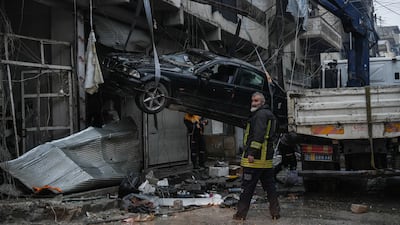
Workers in Aleppo remove damaged cars following clashes between Kurdish-led Syrian Democratic Forces (SDF) and Syrian government troops. EPA -
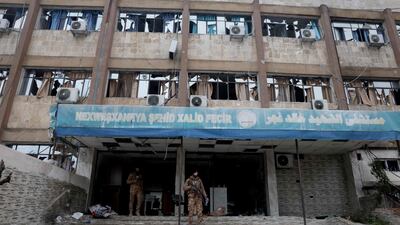
An armed Syrian security officer stands outside the Khaled Fajr Hospital in the Al Sheikh Maqsoud neighbourhood. It had been attacked by machine guns and drones. AFP -
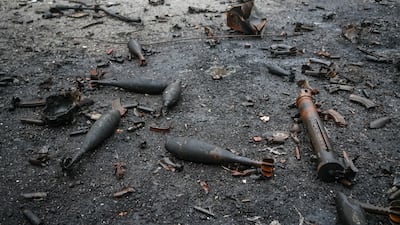
The remnants of munitions following clashes between the SDF and Syrian government troops. Clearance operations were reportedly continuing on Sunday. EPA -
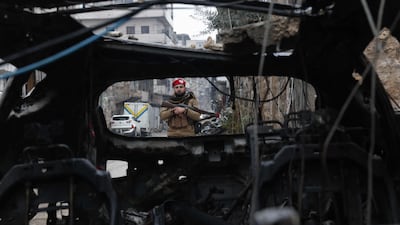
A Syrian security officer is seen through the back window of a destroyed vehicle. AFP -
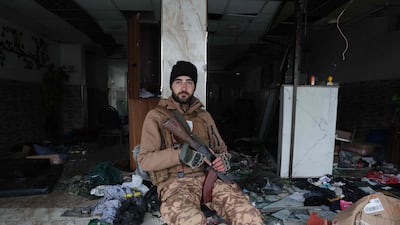
A Syrian security officer sits amongst strewn items and broken glass following a ceasefire which ended several days of fighting between. AFP -
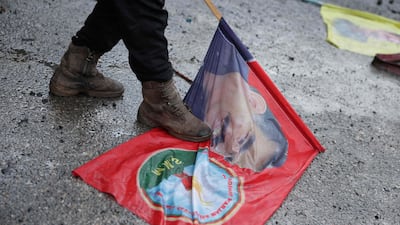
A foot steps on a flag with the image of jailed Kurdish leader Abdullah Ocalan. AFP -
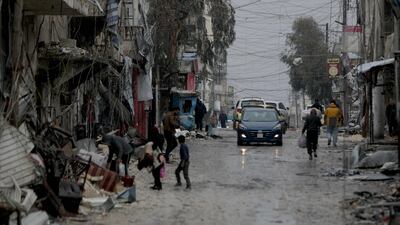
People walk down a street as a car drives by following the ceasefire. AFP -
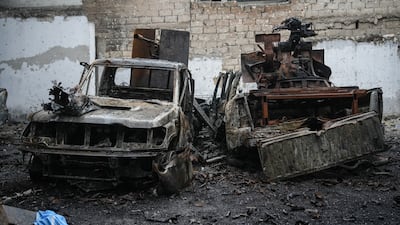
Damaged cars following clashes between the SDF and Syrian government troops in the Sheikh Maqsoud neighborhood of Aleppo. EPA -
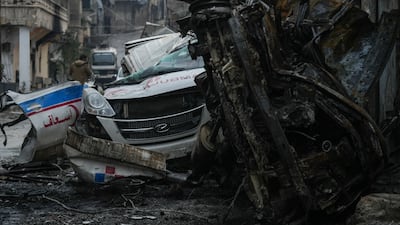
Damaged cars following clashes. Aleppo's governor said the security situation in the area was returning to normal in the neighbourhood of Sheikh Maqsoud. EPA -
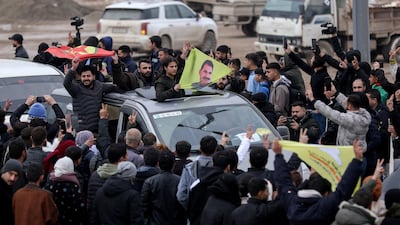
People welcome SDF civilians and fighters following the ceasefire. Reuters


Civilian struggle
Both sides have traded accusations of breaches of international humanitarian law, with the SDF accusing the army of attacking civilian sites. Damascus has accused the Kurdish forces of being behind a series of drone attacks that shook Aleppo on Saturday, including one targeting an official building where its governor and a minister were giving a conference.
The Aleppo clashes have led to intensifying rhetoric between the two sides, further complicating the integration of other SDF-controlled territory, which includes a semi-autonomous, resource-rich region in the north-east covering about a quarter of Syria.
Until now, the SDF and Damascus had shown restrained hostility since the fall of the Bashar Al Assad regime and had even reached an agreement in March on the integration of the SDF into the central government.
Damascus has also accused the SDF of embedding itself in civilian infrastructure, including Yassin Hospital in Sheikh Maqsoud, which officials said was turned into a “fortified military position”. Videos show burnt cars and tanks near Yassin Hospital, with missiles scattered on the ground, although The National was unable to determine to whom they belonged.
But Abou Shivan said he was not aware of SDF presence at Othman Hospital of Ashrafieh. He added that the destruction of civilian infrastructure and the loss of innocent lives did not surprise him. At least 24 people, including civilians, have been killed, and more than 120 were injured, according to the Aleppo health directorate. “It’s always us, civilians, paying the price of armed conflict,” he added.
Abou Shivan knows this all too well. His apartment, adjacent to the hospital, was completely charred after an artillery shell hit his living room.
“It’s all charcoal now,” he said, showing The National what remains of the flat, as shards of glass and sections of wall cracked under his steps. The shell, which left a gaping hole in the wall, completely torched the apartment. Days later, a suffocating smell of burnt rubber lingered in the air.
He said his building was not home to Kurdish militants, but is now completely uninhabitable. “We’re only civilians here. I’m telling you things as they are and you can see for yourself,” he said. “I don’t believe the army targeted us directly, but because the building sits on the front line, I was expecting to see some damage.”
Abou Shivan had already lost his previous home during the 2023 earthquake that struck Syria and Turkey. The building, now reduced to a massive pile of rubble, was one of the few in the neighbourhood to collapse entirely under the tremors. “We’re so used to it, it’s like we don’t feel anything any more. What can I say?” he asked, his voice heavy with exhaustion.
Peaceful coexistence
Like many Kurds fleeing the Aleppo clashes, his family sought refuge last week in Afrin, a former Kurdish heartland hollowed out by mass displacement after Turkey’s 2018 offensive. He said they were too afraid to return to Aleppo. “They don’t feel safe, they're crying on the phone asking me to join them,” he said.
Yet Kurds and members of the Arab minority in Ashrafieh and Sheikh Maqsoud told The National that they have long lived together peacefully, suggesting the SDF-Damascus stand-off can hardly be reduced to an ethnic conflict.
Ghada Raii, an Arab displaced from the area, is among the tens of thousands who fled the fighting. She said she had been desperately waiting with her Kurdish friends to return home. “We’ve always lived together – they’re our neighbours,” she said.
Many Kurds in Ashrafieh and Sheikh Maqsoud came from Afrin through gradual migration over decades, with an increased influx after the Turkish-backed offensive against the city in 2018, said Alexander McKeever, an analyst in Amman focusing on northern Syria. “Over the course of the civil war, many Arabs also ended up there,” he said. There were never any major tensions between the communities, he added.
Territorial control
For Abou Shivan, the main issue lies with what he calls factions within the Syrian army that it “fails to control”. He is referring mainly to the now largely dismantled Syrian National Army (SNA), a Turkey-backed coalition whose commanders were last year placed under EU sanctions over the mass killing of Alawite civilians in the coastal region in March.
Rights groups have also repeatedly accused SNA factions of abuses against Kurdish civilians and others perceived to have ties to Kurdish-led forces, particularly in areas taken over from Kurdish forces since 2018. “They think we‘re infidels,” Abou Shivan said.
The Institute for the Study of War found that 22 per cent of commanders in the new Syrian army divisions previously belonged to pro-Turkish SNA factions. But for Mr McKeever, the Aleppo clashes – and more broadly the stand-off between Damascus and the SDF – are above all political and rooted in a struggle over territorial control, as Syrian President Ahmad Al Shara has vowed to reunify the country since the fall of the Assad regime.
“Overall, it’s a political issue between the government and the SDF. I think Damascus decided that now was the time to force the issue,” he told The National.
He added that he did not see the “SNA playing too much of a role”, in Damascus' takeover of the Kurdish neighbourhoods of Aleppo. “It seems unlikely given the scale of the mobilisation,” he said in a post on X, in which he detailed the diverse backgrounds of the four Aleppo-based army divisions that were deployed, beyond SNA elements.
Simmering tensions
The three neighbourhoods are now cleared of Kurdish fighters. An official at the Syrian Interior Ministry said that government forces detained about 300 Kurds, “including members of the security forces”, and moved more than 400 Kurdish fighters following the Aleppo clashes. It was not immediately clear whether civilians were also among those detained.
But the tensions may not end there. Mr McKeever said other pockets of simmering tension between Damascus and the SDF, such as Deir Hafer in eastern Aleppo, could be the next flashpoint.
In Ashrafieh, residents started to return on Sunday to check on their properties, while the army still barred civilians from accessing Sheikh Maqsoud, which suffered more damage due to prolonged fighting, as clearing operations were under way.
Abou Shivan's neighbour, whose flat was also damaged, said she was not ready to return to Ashrafieh, as she was not sure she will be safe. It remains uncertain when that will change, she added.