

Iraqis will head to the polls on Tuesday as political splits and voter apathy leave the outcome wide open, experts have told The National.
The general election is the country’s sixth since the downfall of former dictator Saddam Hussein. The campaign has seen the formation of competing electoral lists of 31 alliances, 38 political parties and 75 independent candidates.
Twenty years ago there were only a few coalitions which represented the major Shiite groups, Kurdish parties and Sunni Arabs – meaning the once-unified blocs are now fragmented, Renad Mansour, director of the Iraq Initiative at London’s Chatham House, told The National.

“Over the years these blocs have fragmented to the point where today there are several Shiite lists, several Kurdish lists and several Sunni lists, because Iraq's democracy, as it was built, is based on ethno-sectarianism,” Mr Mansour said.
Several powerful, Iran-linked Shiite militias are participating in the election via associated political parties. “Even groups like the PMF [the Popular Mobilisation Forces], which used to compete under one coalition, are now also competing on their own,” Mr Mansour said. “There's an internal competition leading to this fragmentation among Iraq's political parties,” he said.
These parties are contesting the elections as separate electoral lists, but are expected to unite again after the election in a bid to form the largest bloc in parliament. However, the political splits between Iraq's various groups mean the results may not translate into clear alliances.
The public will get to choose between 7,744 candidates, most of them from a range of largely sectarian-aligned parties, in addition to some independents. They are all running for Iraq's 329 parliamentary seats with around 21.5 million registered voters.
Under the constitution, 25 per cent of parliamentary seats must go to women, and nine seats are allocated for religious minorities. The position of speaker of parliament is also assigned to a Sunni, according to convention in Iraq’s post-2003 power-sharing system, while the prime minister is Shiite and the president a Kurd.
Voter apathy
Voter turnout was 41 per cent at the last parliamentary elections in 2021. That was the lowest since 2003, down from the previous low of 44 per cent in 2018.
Moreover, only 21.4 million people out of a total of 32 million eligible voters have updated their information and obtained voter cards, a decrease since 2021, when about 24 million people registered. Unlike in past elections, there will be no polling stations outside the country.
“It's just disappointing to the public that the elections don't directly lead to change and people therefore feel a bit disenfranchised and that's why you get low voter turnout,” Sajad Jiyad, an analyst of Iraqi politics with the Century Foundation, told The National.
-

Iraqi election workers count ballots in Baghdad after an early voting day for security forces and displaced people in the country's national parliamentary election. EPA -

The early voting day on Sunday took took place two days before polls open to the public across the country on Tuesday. AFP -
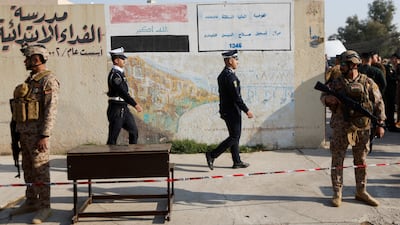
Members of the security forces stand guard outside a polling station in Mosul. Reuters -

A policeman checks comrades arriving to vote at a polling station in Baghdad. EPA -

Displaced Iraqis prepare to cast their vote at a polling station in the Debaga camp east of Makhmur, in northern Iraq. AFP -

A policeman flashes the V sign while standing in the queue to vote in Baghdad. EPA


Previous Iraqi governments have failed to meet the public's expectations of providing adequate public services and employment opportunities, further decreasing the chances of high voter turnout. The general public is apathetic towards the elections, Mr Jiyad said, adding they “believe the elections need to change because they are not voting for a winner or a loser".
“There's no party that wins or there's no president or a particular figure that wins. You vote for a parliament and then you have to wait for months to see the outcome of negotiations between the parties to select a cabinet based on the talks,” he said. “So the public don't really get what they vote for."
Many Iraqis have seen that elections don't necessarily bring about meaningful change, Mr Mansour said. “Even election winners aren't necessarily the ones who then form the government, so over the years we've seen a drop in the voter turnout, because of some of these lessons learnt about elections,” he said.
In a statement given to The National, the head of the UN mission in Iraq, Mohamed Al Hassan said the Iraqi public should go out and vote on Tuesday as it is their democratic right.
“We expressed our hope for wide participation by the Iraqi people, exercising their constitutional right in these elections with full sincerity,” Mr Al Hassan said. “We encourage them to participate effectively in the electoral process with awareness and responsibility and urge them to make good choices of candidates – those capable of serving Iraq."
One of the UN agency's missions, which is to monitor and ensure the elections are fair and transparent, is set to conclude by December, leaving the fate of future polls in the hands of the Iraqi authorities.

