
US special envoy Thomas Barrack said in Beirut on Monday he was "unbelievably satisfied" with Lebanon’s seven-page response to a US proposal calling for the full disarmament of Hezbollah.
His visit comes as the US steps up pressure on Hezbollah and Israeli strikes on Lebanon persist, despite a ceasefire in November, slammed by Lebanese officials as one-sided, that brought 14 months of war with Israel to an end.
The meetings in Beirut coincided with Israeli Prime Minister Benjamin Netanyahu’s visit to Washington, which he prefaced by claiming that more peace deals with Israel are expected soon.
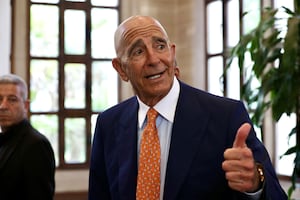
At a press conference after meeting Lebanese President Joseph Aoun in Baabda, Mr Barrack said dialogue between Israel and Syria had begun, and urged Lebanon to follow suit. Hours later, a memo showed that the US administration revoked the foreign terrorist organisation designation for Syrian-based Nusra Front, now known as Hayat Tahrir Al Sham, which was previously Al Qaeda’s Syria branch.
Mr Barrack said he received seven pages of Lebanese remarks on the original US paper - but he said he had not yet reviewed them. He was also scheduled to meet Prime Minister Nawaf Salam, Parliament Speaker Nabih Berri and Foreign Minister Joe Rajji.
“This is a very important time for Lebanon and the region, and there is an opportunity that must be seized," he said, adding that US President Donald Trump wanted to help Lebanon prosper. "It’s time to change the region.
“We do not dictate to Lebanon what it should do, but we support it in its decisions. Lebanon must deal with Hezbollah, not us. Hezbollah must realise that it has a chance for peace.

"We are not dictating to Lebanon how to deal with the issue of Hezbollah's weapons. This is an internal Lebanese decision. However, we would like to see this issue handled responsibly, because the region is changing rapidly, and anyone who fails to implement change will suffer losses."
Mr Barrack cited the necessity of an agreement based on the US proposal due to the unsuccessful ceasefire mechanism adopted between Israel, Hezbollah, and the Lebanese army.
The US-backed diplomatic road map ties Hezbollah’s nationwide disarmament to funding for reconstruction of Lebanon and an end to Israeli military operations in the country.
The National, through Lebanese officials, has been informed of the document's contents.
“The document had been in the works for days on the Lebanese side, with input from advisers to the Prime Minister, the President and the Speaker of Parliament. Work on it continued until just hours before the arrival of the US envoy,” said one of the officials.
“The final additions and amendments to the paper requested by Thomas Barrack were made late on Sunday night, with Hezbollah participating through MP Mohammad Raad, head of the party’s parliamentary bloc, and Hussein Khalil, the group’s security adviser."
The document centres on demands for a full Israeli withdrawal from Lebanese territory, including the contested Shebaa Farms.
Hezbollah, a powerful political party and paramilitary force, suffered devastating losses in its war with Israel that ended in November. The ceasefire called for Hezbollah to begin disarming south of the Litani River, in exchange for an Israeli withdrawal from Lebanese territory. While Hezbollah has co-operated with Lebanese authorities, Israeli strikes on Lebanese soil – which Israel says target Hezbollah infrastructure – have continued. Israel also maintains a military occupation of five points along the border with Lebanon.
A source told The National last week that Hezbollah’s leadership remains divided over the US proposal. The group is reportedly considering giving up some of its missile and drone capabilities as part of a compromise, though an official response is expected to be delivered during Mr Barrack’s visit.
Observers have raised concerns about US pressure tactics, stressing that Hezbollah’s weapons remain a highly sensitive issue in a deeply fractured country, where the militant group continues to enjoy broad popular support.
Finding Hezbollah's tunnels in the mountains of south Lebanon
Lebanon’s political leadership has expressed broad agreement that the state should hold exclusive military authority. However, senior figures have urged the US to adopt a softer approach, citing the difficulty of making a case for Hezbollah’s full disarmament amid the Israeli attacks.
In a televised speech, Hezbollah chief Naim Qassem said his group will “continue the resistance” and “will not be part of legitimising occupation in Lebanon”.
Hezbollah would “not accept capitulation and the aggression must be asked to stop”, he said.
“We are ready for both options – for peace and rebuilding the country – and also for confrontation and defence. We are people who cannot be defeated, and we will not give up our dignity and rights.”
On Sunday night ahead of Mr Barrack’s visit, the Israeli army launched a series of air strikes across southern Lebanon and the Bekaa Valley, targeting areas north of the Litani.

