
Live updates: Follow the latest on Israel-Gaza
The Israeli army will expand its ground invasion of southern Lebanon, Israel's public broadcaster reported on Sunday, with thousands more troops expected to be called up for service.
Apparent approval of plans to extend Israel's invasion comes despite reports that a Russian-brokered ceasefire with Lebanon could be on the horizon.
Israel's Minister of Strategic Affairs, Ron Dermer, reportedly visited Russia in a secret bid to reach a settlement with Beirut, Israeli army radio reported, and Israeli Foreign Minister Gideon Saar indicated Russia could play a part by stopping Hezbollah from rearming via Syria. Mr Saar said Washington was also playing a role.
“I think there is a certain progress,” Mr Saar told a press conference in Jerusalem. “We are working with the Americans on the issue.
“We will be ready to be there if we know, first of all that Hezbollah is not on our border, is north of the Litani River and that Hezbollah will not be able to arm again with new weapons systems.”
But neither Lebanon nor Hezbollah have received any “official or specific proposal”, according to Hezbollah spokesman Mohammad Afif, who spoke to reporters in Beirut's southern suburbs on Monday. “I don't expect anything specific any time soon,” he said.
In contradiction with the reports of a potential ceasefire breakthrough, and six weeks into Israel's invasion of Lebanon, military chief of staff Herzi Halevi approved plans for the Northern Command to expand its incursion to “new areas,” Israel's Kan news agency reported, saying thousands of conscripted and reserve soldiers are to take part.
Senior defence officials said the move will allow the army to “deepen its achievements” in Lebanon – where almost 3,200 people have been killed, 14,000 wounded and at least 1.4 million displaced in the past year of Israeli attacks.
Rumours of a deeper ground invasion circulated last week, while Israel has increased the number of ground troops to Lebanon over the past month, with four divisions confirmed to be operating across the border. There has been no official confirmation from the army.
Mr Afif said five Israeli military divisions with 65,000 soldiers had not been enough to occupy Lebanon, despite 45 days of fighting.
“You will never win your war with air superiority or by destroying and killing civilians, women and children,” he said. “As long as you are unable to advance by land and take actual control, you will never achieve your political goals and the people of the north will never return.”
-

The southern Lebanese village of Al Taybeh is shrouded by smoke during an air strike as Israeli forces seek out Hezbollah. AFP -
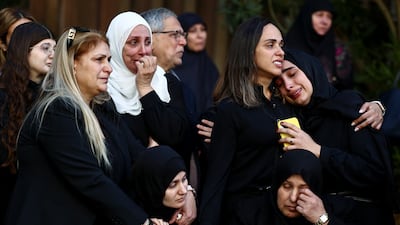
The sister, mother and the partner of Mohammad Farhat, a major with the Lebanese Army who was killed in an Israeli strike with two other soldiers on the outskirts of the village of Yater in southern Lebanon, attend an official memorial in Beirut. Reuters -
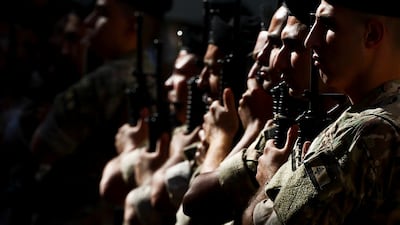
Lebanese Army soldiers take part in an official ceremony to pay tribute after the death of Maj Mohammad Farhat. Reuters -
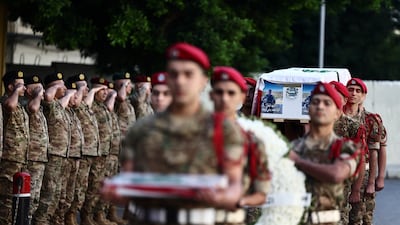
Lebanese Army soldiers carry the coffin of Maj Mohammad Farhat during an official ceremony to pay tribute in Beirut, Lebanon. Reuters -
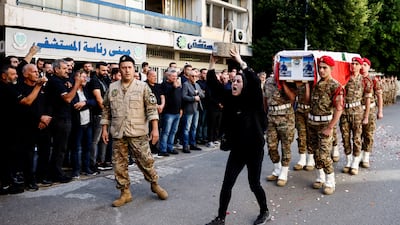
Emotions ran high at a memorial for Lebanese Army Maj Mohammad Farhat, who was killed in an Israeli strike with two other soldiers on the outskirts of the village of Yater in southern Lebanon. Reuters -
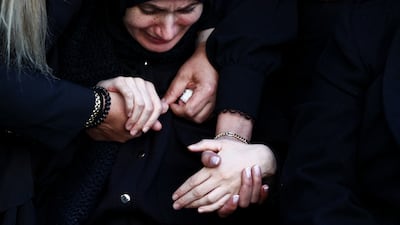
The relatives of Maj Mohammad Farhat are comforted by friends at a memorial in Beirut. Reuters -

The sister of Maj Mohammad Farhat at the official memorial to her brother in Beirut. Reuters -

Mourners at the official ceremony to pay tribute to Maj Mohammad Farhat of the Lebanese Army, who was killed in an Israeli strike with two other soldiers on the outskirts of the village of Yater in southern Lebanon. Reuters


On Sunday, Lebanon's caretaker foreign minister Abdallah Bou Habib said Beirut is “determined” to strengthen its army presence in the south, where villages have been wiped from the map and swathes of major cities destroyed in Israeli air strikes.
In comments made ahead of an Arab-Islamic summit in Riyadh, the minister said Israel is aiming to create a buffer zone “devoid of life” in the south and said Lebanon “has carried more than it can bear”.
Israel has repeatedly stated the return of displaced Israelis to their homes on the border as goal of the war. It has vowed to destroy Hezbollah facilities across Lebanon, launching waves of air strikes nationwide, including regular attacks on Beirut's southern suburbs.
Israeli attacks continued overnight across Lebanon and into Monday morning, with 18 people confirmed killed in Sunday strikes on the eastern Baalbek-Hermel governorate. Among the victims were a couple and their two daughters, in the town of Bednayel.
At least 41 people were killed in Israeli strikes across Lebanon on Sunday, including 23 north of the capital Beirut, reported the Lebanese Health Ministry.
The military also bombed a cemetery in the southern region of Nabatieh, the state-run National News Agency reported, damaging several tombstones in Yahmar Al Shaqif.

