UN Special Rapporteur on the Right to Housing, Balakrishnan Rajagopal, speaks during a press conference at the Asser Institute, in the Hague, Netherlands, in December. EPA

Israel accused of 'domicide' as it flattens homes in Gaza and Lebanon


Anjana Sankar
  • English
  • Arabic

Live updates: Follow the latest on Israel-Gaza

Israel’s recent destruction of villages in southern Lebanon, similar to its “industrial scale” demolition of civilian infrastructure in Gaza, constitutes "domicide" and should be treated as a crime against humanity, a UN expert has said.

Domicide – the systematic destruction of homes to expel civilian populations and render areas uninhabitable – is not recognised as a distinct crime under international law, Prof Balakrishnan Rajagopal, UN Special Rapporteur on the right to housing, told The National in an exclusive interview.

Prof Rajagopal, who teaches law and development at the Massachusetts Institute of Technology in the US, has been actively campaigning for an amendment since October 2022, when he presented a report to the UN General Assembly after the widespread destruction of homes in Ukraine by Russia.

Now, Israel is committing similar crimes in Lebanon and Gaza with impunity, he said.

“I have been advocating for the inclusion of domicide as a crime against humanity because such destruction is not incidental or inadvertent,” he said. "It’s intentional, widespread and often conducted to ensure that people cannot return to their homes. What was going on in Gaza was not even warfare, it was just wanton destruction of buildings and indiscriminate bombing of residential areas.”

About 60 per cent of buildings in Gaza – at least 151,265 structures – and 57 per cent of its agricultural land have been damaged or destroyed in the continuing Israeli military campaign, according to a UN assessment last month. The war has damaged or destroyed more than 92 per cent of Gaza’s main roads and more than 84 per cent of its health facilities, the UN has found. It estimates nearly 70 per cent of Gaza’s water and sanitation plants have been destroyed or damaged.

Israel is already the defendant in a case brought by South Africa to the International Courts of Justice, accusing it of violating its obligations under the Genocide Convention in its war on the Gaza Strip. With Israel invading Lebanon and pounding residential areas with air strikes aimed at what it calls targets related to the militant group Hezbollah, Prof Rajagopal said it is “beginning to look like Israel is conducting a similar campaign of domicide".

'Foundation for future annexation'

“What we are seeing in Lebanon mirrors the destruction in Gaza. It’s an intentional effort to destroy homes, schools, mosques and other basic infrastructure in a way that would prevent people from rebuilding and returning." he said.

Nearly a quarter of southern Lebanon has been damaged following a month of Israeli aggression, with more than 6,000 structures damaged, including mosques and hospitals. Lebanon's disaster risk management unit reported that at least 14 towns had been subjected to a total of 3,809 attacks by Israel over the past year. Experts have raised concerns that Israel may be aiming to create a depopulated buffer zone, a strategy it has already used in northern Gaza.

Areas of Lebanon are now also being razed, such as Douris in the Baalbeck district of eastern Lebanon's Bekaa Valley. AFP

Prof Rajagopal pointed out that Israel’s actions in Lebanon, justified as retaliation for cross-border attacks by Hezbollah, still require adherence to international humanitarian law, which mandates proportionality and civilian protection.

“Israel is engaging in the systematic flattening of villages through what appears to be controlled explosions – this is not proportional and doesn’t distinguish between military targets and civilian life,” he said.

With the massive displacement orders across the Bekaa Valley between the Blue Line and the Litani river, and the destruction of empty buildings, Prof Rajagopal said Israel was “laying the groundwork for annexation” in the future.

“So clearly, what’s going on is a territorial conquest. Annexation through the use of force of a territory that doesn’t belong to you is about as serious a violation of international law as it gets. I’m just astonished that the world is going to stand by and allow this.”

He said it sets an “astonishingly bad message” for every powerful country in the world that they are free to invade a weaker neighbour and seize whatever territory is needed.

  • The southern Lebanese village of Al Taybeh is shrouded by smoke during an air strike as Israeli forces seek out Hezbollah. AFP
    The southern Lebanese village of Al Taybeh is shrouded by smoke during an air strike as Israeli forces seek out Hezbollah. AFP
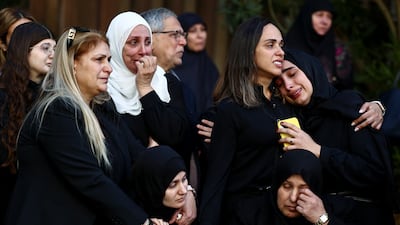
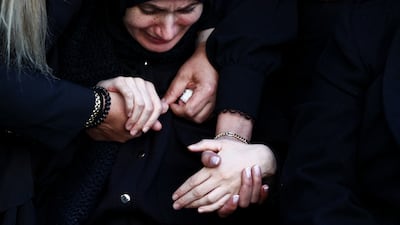
  • The sister, mother and the partner of Mohammad Farhat, a major with the Lebanese Army who was killed in an Israeli strike with two other soldiers on the outskirts of the village of Yater in southern Lebanon, attend an official memorial in Beirut. Reuters
    The sister, mother and the partner of Mohammad Farhat, a major with the Lebanese Army who was killed in an Israeli strike with two other soldiers on the outskirts of the village of Yater in southern Lebanon, attend an official memorial in Beirut. Reuters
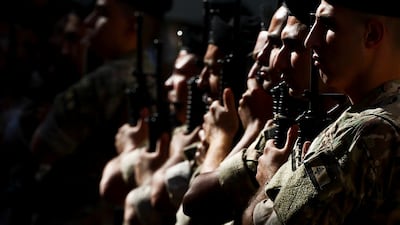
  • Lebanese Army soldiers take part in an official ceremony to pay tribute after the death of Maj Mohammad Farhat. Reuters
    Lebanese Army soldiers take part in an official ceremony to pay tribute after the death of Maj Mohammad Farhat. Reuters
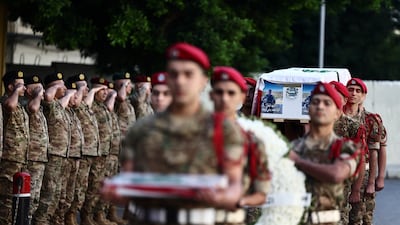
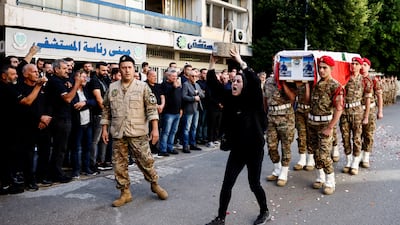
  • Lebanese Army soldiers carry the coffin of Maj Mohammad Farhat during an official ceremony to pay tribute in Beirut, Lebanon. Reuters
    Lebanese Army soldiers carry the coffin of Maj Mohammad Farhat during an official ceremony to pay tribute in Beirut, Lebanon. Reuters
  • Emotions ran high at a memorial for Lebanese Army Maj Mohammad Farhat, who was killed in an Israeli strike with two other soldiers on the outskirts of the village of Yater in southern Lebanon. Reuters
    Emotions ran high at a memorial for Lebanese Army Maj Mohammad Farhat, who was killed in an Israeli strike with two other soldiers on the outskirts of the village of Yater in southern Lebanon. Reuters
  • The relatives of Maj Mohammad Farhat are comforted by friends at a memorial in Beirut. Reuters
    The relatives of Maj Mohammad Farhat are comforted by friends at a memorial in Beirut. Reuters
  • The sister of Maj Mohammad Farhat at the official memorial to her brother in Beirut. Reuters
    The sister of Maj Mohammad Farhat at the official memorial to her brother in Beirut. Reuters
  • Mourners at the official ceremony to pay tribute to Maj Mohammad Farhat of the Lebanese Army, who was killed in an Israeli strike with two other soldiers on the outskirts of the village of Yater in southern Lebanon. Reuters
    Mourners at the official ceremony to pay tribute to Maj Mohammad Farhat of the Lebanese Army, who was killed in an Israeli strike with two other soldiers on the outskirts of the village of Yater in southern Lebanon. Reuters

Gap in international law

While the term domicide remains new in international law discussions, Prof Rajagopal said the practice it describes is being used on a scale, and with intent, in modern warfare such that it requires legal recognition. He proposes it should be defined as the deliberate destruction of housing during armed conflict, where the primary goal is to make areas permanently uninhabitable.

Civilian homes are currently protected by international law in conflicts between states. Purposeful destruction of them is considered a war crime but not a crime against humanity, which covers conflicts within a state or involving non-state actors, such as those between Israel and the Hamas militant group, or Myanmar’s military and rebel forces.

Prof Rajagopal is campaigning for amendments to the Rome Statute of the International Criminal Court to recognise domicide as a stand-alone crime against humanity. Such amendments have been made before; the same statute initially listed starvation as a tool of conflict as a war crime but in 2022 it upgraded it to a crime against humanity.

His mission initially gained traction in response to Russia’s bombing of Ukrainian cities in 2022. However, he pointed out an apparent “double standard” in how international leaders respond to allegations of domicide by Israel.

“There is selective silence when it comes to Israel,” he said. “Western countries that praised the concept when I applied it to Ukraine are now silent. But Middle Eastern countries and those from the Global South are very receptive.”


Skewed figures

In the village of Mevagissey in southwest England the housing stock has doubled in the last century while the number of residents is half the historic high. The village's Neighbourhood Development Plan states that 26% of homes are holiday retreats. Prices are high, averaging around £300,000, £50,000 more than the Cornish average of £250,000. The local average wage is £15,458. 

How to register as a donor

1) Organ donors can register on the Hayat app, run by the Ministry of Health and Prevention

2) There are about 11,000 patients in the country in need of organ transplants

3) People must be over 21. Emiratis and residents can register. 

4) The campaign uses the hashtag  #donate_hope

THE NEW BATCH'S FOCUS SECTORS

AiFlux – renewables, oil and gas

DevisionX – manufacturing

Event Gates – security and manufacturing

Farmdar – agriculture

Farmin – smart cities

Greener Crop – agriculture

Ipera.ai – space digitisation

Lune Technologies – fibre-optics

Monak – delivery

NutzenTech – environment

Nybl – machine learning

Occicor – shelf management

Olymon Solutions – smart automation

Pivony – user-generated data

PowerDev – energy big data

Sav – finance

Searover – renewables

Swftbox – delivery

Trade Capital Partners – FinTech

Valorafutbol – sports and entertainment

Workfam – employee engagement

The%20Killer
%3Cp%3E%3Cstrong%3EDirector%3A%C2%A0%3C%2Fstrong%3EDavid%20Fincher%3C%2Fp%3E%0A%3Cp%3E%3Cstrong%3EStars%3A%C2%A0%3C%2Fstrong%3EMichael%20Fassbender%2C%20Tilda%20Swinton%2C%20Charles%20Parnell%3C%2Fp%3E%0A%3Cp%3E%3Cstrong%3ERating%3A%3C%2Fstrong%3E%204%2F5%C2%A0%3C%2Fp%3E%0A

Mercer, the investment consulting arm of US services company Marsh & McLennan, expects its wealth division to at least double its assets under management (AUM) in the Middle East as wealth in the region continues to grow despite economic headwinds, a company official said.

Mercer Wealth, which globally has $160 billion in AUM, plans to boost its AUM in the region to $2-$3bn in the next 2-3 years from the present $1bn, said Yasir AbuShaban, a Dubai-based principal with Mercer Wealth.

Within the next two to three years, we are looking at reaching $2 to $3 billion as a conservative estimate and we do see an opportunity to do so,” said Mr AbuShaban.

Mercer does not directly make investments, but allocates clients’ money they have discretion to, to professional asset managers. They also provide advice to clients.

“We have buying power. We can negotiate on their (client’s) behalf with asset managers to provide them lower fees than they otherwise would have to get on their own,” he added.

Mercer Wealth’s clients include sovereign wealth funds, family offices, and insurance companies among others.

From its office in Dubai, Mercer also looks after Africa, India and Turkey, where they also see opportunity for growth.

Wealth creation in Middle East and Africa (MEA) grew 8.5 per cent to $8.1 trillion last year from $7.5tn in 2015, higher than last year’s global average of 6 per cent and the second-highest growth in a region after Asia-Pacific which grew 9.9 per cent, according to consultancy Boston Consulting Group (BCG). In the region, where wealth grew just 1.9 per cent in 2015 compared with 2014, a pickup in oil prices has helped in wealth generation.

BCG is forecasting MEA wealth will rise to $12tn by 2021, growing at an annual average of 8 per cent.

Drivers of wealth generation in the region will be split evenly between new wealth creation and growth of performance of existing assets, according to BCG.

Another general trend in the region is clients’ looking for a comprehensive approach to investing, according to Mr AbuShaban.

“Institutional investors or some of the families are seeing a slowdown in the available capital they have to invest and in that sense they are looking at optimizing the way they manage their portfolios and making sure they are not investing haphazardly and different parts of their investment are working together,” said Mr AbuShaban.

Some clients also have a higher appetite for risk, given the low interest-rate environment that does not provide enough yield for some institutional investors. These clients are keen to invest in illiquid assets, such as private equity and infrastructure.

“What we have seen is a desire for higher returns in what has been a low-return environment specifically in various fixed income or bonds,” he said.

“In this environment, we have seen a de facto increase in the risk that clients are taking in things like illiquid investments, private equity investments, infrastructure and private debt, those kind of investments were higher illiquidity results in incrementally higher returns.”

The Abu Dhabi Investment Authority, one of the largest sovereign wealth funds, said in its 2016 report that has gradually increased its exposure in direct private equity and private credit transactions, mainly in Asian markets and especially in China and India. The authority’s private equity department focused on structured equities owing to “their defensive characteristics.”

The specs: 2018 Jaguar F-Type Convertible

Price, base / as tested: Dh283,080 / Dh318,465

Engine: 2.0-litre inline four-cylinder

Transmission: Eight-speed automatic

Power: 295hp @ 5,500rpm

Torque: 400Nm @ 1,500rpm

Fuel economy, combined: 7.2L / 100km

Company%20Profile
%3Cp%3E%3Cstrong%3ECompany%20name%3A%20%3C%2Fstrong%3ENamara%0D%3Cbr%3E%3Cstrong%3EStarted%3A%20%3C%2Fstrong%3EJune%202022%0D%3Cbr%3E%3Cstrong%3EFounder%3A%20%3C%2Fstrong%3EMohammed%20Alnamara%0D%3Cbr%3E%3Cstrong%3EBased%3A%20%3C%2Fstrong%3EDubai%20%0D%3Cbr%3E%3Cstrong%3ESector%3A%20%3C%2Fstrong%3EMicrofinance%0D%3Cbr%3E%3Cstrong%3ECurrent%20number%20of%20staff%3A%20%3C%2Fstrong%3E16%0D%3Cbr%3E%3Cstrong%3EInvestment%20stage%3A%20%3C%2Fstrong%3ESeries%20A%0D%3Cbr%3E%3Cstrong%3EInvestors%3A%20%3C%2Fstrong%3EFamily%20offices%0D%3Cbr%3E%3C%2Fp%3E%0A
UAE SQUAD

Goalkeepers: Ali Khaseif, Fahad Al Dhanhani, Mohammed Al Shamsi, Adel Al Hosani

Defenders: Bandar Al Ahbabi, Shaheen Abdulrahman, Walid Abbas, Mahmoud Khamis, Mohammed Barghash, Khalifa Al Hammadi, Hassan Al Mahrami, Yousef Jaber, Salem Rashid, Mohammed Al Attas, Alhassan Saleh

Midfielders: Ali Salmeen, Abdullah Ramadan, Abdullah Al Naqbi, Majed Hassan, Yahya Nader, Ahmed Barman, Abdullah Hamad, Khalfan Mubarak, Khalil Al Hammadi, Tahnoun Al Zaabi, Harib Abdallah, Mohammed Jumah, Yahya Al Ghassani

Forwards: Fabio De Lima, Caio Canedo, Ali Saleh, Ali Mabkhout, Sebastian Tagliabue, Zayed Al Ameri

THE BIO

Born: Mukalla, Yemen, 1979

Education: UAE University, Al Ain

Family: Married with two daughters: Asayel, 7, and Sara, 6

Favourite piece of music: Horse Dance by Naseer Shamma

Favourite book: Science and geology

Favourite place to travel to: Washington DC

Best advice you’ve ever been given: If you have a dream, you have to believe it, then you will see it.

The specs

Engine: 2.9-litre, V6 twin-turbo

Transmission: seven-speed PDK dual clutch automatic

Power: 375bhp

Torque: 520Nm

Price: Dh332,800

On sale: now

Updated: November 05, 2024, 9:28 AM