

Live updates: Follow the latest on Israel-Gaza
The Israeli army began an attack on Baalbek on Wednesday, after issuing an eviction order for the city and surrounding villages, the Lebanese city’s mayor said.
Mayor Mustafa Al Chal said there were three raids on the city centre, but most residents had left the city and its outskirts in the hours after the Israeli order. “The majority of people have been displaced to areas near Baalbek, mostly Christian areas in the north,” he told The National.
Villages on the route south out of Baalbek were nearly abandoned. A worker at one of the few open petrol stations on the road said people from nearby villages – even those not in the area marked in the Israeli army’s eviction order had left quickly.
Residents from the Baalbek area told The National they had received phone calls from the Israeli army telling them to “leave immediately”.
The Israeli military said it was preparing to attack Hezbollah sites, although recent visits to the region by The National suggest that the vast majority of casualties were civilians.
“Don't worry, God is with us,” said Ali Allam, director of Baalbek's Dar Al Amal Hospital, where hundreds of people injured in earlier attacks are being treated.
The Israeli military later said that strikes in the Bekaa region were also aimed fuel depots located inside military compounds belonging to Hezbollah’s Logistical Reinforcement Unit 4400, while Lebanon's Health ministry reported that at least 11 people were killed and 15 wounded in Israeli strikes on the town of Sahmar in western Bekaa.
The Israeli military also said it had killed the deputy commander of Hezbollah's elite Radwan force, Mustafa Ahmed Shahadi, in air strikes on the southern Nabatieh region on Wednesday.
At least 14 people were killed and about 60 injured in Israeli attacks on south Lebanon overnight, in areas that had largely been spared from Israel's bombings until it escalated its war on Lebanon six weeks ago.
Eight people were killed and 21 injured in the attack on Sarafand, just outside Sidon, south Lebanon's largest city. Attacks in Sidon killed six and injured 37, the Health Ministry said.
More than 2,700 people have been killed, and another 12,592 have been wounded in the year-long conflict between Israel and Iran-backed Hezbollah, with the largest number of casualties in the past six weeks, according to the Health Ministry. About 1.4 million have also been displaced.
Israel's attacks have caused widespread destruction across Lebanon, particularly in the south, the capital Beirut and in the Bekaa Valley neighbouring Syria, where Baalbek is located. It also began a land invasion of southern Lebanon but progress has been slow in the face of resistance from Hezbollah fighters.
-

The southern Lebanese village of Al Taybeh is shrouded by smoke during an air strike as Israeli forces seek out Hezbollah. AFP -
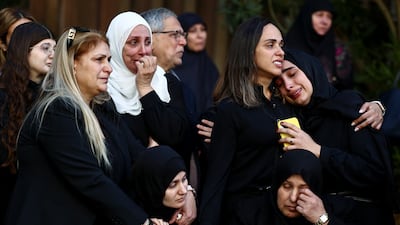
The sister, mother and the partner of Mohammad Farhat, a major with the Lebanese Army who was killed in an Israeli strike with two other soldiers on the outskirts of the village of Yater in southern Lebanon, attend an official memorial in Beirut. Reuters -
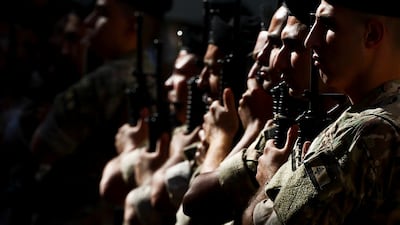
Lebanese Army soldiers take part in an official ceremony to pay tribute after the death of Maj Mohammad Farhat. Reuters -
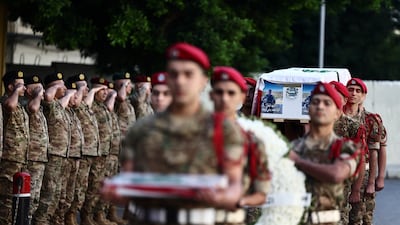
Lebanese Army soldiers carry the coffin of Maj Mohammad Farhat during an official ceremony to pay tribute in Beirut, Lebanon. Reuters -
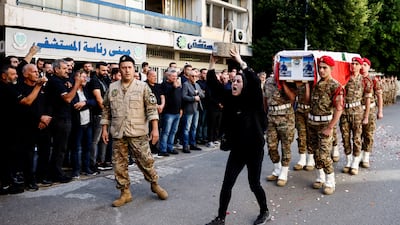
Emotions ran high at a memorial for Lebanese Army Maj Mohammad Farhat, who was killed in an Israeli strike with two other soldiers on the outskirts of the village of Yater in southern Lebanon. Reuters -
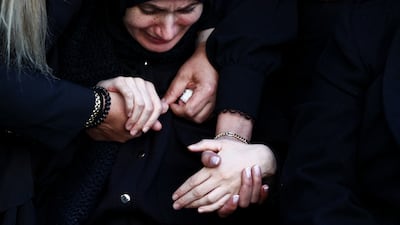
The relatives of Maj Mohammad Farhat are comforted by friends at a memorial in Beirut. Reuters -

The sister of Maj Mohammad Farhat at the official memorial to her brother in Beirut. Reuters -

Mourners at the official ceremony to pay tribute to Maj Mohammad Farhat of the Lebanese Army, who was killed in an Israeli strike with two other soldiers on the outskirts of the village of Yater in southern Lebanon. Reuters


The UN peacekeeping force, Unifil, said on Wednesday that villages in southern Lebanon had been "completely destroyed" by Israeli strikes.
"It's pretty dramatic," Andrea Tenenti, spokesman of UN Interim Force In Lebanon, said in a press briefing.
He said that "monitoring capabilities have been limited" but forces have been able to work on inaccessible roads on Tuesday, allowing for more monitoring opportunities in the region.
"So villages very close to the Blue Line, I would say ... kilometres from the Blue Line are completely destroyed," Mr Tenenti said.
The state-run National News Agency said on Tuesday that Israeli tanks entered the outskirts of the village of Khiam, the farthest the ground invasion into south Lebanon has reached since it started last month. NNA reported that a large number of tanks belonging to the Israeli army entered the eastern outskirts of Khiam about 6km from the border with Israel.
Hezbollah said it destroyed two tanks using guided missiles and fired on Israeli troops south and south-west of Khiam with rockets and artillery.
NNA said Israeli forces carried out a series of air attacks on Khiam later on Tuesday and launched a large-scale sweep “using heavy and medium weaponry”.
The attacks on Tuesday came a day after Israel Israeli air strikes killed at least 67 people and wounded at least 120 more across the Baalbek-Hermel region in the Bekaa Valley on Monday in the “most violent day” for the area since the war began.

