
At least 16 people were killed and 52 injured in a series of Israeli air strikes that hit a municipal building in the south Lebanese city of Nabatieh on Wednesday, with the mayor among the dead, Lebanon's health ministry said.
Ahmed Kahil had been co-ordinating a meeting of the local crisis committee that was “intentionally targeted”, Lebanon's caretaker Prime Minister Najib Mikati said. “If all the countries of the world are unable to deter a blatant aggression against the Lebanese people, is it any use resorting to the [UN] Security Council to demand a ceasefire?” he added.
Around a dozen Israeli strikes were carried out on Nabatieh and surrounding areas on Wednesday morning. “What can deter the enemy from its crimes that have reached the point of targeting peacekeeping forces in the south?” Mr Mikati said.
The crisis team refused to leave Nabatieh despite repeated Israeli threats.
UN special co-ordinator for Lebanon Jeanine Hennis-Plasschaert said the attack "follows other incidents in which civilians and civilian infrastructure have been targeted across Lebanon".
"Violations of international humanitarian law are utterly unacceptable. Civilians and civilian infrastructure must be protected at all times," she said. "Civilian suffering is reaching unprecedented heights."
The assault in Nabatieh came shortly after the Israeli military carried out a series of strikes on the southern suburbs of Beirut, despite Mr Mikati saying on Tuesday that US officials had assured him Israel would cut down or moderate attacks on the capital.
Black smoke billowed between buildings early on Wednesday in Beirut's southern Dahieh district, a formerly densely populated area where militant group Hezbollah holds substantial influence.
Lebanon's National News Agency reported there were at least three Israeli strikes on the area in the morning, one of which targeted a building near a school in the Haret Hreik neighbourhood.
They were the first series of strikes on the city and its suburbs since Thursday, when two attacks near the centre killed 22 people and brought down buildings in a heavily populated neighbourhood.
The Israeli military said in a statement that it “conducted a strike on strategic weapons” belonging to Hezbollah in Dahieh. “These weapons were stockpiled by Hezbollah in an underground storage facility,” it said.
A map published by the Israeli army on social media showed the building hit was in Haret Hreik. Military spokesman Lt Col Avichay Adraee told Dahieh residents through X that they “must leave this building and the surrounding buildings immediately and move away from them at a distance of no less than 500 metres”.
Elsewhere, footage emerged online of Israel destroying a Lebanese village near the border, similar to actions the country has carried out in its war on Gaza. The images, shown on Lebanese and Israeli media, show the village of Mhaibib being demolished in a series of detonations.
Residents of the village are believed to have fled before the destruction.
The Lebanese Red Cross said two paramedics were injured on Wednesday in a strike on the southern village of Jouaiyya. A rescue mission involving UN peacekeepers is under way.
Peace talks stalled
The strikes came after Israeli Prime Minister Benjamin Netanyahu rejected any ceasefire in Lebanon that would leave Hezbollah close to his country's border.
Mr Netanyahu vowed to keep fighting despite pressure from the US on Tuesday over Israel's conduct in its wars in Lebanon and Gaza. The Americans criticised recent bombings of Beirut and demanded more humanitarian aid reach the Palestinian territory.
In a call with French President Emmanuel Macron, Mr Netanyahu said he was “opposed to a unilateral ceasefire which does not change the security situation in Lebanon, and which will only return it to the way it was”, according to a statement from the Israeli leader's office.
-
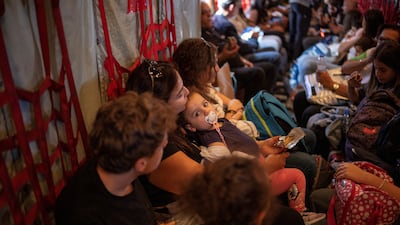
Greeks and Greek-Cypriots on board a Hellenic Air Force C130 being evacuated from Lebanon. Reuters -
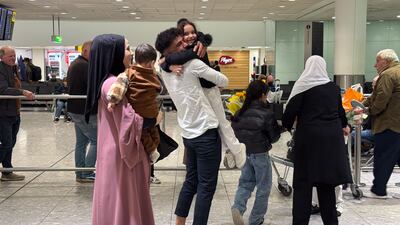
People greet their family members arriving from a commercial flight from Beirut at Heathrow Airport in London. EPA -

Gigi Khalifa, 46, with her daughter Jood, 15, and son Karim, 12, speak to the media after being evacuated from Lebanon, in Larnaca, Cyprus. Reuters -
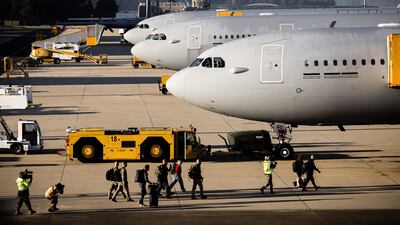
A plane prepares to depart from Eindhoven Air Force base for Beirut to evacuate Dutch citizens. EPA -
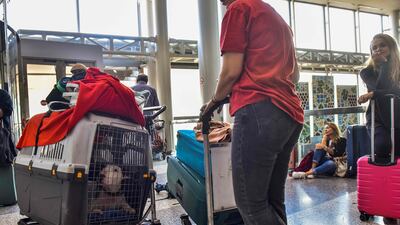
German citizens arrive at Beirut's airport as they flee Lebanon. AFP -
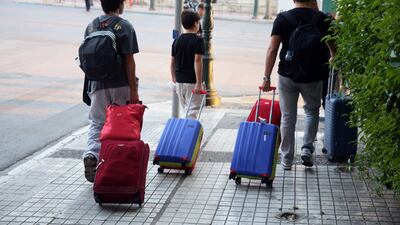
Greek citizens, who where evacuated from Beirut, arrive outside the Foreign Ministry building in Athens. EPA -
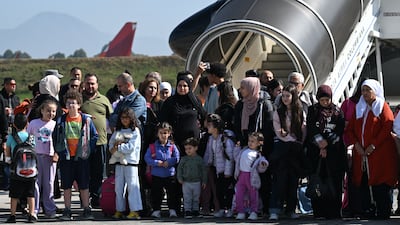
Passengers pose for a picture after disembarking a Colombian government evacuation flight from Lebanon at El Dorado International Airport in Bogota. AFP -
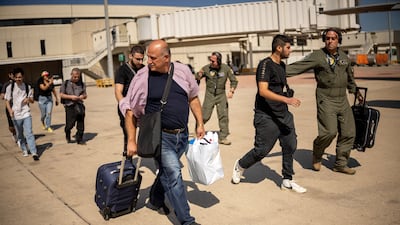
Greeks and Greek-Cypriots prepare to board a Hellenic Air Force C130 in Beirut. Reuters -
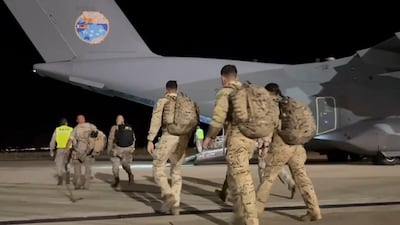
Spanish military personnel boarding a plane headed to Beirut, at the Torrejon military base in Madrid. EPA -
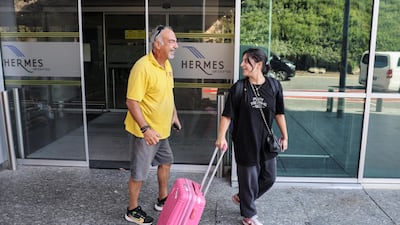
Clea Rita Barsamian with her father after being evacuated from Lebanon, at Larnaca International Airport, Cyprus. Reuters -
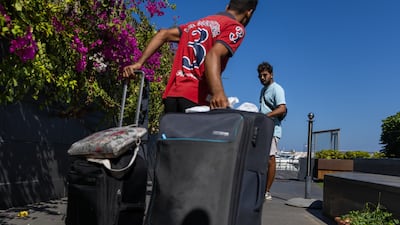
People in Beirut take their suitcases to a yacht that will ferry people to Cyprus. Getty Images


Mr Netanyahu and the military have insisted there must be a buffer zone along Israel's border with Lebanon, free of Hezbollah fighters.
“Prime Minister Netanyahu clarified that Israel would not agree to any arrangement that does not provide this and which does not stop Hezbollah from rearming and regrouping,” the statement said.
The Israeli military has repeatedly bombarded south Beirut in recent weeks, as well as carrying out deadly strikes elsewhere in the capital and across Lebanon.
On Tuesday, US State Department spokesperson Matthew Miller said Washington had conveyed its concerns to Netanyahu's government over the recent strikes.
“When it comes to the scope and nature of the bombing campaign that we saw in Beirut over the past few weeks, it's something that we made clear to the government of Israel we had concerns with and we were opposed to,” Mr Miller told reporters, adopting a harsher tone than Washington had taken previously.
At least 1,356 people have been killed since Israel escalated its bombing last month, according to an AFP tally of Lebanese Health Ministry figures, although the real toll is likely to be higher.

On Tuesday night, 15 people were killed in an air strike on southern Lebanon, Lebanese state media reported.
The town of Qana, about 10km south-east of the city of Tyre, came under attack, with the death toll expected to rise. Fifteen people were injured and taken to hospitals in Tyre, the National News Agency reported.
It is not the first time Qana has faced an Israeli attack. In 1996, more than 100 civilians sheltering at a UN compound were killed in an Israeli barrage. In 2006, an Israeli strike on the village killed 28 people, including 13 children.
Israel has been trading fire with Tehran-backed Hezbollah since the group began launching missiles across Lebanon's border in support of Hamas in October last year after the Gaza-based militants launched a deadly attack on southern Israel that triggered Israel's military campaign.
Now, in addition to Israeli aerial strikes that have caused Hezbollah significant damage in the past month, the Lebanon-based group is under Israeli ground assault from the south and faces naval shelling from the Mediterranean to the west.
Israeli strikes have killed at least 2,350 people in Lebanon over the last year, according to the country's Health Ministry. More than 1.2 million people in Lebanon have been displaced.

