Displaced people in their tents at the seaside at Ramlet Al Baida beach in Beirut. More than one million people have been displaced by the Israeli air assault on the country. EPA

Lebanon is paying the price in Israel's war - and it can't afford it


  • English
  • Arabic

Live updates: Follow the latest on Israel-Gaza

More than 2,000 people have been killed in Lebanon in the past year, while more than a million people are displaced. Israel has effectively declared war on half of Lebanon’s territory, while the population of the other half is living in fear of war spreading into the rest of the country.

Israel has ordered residents of more than 100 villages to leave their homes, rescue workers are being attacked, the nightly bombings by Israel are a trauma for much of the country and shelters are overwhelmed.

“I remember Albert Einstein's quote saying 'what counts the most is what cannot be counted.' The most terrible price has been paid by the victims,” said Karim Bitar, a professor of International Relations at Saint Joseph University in Beirut.

“What is also difficult to count and will be very important in the next few years is the psychological trauma that has been endured by millions of Lebanese,” he added.

In Beirut's Martyr's Square, dozens of displaced families camp out in the open while cars belonging to people who fled Israel's attacks jam the roads.

Hezbollah's war

The displacement is the result of a year of war between Hezbollah and Israel – a war “Hezbollah is responsible for dragging Lebanon into”, according to Khalil Helou, a retired Lebanese army general and a lecturing professor in geopolitics.

Hezbollah has engaged Israel in a cross-border conflict in support of its ally Hamas in the Gaza Strip since October 8, 2023 – the day after Hamas infiltrated Israel, setting off a series of events that set the region aflame.

Hezbollah always insisted it did not want a full-on war, but was ready for it if it was imposed – something that came to fruition last month.

In mid-September, thousands of pagers used by Hezbollah to avoid communication interceptions by Israel exploded simultaneously, setting off the Lebanon phase of Israel’s war to eradicate its enemies in Gaza, the occupied West Bank, and Lebanon.

People carry their belongings while walking on the rubble, after an Israeli strike, as they flee Lebanon due to ongoing hostilities between Hezbollah and Israeli forces, at Masnaa border crossing with Syria, in Lebanon, October 4, 2024. REUTERS / Mohamed Azakir

“I don't think that what anyone expected, be that inside or outside Lebanon, was just how badly Hezbollah would be damaged by these latest Israeli attacks,” said David Wood, senior Lebanon analyst at Crisis Group.

The government has largely been a helpless bystander while the Lebanese Army has stayed away.

What had been a low-intensity war suddenly became the major conflict Lebanon’s population had long feared was inevitable. Israel launched an air assault on various parts of Lebanon and Beirut, targeting Hezbollah’s command structure and weapons stores.

The party’s charismatic leader of three decades, Hassan Nasrallah, was assassinated in late September – leaving serious questions about Hezbollah’s ability to fight off a major Israeli ground and air invasion. By October, Israeli troops were in southern Lebanon.

Since then, as Hezbollah fights a ground battle with Israel on its own turf, at least eight Israeli soldiers have been killed – also raising serious questions about Israel’s entry into what could prove to be yet another un-win-able war.

Meanwhile, thousands of displaced people throughout Lebanon are still sleeping in streets and orchards, under shop awnings, and in abandoned, decrepit homes.

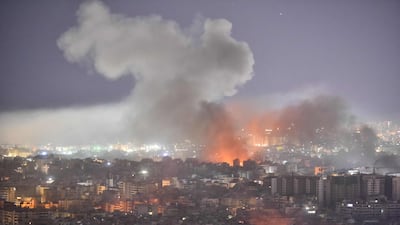
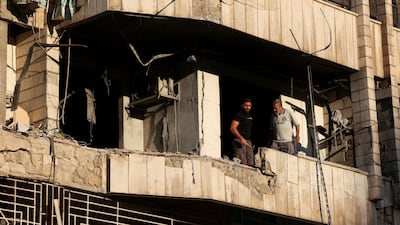
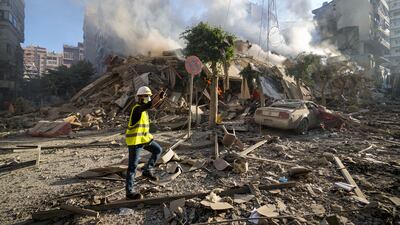
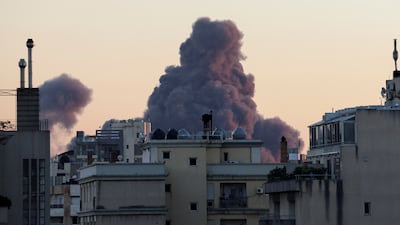
Israeli strikes on Beirut – in pictures

  • Smoke rises from the site of an Israeli air strike that targeted a neighborhood in Beirut’s southern suburb. AFP
    Smoke rises from the site of an Israeli air strike that targeted a neighborhood in Beirut’s southern suburb. AFP
  • People inspect damage at the site of an Israeli strike on central Beirut's Bachoura neighbourhood. Reuters
    People inspect damage at the site of an Israeli strike on central Beirut's Bachoura neighbourhood. Reuters
  • Smoke rises over Dahieh in Beirut's southern suburbs. Reuters
    Smoke rises over Dahieh in Beirut's southern suburbs. Reuters
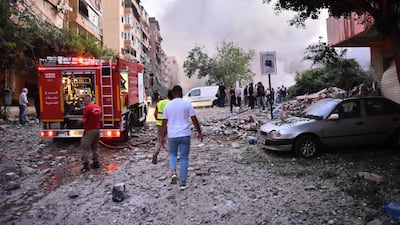
  • A man walks amid the rubble of a building hit in an overnight Israeli air strike that targeted the neighbourhood of Moawwad in Beirut's southern suburbs. AFP
    A man walks amid the rubble of a building hit in an overnight Israeli air strike that targeted the neighbourhood of Moawwad in Beirut's southern suburbs. AFP
  • Smoke rises from the site of an Israeli air strike in Dahiyeh, Beirut. AP
    Smoke rises from the site of an Israeli air strike in Dahiyeh, Beirut. AP
  • Smoke rises from the site of an Israeli air strike in Dahiyeh, Beirut. AP
    Smoke rises from the site of an Israeli air strike in Dahiyeh, Beirut. AP
  • Smoke rises from a reported Israeli strike in Beirut's southern suburbs on September 27. Reuters
    Smoke rises from a reported Israeli strike in Beirut's southern suburbs on September 27. Reuters
  • Rescuers amid the rubble of a building destroyed in an Israeli strike on Beirut's southern neighbourhood of Haret Hreik. AFP
    Rescuers amid the rubble of a building destroyed in an Israeli strike on Beirut's southern neighbourhood of Haret Hreik. AFP
  • A building hit by an Israeli strike in Beirut's southern suburbs. Reuters
    A building hit by an Israeli strike in Beirut's southern suburbs. Reuters
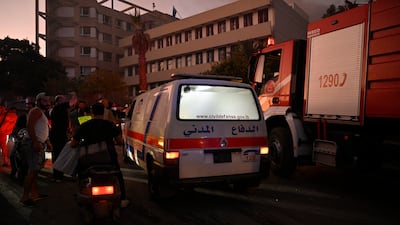
  • An ambulances removed casualties from an Israeli strike on Dahieh, in southern Beirut. Israel's military claimed to have struck "the central headquarters of the Hezbollah". EPA
    An ambulances removed casualties from an Israeli strike on Dahieh, in southern Beirut. Israel's military claimed to have struck "the central headquarters of the Hezbollah". EPA
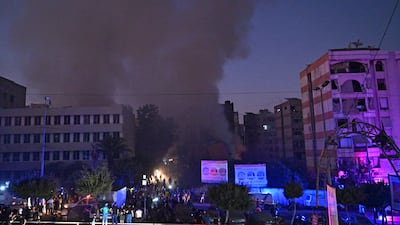
  • Smoke rises from an Israel strike in Dahieh, southern Beirut. Israel claimed it had struck Hezbollah headquarters 'intentionally built under residential buildings'. EPA
    Smoke rises from an Israel strike in Dahieh, southern Beirut. Israel claimed it had struck Hezbollah headquarters 'intentionally built under residential buildings'. EPA
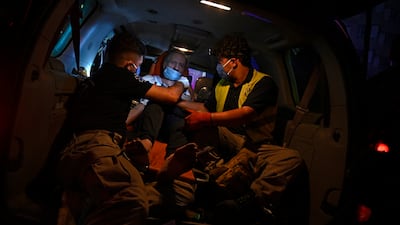
  • A casualty is taken by ambulance from the Dahieh, southern Beirut, following an Israeli strike. EPA
    A casualty is taken by ambulance from the Dahieh, southern Beirut, following an Israeli strike. EPA
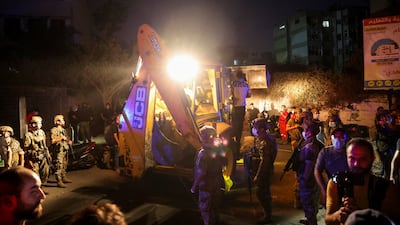
  • Members of the Lebanese military gather after an Israeli strike in Beirut's southern suburbs. Reuters
    Members of the Lebanese military gather after an Israeli strike in Beirut's southern suburbs. Reuters
  • The aftermath of an Israeli air strike in the southern Beirut neighbourhood of Haret Hreik. AFP
    The aftermath of an Israeli air strike in the southern Beirut neighbourhood of Haret Hreik. AFP

They are the unlucky thousands – of some 1.2 million people displaced by the Israeli air assault.

But perhaps they’re lucky to be alive. The Israeli assault has wiped out entire families, targeting different villages each day. Since Israel escalated its campaign on Hezbollah and Lebanon on September 16, more than 1,401 people have been killed. According to the UN, about 400,000 children have been displaced.

Lebanon has lost a lot of its friends in the international community
David Wood

“Doctors tell us of treating children who are bloodied, bruised, and broken, suffering both physically and mentally. Many are experiencing anxiety, flashbacks, and nightmares related to explosions,” said Unicef Regional Director Adele Khodr.

The Lebanese Army, regarded as paling in comparison in strength to Hezbollah, has maintained a policy of non-involvement.

Rebuilding

“It's obvious the immediate damage that the war has brought to Lebanon in terms of destroying things,” said David Wood, senior Lebanon analyst at Crisis Group.

“There's also this potential for domestic tensions to be inflamed, which is something that we are really worried about. That's a really serious issue and depending on how the war goes, it's likely to gather the wrong kind of momentum.”

There's also the cost of rebuilding. When Israel and Hezbollah last fought an all-out war in 2006, Lebanon could count on an array of powerful international friends to help rebuild. But many of them, chiefly the Gulf states, have significantly reduced their engagement – in large part because of Hezbollah.

“Lebanon has lost a lot of its friends in the international community. Its elites, through the complete pursuit of self-interest and wastefulness, have made any potential donors very reluctant to give money to the country,” said Mr Wood.

“Even in a best-case scenario if there was a quick resolution to the conflict, I struggle to imagine that reconstruction would be anything other than an incredibly painful and incomplete recovery.”

The country had already been entrenched in one of the worst economic crises in modern times. Efforts to correct the financial system and enact economic reforms were already dragging at a snail's pace – and the war has hardly helped matters.

Lebanon was hardly in the ideal situation before October 2023 and politicians and diplomats had warned that the country was unable to handle the impact that a wider war would inflict.

“Economic cost, human cost, cost in terms of mental health for an entire population and political cost in the sense that today Lebanon's very existence is jeapordised,” explained Prof Bitar.

“There is a serious risk of civil strife, of seeing Lebanese unity and national unity put to the test.”


UPI facts

More than 2.2 million Indian tourists arrived in UAE in 2023
More than 3.5 million Indians reside in UAE
Indian tourists can make purchases in UAE using rupee accounts in India through QR-code-based UPI real-time payment systems
Indian residents in UAE can use their non-resident NRO and NRE accounts held in Indian banks linked to a UAE mobile number for UPI transactions

Benefits of first-time home buyers' scheme
  • Priority access to new homes from participating developers
  • Discounts on sales price of off-plan units
  • Flexible payment plans from developers
  • Mortgages with better interest rates, faster approval times and reduced fees
  • DLD registration fee can be paid through banks or credit cards at zero interest rates
Our legal columnist

Name: Yousef Al Bahar

Advocate at Al Bahar & Associate Advocates and Legal Consultants, established in 1994

Education: Mr Al Bahar was born in 1979 and graduated in 2008 from the Judicial Institute. He took after his father, who was one of the first Emirati lawyers

The biog

Name: Maitha Qambar

Age: 24

Emirate: Abu Dhabi

Education: Master’s Degree

Favourite hobby: Reading

She says: “Everyone has a purpose in life and everyone learns from their experiences”

COMPANY%20PROFILE
%3Cp%3E%3Cstrong%3ECompany%20name%3A%3C%2Fstrong%3E%20Switch%20Foods%3Cbr%3E%3Cstrong%3EStarted%3A%3C%2Fstrong%3E%202022%3Cbr%3E%3Cstrong%3EFounder%3A%3C%2Fstrong%3E%20Edward%20Hamod%3Cbr%3E%3Cstrong%3EBased%3A%3C%2Fstrong%3E%20Abu%20Dhabi%2C%20UAE%3Cbr%3E%3Cstrong%3EIndustry%3A%3C%2Fstrong%3E%20Plant-based%20meat%20production%3Cbr%3E%3Cstrong%3ENumber%20of%20employees%3A%3C%2Fstrong%3E%2034%3Cbr%3E%3Cstrong%3EFunding%3A%3C%2Fstrong%3E%20%246.5%20million%3Cbr%3E%3Cstrong%3EFunding%20round%3A%3C%2Fstrong%3E%20Seed%3Cbr%3E%3Cstrong%3EInvestors%3A%3C%2Fstrong%3E%20Based%20in%20US%20and%20across%20Middle%20East%3C%2Fp%3E%0A
From Europe to the Middle East, economic success brings wealth - and lifestyle diseases

A rise in obesity figures and the need for more public spending is a familiar trend in the developing world as western lifestyles are adopted.

One in five deaths around the world is now caused by bad diet, with obesity the fastest growing global risk. A high body mass index is also the top cause of metabolic diseases relating to death and disability in Kuwait,  Qatar and Oman – and second on the list in Bahrain.

In Britain, heart disease, lung cancer and Alzheimer’s remain among the leading causes of death, and people there are spending more time suffering from health problems.

The UK is expected to spend $421.4 billion on healthcare by 2040, up from $239.3 billion in 2014.

And development assistance for health is talking about the financial aid given to governments to support social, environmental development of developing countries.


Milestones on the road to union

1970

October 26: Bahrain withdraws from a proposal to create a federation of nine with the seven Trucial States and Qatar. 

December: Ahmed Al Suwaidi visits New York to discuss potential UN membership.

1971

March 1:  Alex Douglas Hume, Conservative foreign secretary confirms that Britain will leave the Gulf and “strongly supports” the creation of a Union of Arab Emirates.

July 12: Historic meeting at which Sheikh Zayed and Sheikh Rashid make a binding agreement to create what will become the UAE.

July 18: It is announced that the UAE will be formed from six emirates, with a proposed constitution signed. RAK is not yet part of the agreement.

August 6:  The fifth anniversary of Sheikh Zayed becoming Ruler of Abu Dhabi, with official celebrations deferred until later in the year.

August 15: Bahrain becomes independent.

September 3: Qatar becomes independent.

November 23-25: Meeting with Sheikh Zayed and Sheikh Rashid and senior British officials to fix December 2 as date of creation of the UAE.

November 29:  At 5.30pm Iranian forces seize the Greater and Lesser Tunbs by force.

November 30: Despite  a power sharing agreement, Tehran takes full control of Abu Musa. 

November 31: UK officials visit all six participating Emirates to formally end the Trucial States treaties

December 2: 11am, Dubai. New Supreme Council formally elects Sheikh Zayed as President. Treaty of Friendship signed with the UK. 11.30am. Flag raising ceremony at Union House and Al Manhal Palace in Abu Dhabi witnessed by Sheikh Khalifa, then Crown Prince of Abu Dhabi.

December 6: Arab League formally admits the UAE. The first British Ambassador presents his credentials to Sheikh Zayed.

December 9: UAE joins the United Nations.

When is VAR used?

Goals

Penalty decisions

Direct red-card incidents

Mistaken identity

If you go:
The flights: Etihad, Emirates, British Airways and Virgin all fly from the UAE to London from Dh2,700 return, including taxes
The tours: The Tour for Muggles usually runs several times a day, lasts about two-and-a-half hours and costs £14 (Dh67)
Harry Potter and the Cursed Child is on now at the Palace Theatre. Tickets need booking significantly in advance
Entrance to the Harry Potter exhibition at the House of MinaLima is free
The hotel: The grand, 1909-built Strand Palace Hotel is in a handy location near the Theatre District and several of the key Harry Potter filming and inspiration sites. The family rooms are spacious, with sofa beds that can accommodate children, and wooden shutters that keep out the light at night. Rooms cost from £170 (Dh808).

Updated: October 05, 2024, 9:27 AM