


Nato should play a bigger role in the co-ordination of support for Ukraine, Jens Stoltenberg said on Friday, as he dismissed concerns about escalation in the war, stressing Kyiv has the right to self-defence.
Speaking after an informal meeting of Ministers of Foreign Affairs members in Prague, the Secretary General said Nato countries provide “practically all” military aid to Ukraine, so it makes sense that the alliance should play a greater co-ordinating role in the provision of equipment and training.
He was speaking after US President Joe Biden quietly gave Ukraine approval on Thursday to use American-made weapons inside a limited area of Russia.
“We need to ensure that when support is announced, pledged, that actually that turns into real deliveries to Ukraine,” Mr Stoltenberg told a press conference.
“And we have seen some discrepancies between what has been promised and what has been delivered. So for better co-ordination, for better compliance and for ensuring predictability I strongly believe that Nato should play a bigger role in co-ordinating support.
“And we will find ways to ensure that these decisions will work and not be blocked.”
He said allies should also commit to a “multiyear” financial pledge for Ukraine, providing around €40 billion ($43 billion) worth of military support each year.
“We need a firm commitment for the long haul to ensure Ukraine is able to plan, to ensure that Ukraine has the predictability they need to conduct this war of self-defence, but also to send a message to Moscow that Moscow cannot wait us out.” he said.
“The more clear it is to Russia that Ukraine's Nato allies are prepared for the long haul, the sooner the war can end.”
Foreign ministers also discussed Ukraine’s path to Nato membership, added Mr Stoltenberg.
“Allies agree that Ukraine’s future is in Nato. And we are determined to make progress in sorting this path,” he said.
“I hope that at the summit in Washington we can take further steps and I also believe strongly that the fact that we will most likely establish a mission providing a stronger structure for providing support to Ukraine, that will also help to move Ukraine closer to membership.”
No final decisions were taken on the issues, but significant progress was made, he said.
On Moscow’s claims of escalation following the US and Germany’s green light to use their weapons inside Russia to counter advances in the Kharkiv region, he said: “Russia started this war”.
“They annexed Crimea in 2014. And in 2022, Russia’s full-scale invasion of Ukraine began the bloodiest conflict in Europe since World War Two,” added Mr Stoltenberg.
“Russia is striking hospitals, schools and shopping malls. Russia is bombing power and water infrastructure. Russia is killing Ukrainian civilians.
“Ukraine is defending itself from appalling Russian brutality,” he said.
“So let me be clear. Self-defence is not escalation. Self-defence is a fundamental right enshrined in the UN Charter.”
Russia is the one escalating the war by opening a new front, he added.
Ukraine's outgunned forces are struggling to hold back Moscow's offensive in the Kharkiv region, with the Kremlin launching attacks from its own territory.
President Biden's approval for the use of US-made weapons reflects how serious the situation has become in Ukraine's second-largest city.
Weapons wanted by Ukraine – in pictures
-
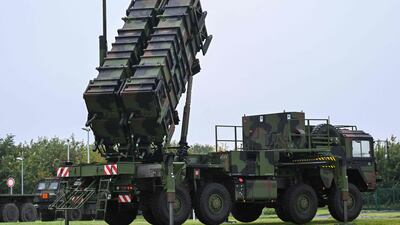
Air defence: Ukraine’s air defence largely depends on the Patriot system. AFP -
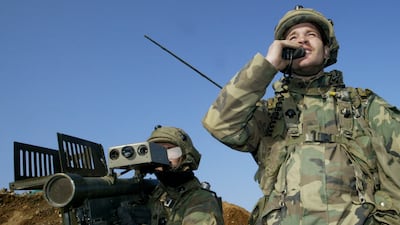
Air: Stinger short-range surface-to-air missile. Reuters -
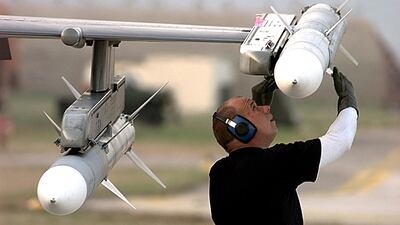
Air: Aim-120 air-to-air missiles. More than 14,000 of the missiles, that have a range exceeding 120km, have been produced with their accuracy so good that they have been nicknamed “Slammer”. Getty Images -
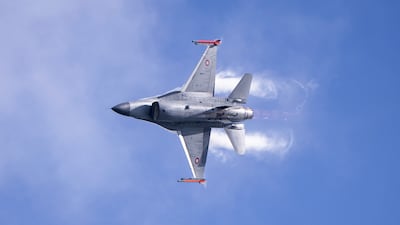
Air: F-16s will provide greater surveillance and the ability to attack high-value targets behind Russian lines in occupied Ukraine. EPA -
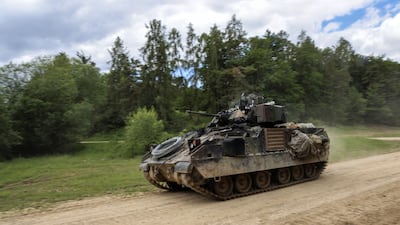
Armour: Bradley IFV. The Ukrainians have found the Bradley infantry fighting vehicle, with its 25mm cannon, very useful in protecting troops and providing decent firepower. Bloomberg -
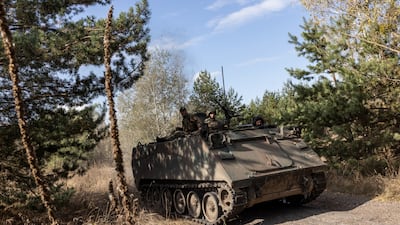
Armour: M113. The 1960s-designed versatile M113 armoured personnel carrier has proven effective in protecting troops against minefields. Getty Images -
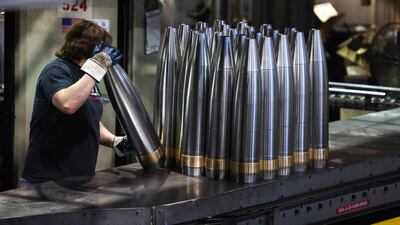
Artillery: 155mm artillery rounds. A massive delivery of 155mm rounds could prove crucial in preventing further Russian advances, particularly in its expected summer offensive. AFP -
Artillery: ATACMs long-range precision missiles. The ATACMS have a range of 300km with the ability to land within a few metres of a target. Getty Images -
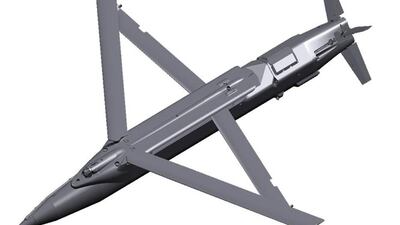
Artillery: Ground-Launched Small Diameter Bomb (GLSDB). It can be fired from the HIMARS system. Photo: Wikimedia Commons -

Artillery: M777 guns and replacement barrels. The Ukrainians need many M777 howitzer barrels to replace those worn down by extensive use. Getty Images


“The President recently directed his team to ensure that Ukraine is able to use US-supplied weapons for counter-fire purposes in the Kharkiv region, so Ukraine can hit back against Russian forces that are attacking them or preparing to attack them,” a State Department representative told The National on Thursday.
Germany followed suit on Friday, saying Ukraine could use weapons supplied by Berlin to defend itself against attacks launched from just inside Russia against Kharkiv, in accordance with international law.
Until now, Ukraine has been prohibited from using western-supplied weapons provided by some countries to attack Russia, and Ukrainians have long argued that Moscow enjoys a great advantage when it attacks the Kharkiv region, which borders Russia, because it can amass troops and launch deadly attacks from within in its own territory.
The ability to strike supply lines feeding the Kharkiv offensive further inside Russia will help Ukraine degrade Russian capabilities in the region.
Ukrainian President Volodymyr Zelenskyy on Friday hailed the United States' decision.
“This is a step forward towards [the] goal … of making it possible to defend our people who live in the villages on the border,” he told reporters in Stockholm where he took part in a Ukraine-Northern Europe security summit.
On Friday, Russia and Ukraine exchanged prisoners of war in a swap mediated by the UAE.
It was the fourth major prisoner exchange of the year so far.

