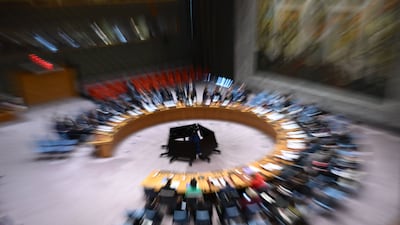

Costa Rica’s Rebeca Grynspan narrowly held her lead in the race to become the next UN Secretary General on Friday, as the Security Council held a ninth round of voting.
Ms Grynspan, who has led the race for months, received 10 encouraging votes and 10 discouraging votes, including two vetoes from permanent council members.
The result marked a setback from the previous straw poll on November 5, when she received 12 “encourage” votes.
The UAE’s Lana Nusseibeh received seven encourage votes and six discourage, while Argentina’s Rafael Grossi secured eight encourage votes and six discourage.
Both Ms Nusseibeh and Mr Grossi faced opposition from three permanent members, complicating their paths to the top UN job.
Turkey’s Feridun Sinirlioglu received five encourage votes and 10 discourage, including four vetoes.
Friday’s vote was particularly significant because council members used colour-coded ballots for only the second time in the selection process.
The system distinguishes votes cast by the five permanent members — the US, Britain, France, Russia and China — from those of the 10 elected members. Any of the five permanent members can effectively block a candidate from taking the post, making its opposition a major obstacle even for contenders with broad support.
The council first used coloured ballots on October 16 before returning to regular voting for the next two rounds.
Friday marked the first time that Ms Nusseibeh and Mr Sinirlioglu faced colour-coded ballots, which offered a clearer indication of whether either could secure the support needed to win.
No new candidates have entered the race since the previous round.
US ambassador to the UN Mike Waltz told reporters after the vote that Washington was focused on choosing the strongest candidate rather than favouring any particular region, although he welcomed the prospect of a Latin American taking the post.
“We just prefer the best candidate. But if that came from Latin America, that would be fantastic,” he told reporters.
Mr Waltz stressed the need for a leader capable of reforming the UN and strengthening its role in global peace and security.
He strongly suggested that candidates who had failed to gain sufficient support should withdraw.
“If they haven't received it, we think it's probably time to step aside and let the council consider a narrower field,” he said.
Minh-Thu Pham, co-founder of the Starling Institute and a former adviser to UN secretary general Kofi Annan, described the results as “concerning” and said it was time to “wrap up” the process.
"There’s still no consensus and we seem to have taken a step backwards. I think some were hoping that the summit yesterday between China, US and Russia would have produced more clarity, since they did speak about the UN, but that hasn’t happened," she said. "It’s clear Shenzhen was not where the big deal was made ... though many suspected it would be."
She added that Friday's outcome may also reflect council members — and especially the five veto-wielding members — sensing "the end was near" and attempting to extract what commitments they can.
Earlier this week, US President Donald Trump, Russian President Vladimir Putin and Chinese President Xi Jinping issued a joint declaration following trilateral talks in Shenzhen.
The declaration issued by the permanent Security Council members included a major commitment to reforming the UN, an institution whose foundations were shaped by the Allied powers at the 1945 Yalta Conference.
At the Yalta Conference, US President Franklin D Roosevelt, British Prime Minister Winston Churchill and Soviet leader Joseph Stalin helped lay the groundwork for the UN, agreeing on how the Security Council would operate, including voting rules and veto powers.
This week's declaration also took aim at the International Criminal Court (ICC), emphasising state consent and the immunity of government officials from prosecution.

