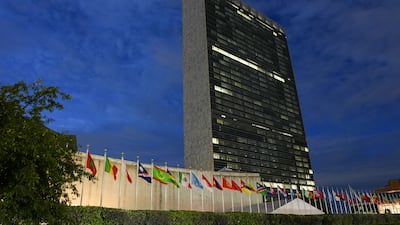

Less than three months before UN Secretary General Antonio Guterres's term expires, the Security Council has not decided who will succeed him, and the rules offer little guidance on what happens if the panel cannot agree on an applicant.
Rebeca Grynspan of Costa Rica led the fourth straw poll last month with 10 “encourage” votes, three “discourage” votes and two “no opinions", but she remains short of a clear consensus. A candidate needs at least nine votes in the 15-member Council and must avoid a veto from any of the five permanent members.
The Security Council is expected to conduct a fifth secret straw poll on Wednesday morning. The Council has not yet moved to a colour-coded ballot, which would reveal whether any of the five veto-wielding members had voted against a candidate.

Ben Cohen, who focuses on international organisations at the Foundation for the Defence of Democracies, said Ms Grynspan was unlikely to be Washington’s first choice. But she could emerge as a compromise candidate if the five permanent members of the Security Council reject the other leading contenders and agree that they could accept her, he said.
The selection carries particular significance this year. In its 81-year history, the UN has never been led by a woman, and several women are among the candidates seeking the post.
Should none of the publicly named contenders have a veto-proof way forward in their applications, other names have been unofficially suggested as possible candidates, including Nickolay Mladenov, head of the Board of Peace, and UAE Minister of State Lana Nusseibeh, who has not publicly commented on the race.
Diplomats have raised the possibility that new candidates or a “dark horse” could enter the contest as the permanent members seek consensus.
Esther Brimmer, former US assistant secretary of state for international organisation affairs in the administration of president Barack Obama, said she thinks it is possible a new candidate will emerge.
“That variable I think is also keeping everyone concerned about what the outcome will be,” Ms Brimmer told The National
Some diplomats have raised the possibility that the US could push for a candidate from the business world, reflecting Washington’s concerns about the UN’s finances and bloated bureaucracy.
“I did hear about that as well,” said Mr Cohen. “They could parachute in a capable businessperson with a good record of balancing books and doing budgets.”
He said such a candidate could appeal to Washington because of its concerns that the UN is financially wasteful, duplicates functions and is burdened by an oversized bureaucracy.
But Mr Cohen questioned whether such a candidate could win the support of Russia and China, both of which hold vetoes over the selection of the next secretary general.
“Is it going to fly with the Russians and the Chinese?” he asked.
Under the UN Charter, the General Assembly appoints the Secretary General on the recommendation of the Security Council. But the Charter does not state what happens if the Council fails to agree on a candidate.
What next?
Experts say several scenarios could emerge.
Richard Gowan, the International Crisis Group's global issues and institutions programme director, said he believed Mr Guterres had little appetite to remain in office beyond the expiry of his second five-year term. He said Washington appears opposed to an extension anyway.
“I don't think Guterres wants to stay on even one more day and he is not going to volunteer to be a lame duck indefinitely,” Mr Gowan said.

The General Assembly, which usually ratifies the council's choice as a formality, might press for a bigger voice.
“Nobody is very clear what happens if the secretary general's chair is empty on January 1,” said Mr Gowan.
“Some member states are cooking up plans for the General Assembly to install a new UN chief without a recommendation from the Security Council. But that could get very messy indeed, as I think the veto powers might refuse to recognise the legitimacy of anyone who does not have Council endorsement.”
The UN has never let a secretary general's term lapse without a successor or an extension in place. It has, however, come close.
In 1981, the Council deadlocked for weeks as China backed Salim Salim of Tanzania and the US opposed him, while Austria’s Kurt Waldheim sought a third term. After 16 rounds of voting, the Council turned to Javier Perez de Cuellar of Peru in mid-December, less than three weeks before the term expired.
The 1996 selection was nearly as tight. Washington vetoed a second term for Egypt’s Boutros Boutros-Ghali, and African governments resisted alternatives for weeks. Ghana’s Kofi Annan was recommended in mid-December and appointed days later.
The closest precedent for a gap came in 1950, when the Soviet Union vetoed a second term for Trygve Lie of Norway and the Council could not agree on anyone else. The General Assembly extended Mr Lie's term by three years on its own, without a Council recommendation. Moscow called the move illegal and refused to deal with him, and he resigned in 1952.
A more likely temporary solution, said Mr Gowan, would be for a group of senior UN officials to oversee the organisation, with one official serving as its senior administrative officer without formally assuming the title of acting secretary general.
Mr Gowan said he still expected the five permanent Security Council members to reach a last-minute compromise rather than allow the post to become vacant.
“I do not think the P5 actually want this car crash,” he said. “They know it would make them look very silly and raise questions about their competence to steer the UN more generally. So I think a last-minute compromise is still more likely than an empty chair.”
“But with the big powers in their current state, a car crash is possible.”

