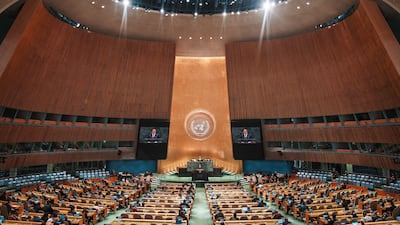

The UN Security Council held a fourth secret straw poll on Tuesday in the race to choose the next Secretary General, with Costa Rica's Rebeca Grynspan retaining her lead but still short of a clear consensus.
UN diplomats told The National that Ms Grynspan led the latest poll with 10 “encourage” votes, three “discourage” votes and two “no opinion” votes.
Guyana’s Carolyn Rodrigues-Birkett and Argentina's Rafael Grossi, were close behind, each receiving eight “encourage” votes.
Ms Rodrigues-Birkett received six “discourage” votes and one “no opinion” vote, while Mr Grossi, the director general of the UN nuclear watchdog, received seven “discourage” votes and no “no opinion” votes.
Four rounds of secret ballots have so far not produced an obvious frontrunner to succeed Antonio Guterres.
Ms Grynspan, a former Costa Rican vice president who has led the UN Conference on Trade and Development (Unctad) since 2021, entered Tuesday’s vote with a narrow advantage after finishing first in the previous round.
It will only become clear later in the process, when colour-coded ballots show whether a candidate is opposed by a permanent Security Council member, whether they face a potentially decisive obstacle.
Daniel Safran-Hon, a non-resident senior adviser at the International Peace Institute, said the latest results strengthened the case for Council members to move to colour-coded ballots.
He also played down speculation that a new candidate could enter the race and break the deadlock.
“I think there’s a bit of a myth of the dark horse, because the fact is that no one is joining the race,” he told The National. “There are so many rumours about people who might join, but no one is doing it.”
Entering this late would be difficult, he said, pointing to Bulgaria's Kristalina Georgieva, who joined the 2016 contest late but failed to overtake Antonio Guterres.
Mr Safran-Hon said Ms Grynspan had already cleared the nine-vote threshold needed for the Security Council to recommend a candidate. The key question was whether any of her three "discourage" votes came from a permanent member, which could block her nomination.
There has been little public indication that a permanent member is determined to stop Ms Grynspan, he said, though her 10 "encourage" votes did not amount to a "commanding lead".
"She's at 10. This is the same, to be fair, [as] she got in the first round," he said, noting that Ban Ki-moon and Mr Guterres had stronger support at similar points in their races.
Minh-Thu Pham, co-founder of the Starling Institute and former advisor to Secretary General Kofi Annan, told The National that Ms Rodrigues Birkett faces resistance from Washington over both her closeness to China and her positions on Gaza.
Mr Grossi faces obstacles of his own. Ms Pham said Russian opposition could hurt his candidacy, while Argentine President Javier Milei’s remarks on the Falkland Islands could prove difficult for Britain to overlook.
“I think if a candidate gets through right now in this difficult environment, it means that they have what it takes."
The selection carries particular significance this year. In its 81-year history, the UN has never been led by a woman, and several women are among the candidates seeking the post.
Ms Pham said the world body does not necessarily need a high-profile political figure as its next leader, arguing that a candidate with a more technocratic background might be more willing to challenge governments and take risks.
“I think you need a Secretary General who is not, at the outset, a rock star,” she noted.
She pointed to the current UN chief, Antonio Guterres, a former Portuguese prime minister, saying expectations that his political experience would translate into a strong leadership profile had produced a “pretty mixed” record.
“I think he was a bit more hesitant to step into the role of upsetting governments when he maybe needed to, when push came to shove,” Ms Pham said.
By contrast, she suggested that a less political figure might be more comfortable absorbing criticism that comes with the job.
"Somebody who was a technical bureaucrat before knows that maybe their role is, as Kofi Annan used to say, not SG meaning Secretary General, but SG meaning scapegoat, and that you don't have that ego there."

