
For months, the leading candidates to be the next UN secretary general have struggled to win over a divided Security Council. Now Turkey is betting the impasse could be its opportunity.
Ankara has nominated Feridun Sinirlioglu, a former foreign minister, to succeed Antonio Guterres, widening a contest once expected to be won by a candidate from Latin America.
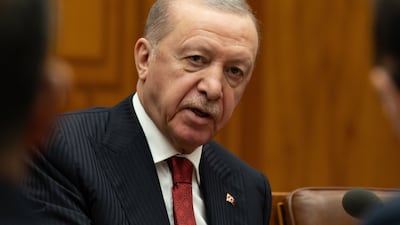
The bid also gives Turkish President Recep Tayyip Erdogan a platform for his longstanding argument that countries such as his deserve a greater say in an international system dominated by a handful of powerful states.
“Erdogan clearly smells an opportunity here,” Ben Cohen, senior analyst with the Foundation for the Defence of Democracies, told The National.
He said having an ally of Mr Erdogan's at the UN’s helm would serve Ankara’s political ambitions while strengthening the image it seeks to project.

“At a time when Turkey is pursuing a neo-Ottoman foreign policy, having an Erdogan ally as UN secretary general would help both politically and in terms of optics, proving, as far as the Turks are concerned, that they are a responsible international actor whose main concern is reviving the UN as an arbiter of peace and international law,” Mr Cohen said.
Turkey also has a direct interest in the UN’s work, with the Security Council regularly discussing conflicts and disputes involving its neighbours.
“Given the number of files on the UN agenda concerning Turkey's neighbours, including Cyprus, Syria and Iran, it is only natural that Ankara aims for maximum influence in New York,” said Richard Gowan, programme director for Global Issues and Institutions at the International Crisis Group.
Turkey’s UN ambassador, Ahmet Yildiz, submitted the nomination on Friday, as another informal Security Council vote showed that no candidate had secured agreement.
Costa Rica’s Rebeca Grynspan led the October 30 straw poll with 11 "encourage" votes, followed by Argentina’s Rafael Grossi with nine, Guyana’s Carolyn Rodrigues-Birkett with eight and the UAE’s Lana Nusseibeh with seven. The poll is not a formal vote to recommend a candidate.
Turkish Foreign Minister Hakan Fidan said Ankara had initially stayed out of the contest out of respect for expectations that the next secretary general would come from Latin America. But after following the process for about a year, Turkey decided to act.
“Once the deadlock became clear, we officially submitted our own candidate to the UN with a letter signed by our President,” Mr Fidan said on Saturday, on the sidelines of the G20 foreign ministers’ meeting in Atlanta, Georgia. “Our goal is to provide a diplomatic contribution aimed at overcoming the impasse.”
Mr Gowan said entering earlier could have carried a political cost.
“Like Nusseibeh, Sinirlioglu had to wait until the Latin American candidates started to lose steam before joining the race,” he said. “I think both understood that they would face pushback if they looked like they were pre-empting the Latin Americans.”
Ms Nusseibeh entered the race last month and has secured backing from Gulf Co-operation Council countries, Cyprus, Jordan and Palestine, among others. She has been a Minister of State of the UAE and its permanent representative to the UN in New York, from 2013 to 2024.
Mr Sinirlioglu, 70, briefly served as Turkey’s foreign minister in 2015, then represented the country at the UN from 2016 to 2023. In December 2024, he was appointed secretary general of the Organisation for Security and Co-operation in Europe.
Whether those credentials can win him sufficient backing in New York remains unclear.
“I don’t think Sinirlioglu warrants the descriptor ‘compromise’ candidate. They include Greece, which is currently serving on the Security Council, Cyprus, Israel, a large swath of the European Union, and Middle Eastern states,” said Mr Cohen.
Cyprus has already indicated its opposition. The government’s spokesman, Konstantinos Letymbiotis, told reporters on Sunday that Mr Sinirlioglu’s candidacy was a “profound institutional contradiction”.
“It is indeed paradoxical for a country that has continued for 52 years to illegally occupy 37 per cent of the territory of the Republic of Cyprus, a United Nations member state, and to disregard Security Council resolutions, to seek to lead the very Organisation founded to safeguard international peace, the sovereignty and territorial integrity of states,” Mr Letymbiotis said.

“You cannot seek to lead the United Nations while refusing to respect the principles on which it is founded. You cannot seek to represent international law while continuing to violate it.”
Gonul Tol, director of the Turkey programme at the Middle East Institute, said Ankara sees itself as able to bridge divisions between the West, Russia and the Global South. A campaign for the UN’s highest office gives it another opportunity to make that case.
“But even if he doesn’t win, the candidacy gives Ankara an opportunity to raise its diplomatic profile, build support for its vision of global governance and reinforce Erdogan’s narrative that Turkey is a power whose voice can no longer be ignored,” said Ms Tol.
Winning, however, would require the consent of the very powers whose privileges Mr Erdogan has challenged.
To recommend a candidate, the Security Council needs at least nine votes and no veto from any of its five permanent members: the US, Britain, France, Russia and China.
How those powers would respond to Mr Sinirlioglu remains uncertain. Mr Cohen said Russia’s experience working with him at the OSCE could help his candidacy.
“The Russians have worked productively with Sinirlioglu during his tenure at the OSCE, with [Russian Foreign Minister Sergey Lavrov praising him on a few occasions, so it could be that he will emerge as Moscow’s favoured candidate,” he said.
Russian support could give Washington a reason to oppose him, Mr Cohen said, but President Donald Trump’s relationship with Mr Erdogan makes a US veto far from certain.
“Trump has cultivated Erdogan, so it’s not obvious that the US would exercise its veto, even though on key issues – Israel and the Palestinians, future of Cyprus, sanctions regimes – the US and Turkey are in sharp disagreement,” he said.
China’s position was harder to assess, Mr Cohen added.

