
Imagine walking through the narrow streets of the Latin Quarter in Paris, with its cobblestones, cafes and bookshops. Now imagine seeing those streets for the first time as an Egyptian intellectual in the early 19th century.
Rifaa Al Tahtawi's observations might sound surprisingly familiar today.
The French, he wrote, were a curious people with a fascination for museums. They were fond of money but also of state intervention. They placed the poor and the old in dedicated institutions. Women, he observed, ruled the household.

Those were some of the thoughts penned to paper by Al Tahtawi in 1834 in his critical yet forgiving book, An Imam in Paris, after spending five years in the French capital as imam to the first Egyptian educational mission to France. It became one of the most influential early accounts by an Arab intellectual of European society.
Today, few French people have heard of him. Part of the reason may be that France’s relationship with the Arab world is often discussed through the prism of contemporary politics, leaving less space for the longer and more complicated history of cultural and intellectual exchange.

One of the bodies seeking to fill that gap is the Arab World Institute, a vibrant institution that hosts exhibitions, concerts, Arabic language classes and the largest collection of modern and contemporary Arab art in the Western world.
The National recently joined one of its popular summer tours. With anti-migration and anti-Islam rhetoric on the rise, the chance to learn about how bridges have been built, and sometimes burnt, has rarely felt more timely. The tour offered a reminder that Arab-French relations go back at least a millennium and cannot easily be reduced to the politics of the present.
“The concept was to revisit the relationship between France and the Arab world – a relationship shaped by fear and fascination, depending on the era, and often by both,” Marie-Georges Nida, speaker and art historian at the Arab World Institute, told visitors as they started the tour.
First impressions
Being made up of people who had paid to spend several hours of a rainy Saturday afternoon walking through Paris learning about Arab-French history, the audience was in general more knowledgeable than average about the Middle East.
guide at the Arab World Institute
Yet many were surprised to hear that France’s relationship with the Arab world dates back centuries, predating the colonial expansion of the late 19th century. Some were also unaware of France’s historic ties with Arab Christian communities in the Levant, which have contributed to the enduring importance of Lebanon and Syria in French diplomacy.
But what generated the most curiosity were Al Tahtawi’s observations of Paris and its people through the eyes of a foreign visitor. His journey came in the wake of Emperor Napoleon Bonaparte’s 1798 invasion of Egypt, a fiasco for France that nevertheless opened the door to cultural exchanges between the two countries.

“He was the darling of the Parisian elite and the Parisian bourgeoisie; everyone was clamouring for him. He was welcomed into people's homes and frequented the opera, theatres and racetracks, discovering the full scope of Parisian social life,” Ms Nida said. “He was incredibly curious.”
In his book, he spoke of the contrast between Cairo, which had been little developed by the Ottomans, and Paris, with its paved streets and street lights. He admired the French for their appetite for knowledge and numerous museums. But he was also critical of what he saw as a failure to care adequately for those in need, Ms Nida said.
“He said people are sordidly avaricious – that’s the term he used, 'sordid avarice' – and relied on the state to make up for that sordid avarice. He talked about the race for money. There are things, you realise, that haven’t really changed all that much,” she said.
A new viewpoint
Christiane Jalbert, a professor of classics, was among those who noted down the book's name. “I immediately thought: I need to read this,” she told The National. She said she had written her thesis on how 19th century French explorers described Asian men in their travel books. What appeared to draw her to Al Tahtawi was that he offered a reversal in perspective.

Lydia Devige, a professor of French literature currently working in Egypt, was also curious. “It is absolutely true: France is a complete paradox. They claim to look after the poor, yet they still house them in institutions in 2026. [In Egypt] they have a real sense of community,” she said.
Some participants in the tour had expected to walk the streets of Barbes, in the north of Paris, where there is a high concentration of North African immigrants, shops and music. “We had no concept of Arab culture within Western culture prior to the migrations of the 1960s,” David Victor Basello, a craft artist, said.
Yet the tour showed that the history reaches much further back. Some 500 years ago, the College de France was founded in the Latin Quarter by a Renaissance king keen for Arabic to be taught in his kingdom. “That was a total discovery,” Mr Basello said. “I never thought the visit would go that far back in time.”
Not a pastiche
The tour began at the Arab World Institute, conceived in the post-colonial era of the 1960s, when France was thinking of ways to maintain relations with its former North African colonies. The project stalled before being revived after the 1973 oil shock, which triggered French interest in projecting soft power to the Gulf states.

France’s president at the time, Valéry Giscard d’Estaing, brought together France and 22 Arab states to create the institute, which has since been jointly managed by a French and Arab leadership structure, with an Arab director and a French president.
Opened in 1987, the institute was designed to blend into the Paris skyline, with a grey-and-glass facade featuring 240 metal panels inspired by traditional Middle Eastern mashrabiya latticework, commonly seen in the medieval quarters of Arab cities. “The idea was to create a very neutral building,” Ms Nida said. “Building a pastiche of Oriental architecture in the heart of Paris was not the goal.”
The panels open and close like the iris of an eye, responding to the intensity of the sun and helping to keep the light inside the building at a constant level. More traditional wooden mashrabiya could be seen later in the tour at the Great Mosque of Paris, after a two-and-a-half-hour walk.

But the first stop was at the lesser-known 12th century church of Saint-Julien-le-Pauvre, built around the same time as the Notre-Dame cathedral. Closed during the French Revolution, it was later used for storage by the nearby Hotel-Dieu Hospital and was slated for demolition in the 19th century during Georges-Eugene Haussmann’s renovation of Paris. It was saved by writers and intellectuals such as Victor Hugo, who argued it had to be preserved because it was the oldest in Paris (a title in reality held by the Church of Saint-Germain-des-Pres).
Levantine merchants
A growing community of Syrian and Lebanese Christians, many of whom had moved to Paris to flee Ottoman persecution, offered to take it over. It became a Melkite Greek Catholic church with additions including an iconostasis, a decorated screen behind which the priest performs part of the liturgy.
“These Christians had heard of France – Napoleon Bonaparte’s expedition had resonated widely – and many viewed it not only as a Christian nation but also as the land of human rights and the French Revolution. They sought refuge in France, specifically in this neighbourhood – a wretched, dilapidated, and unsanitary area – to open shops, as many of them were merchants,” Ms Nida said.
At a brisk pace under the late-summer rain, Ms Nida then headed with her group for the College de France. In the 13th century, Paris witnessed the rise of universities as a space of learning at roughly the same time as the return of crusaders, Ms Nida said – “a pivotal moment for the realisation of the Eastern world's technical and scientific superiority over Europe”.
While it appeared clear to many that learning Arabic was essential to access Arab advances in science and medicine, resistance was fierce. The French clergy was particularly alarmed by the number zero, which represented emptiness and the devil. “This mistrust of the East ran quite deep; it affected not only Arabs but also Greek speakers. This all changed with the Renaissance and Francis the First,” who ruled from 1515 to 1547, Ms Nida said.

Frustrated that he could not find translators to speak to his ally, Ottoman ruler Soleiman the Magnificent, and eager to develop a network of diplomats fluent in local languages, in 1526 Francis the First created a school in Paris where students could study Arabic, and later Turkish and Persian. To this day, the College de France is known for its openness to new fields of study – it has just under 50 research chairs that constantly evolve.
Competing impulses
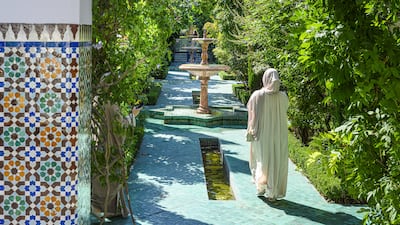
The audience was more familiar with the tour’s last stop, the Great Mosque of Paris, a landmark monument inspired by the architecture of Al Qarawiyyin mosque in Fes, Morocco. The mosque is famous among visitors for its restaurant, which serves pastries and mint tea. With the sun finally down, this “garden of Eden” was an ideal setting for explanations about how traditional Arab gardens are created to stimulate the five senses, with flowers, fruit trees, water and birds.
Construction began in the years after the First World War as a symbolic tribute to the nearly 100,000 Muslims from French colonies in North and West Africa who died fighting for France. At the time, there were very few mosques in France and Muslim soldiers were initially fed non-halal meat and buried according to Christian rites.
But the idea of building a mosque predated the war and was driven by two competing impulses: that of so-called Orientalists, who idealised the Middle East, and that of domestically focused politicians who wanted greater control over France’s Muslim population, according to Ms Nida.

It was almost immediately criticised after its construction by anti-colonial activists and remains a symbol of historically fraught French-Algerian relations.
The mix of elegant architecture, portent and history, as well as the lived experience of so many, is well explored during the walking tour. It is a reminder that France’s relationship with the Arab and Islamic world has never been straightforward. But the connections endure and continue to shape Paris today.

