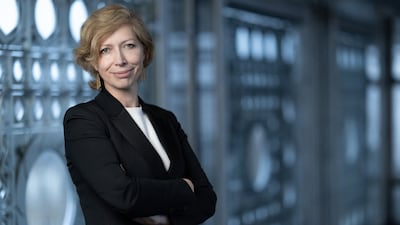

Anne-Claire Legendre wants Arab artists and cultural figures to have greater autonomy over how their work is presented at the Arab World Institute in Paris.
The former French diplomat, appointed president of the institute this year, says it can no longer operate mainly as a European showcase for Arab culture when a growing number of regional museums, festivals and cultural organisations are presenting that work themselves.
Legendre will be in Abu Dhabi on September 20 for the Congress of Arabic and Creative Industries at Manarat Al Saadiyat, where she will take part in the opening session, titled Arabic Language and Identity in a Changing World.

Her visit comes during her first full season in charge of the institute, with programmes under way in design, fashion, literature, film and music.
Her visit to the congress, where she will meet policymakers and cultural organisations in the UAE, forms part of a more inclusive approach aimed at giving creatives from the region a greater say in what the institute presents.
“We are now into a moment when what we want to do is basically give the key to the crowd from the Arab world and give them the chance to curate the events and showcase their talent in a much different way,” Legendre says.
“It’s not Europeans looking at what’s happening in the Arab world. It’s Arab players showcasing and curating to bring their vision of the world to the European scene.”
The new approach is already bearing fruit across the Arab World Institute's current programme. This month, it is exhibiting finalists for the fourth edition of its design prize, dedicated to designers from the Arab world, with categories for early-career talent, craftsmanship, social and environmental impact and established work.

The second Arab Fashion Award is also under way, with finalists selected from designers working across the Arab world and diaspora.
Legendre says these events, which focus on emerging talent, are a way not only to cross borders but also generations.
“European society is largely ageing, and so there is a risk of a generational gap between the Middle East and Europe, and that’s why we need the younger generation to come to us,” she says.
“So it is very interesting to have them curate a show, define what should be in a music festival and showcase what’s really happening when you go around the Arab world.”
A former French ambassador to Kuwait who has spent much of her career working on the Middle East and North Africa, Legendre is aware of France’s long history of using institutions, quotas and public funding to protect its language and culture.
French television channels must devote at least 40 per cent of annual audiovisual programming to work originally produced in French, while private radio stations are generally required to ensure at least 40 per cent of songs broadcast are in French.
The issue has particular relevance in the Arab world. The 2023 Arab Youth Survey, based on interviews with 3,600 Arab citizens aged 18 to 24 in 18 countries, found that 54 per cent believed Arabic was less important to them than it was to their parents.
Asked if Arab policymakers could consider similar measures to preserve the use and appeal of Arabic, Legendre says the French example is worth considering.
“Each country makes its sovereign choices,” she says. “For the French state, these policies were about supporting the French-speaking cultural scene, while for artists and producers they were seen as public subsidies for culture. In that sense, they helped sustain a cinema industry in France in a way that has not happened to the same extent in some other European countries.”
Legendre also suggests greater support for Arabic education tailored to communities in the Gulf.
“These countries are very multicultural, and I don’t think that will change because that is their nature. There should be a real policy to support and promote education in Arabic,” she says.
“For instance, as a newcomer in the Gulf, have you ever been offered free Arabic training to help you understand your environment differently? This is what New York does. In this very multicultural city, newcomers can access free English-language training.”

At the congress, Legendre will also address the need to improve the capacity of publishers and translators so that both classical Arabic literature and modern works can reach wider international audiences.
“When you look at the promotion of Arabic cultural productions, I think there is a particular problem with publishing,” she says. “Books in Arabic are among the least translated, and what we see today is that the rate of translation is decreasing. Publishers in Europe and the US are not making enough effort to identify the writers or intellectuals who should be translated.”
She says the Arab World Institute is trying to address that gap through its Arabic Language Week in December, held around World Arabic Language Day on December 18. The programme will include literary and cultural events, as well as announcing the winner of the 2026 Arab Literature Prize.
“What we want is to bring together a large number of publishing houses and the recipients of major literary and book awards in the Arab world, so that in one place publishers can meet the 2026 winners,” she says.
“They can then decide what interests them, but at least they don’t have to do all the work of identifying and researching those writers, because I think there is a lack of easy access to Arabic publishing.”
The same lack of visibility extends to European film and television, Legendre adds.
“Yesterday, I was in a meeting with one of the biggest festivals for series in Europe, and they were asking me: ‘Can you help us identify a series from the Arab world? And perhaps we can work together using literature or novels to be adapted into series,'” she recalls.
“So I think the role of the institute is really to help this, because it is important for French and European audiences who have this understanding of Arabic history, especially for those in Europe who want to relate to the language of their parents, grandparents or great-grandparents.”
Legendre clearly cherishes the freedom her work with the institute provides, away from traditional diplomacy.
“What I’ve seen is that narratives are key today in diplomacy,” she says. “And it’s very difficult for traditional diplomacy to build powerful narratives. This is why we need culture to do that.”
The Congress of Arabic and Creative Industries takes place on September 20 at Manarat Al Saadiyat, Abu Dhabi. Entry is free with registration