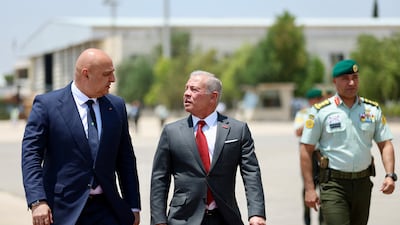

Lebanese President Joseph Aoun and Jordan's King Abdullah II are scheduled to attend a meeting in Paris on Thursday, hosted by French President Emmanuel Macron, to push forward talks on replacing the UN interim force in south Lebanon (Unifil).
An adviser to Mr Macron described the meeting as a technical gathering of high-level military officials, including from the US. Army chiefs from Lebanon, Jordan, the UK and France will also be present.
“It is a highly focused, highly operational meeting, with the objective of providing the best possible support for a clear, credible and realistic plan to deploy the Lebanese Army across the territory,” the adviser said.

Unifil's scheduled departure under US and Israeli pressure has caused fear in Lebanon and Europe that it may worsen security conditions in the region. Israel is now occupying about 700 square kilometres of Lebanese territory and insists the Lebanese Armed Forces must disarm Iran-backed militia Hezbollah. Beirut argues the Israeli occupation and bombing campaigns across the country are weakening state institutions, including the military.

Italy and France are playing a lead role in laying the groundwork to replace Unifil, with an estimated 10 EU nations in total ready to contribute to a new military and civilian mission to advise and train the Lebanese Armed Forces. Discussions with Israeli and US representatives are expected to take place at the UN General Assembly in New York next week.
Speaking earlier this month, Mr Macron's special envoy for Lebanon, Jean-Yves Le Drian, said: “Strengthening the army is crucial. You cannot ask the army to ensure Hezbollah gives up its weapons if it lacks the means to command respect.”
Hezbollah emerged as a militia in the early 1980s during the Lebanese civil war largely in response to the Israeli occupation of southern Lebanon. Israel withdrew in 2000 after 18 years under pressure from Hezbollah's guerrilla tactics.
Hezbollah, which also functions as a political party, was the only militia allowed to keep its weapons at the end of the civil war in 1990 to continue what it describes as “resistance” to Israel. Its weaponry was long considered equal if not superior to that of the Lebanese Armed Forces, which had a weak presence in the militia's strongholds.
Observation role
During its five-decade deployment, Unifil, comprising thousands of peacekeepers from dozens of countries, played an observation role, recording Israeli and Hezbollah breaches of any ceasefire. It has come under fire from both sides and lost several personnel this year during hostilities.
Israel has accused Unifil of failing to disarm Hezbollah, though Unifil's mandate was limited to supporting the Lebanese Armed Forces in doing so. The 2006 war between Hezbollah and Israel was settled when UN Security Council resolution 1701 called for Hezbollah's withdrawal south of the Litani river. Lebanon later accused Israel of breaching its territory and airspace.
Mr Macron's adviser said Washington needs to be included in the plan to replace Unifil, which could take the shape of another UN-led mission and be multinational.
“We are discussing with the Italians – the largest troop contributors to Unifil – how to redefine an international mandate,” they said. “This is what the Lebanese authorities desire in order to avoid a security vacuum in southern Lebanon.

“The modalities of this multinational action remain to be defined, not least because the Lebanese have not made a request that aligns with American demands at the UN Security Council,” the adviser added. “We still need to calibrate the terms of this presence and be absolutely clear about the mandate.”
The Paris meeting is taking place under the so-called Aqaba format, an initiative launched in 2015 by King Abdullah to enhance regional military and security co-operation.
France, a former colonial power in the region, has organised a number of conferences in support of Lebanon in the past few decades but is not involved in the US-brokered Lebanese-Israeli talks. The adviser promised that Thursday's gathering would be different.
“It will not be a matter of holding yet another conference in support of the army or Lebanon,” they said. “It will be a far more ambitious conference, grounded in a clear operational plan for the Lebanese Army, with the goal of ensuring state authority is exercised across the entire national territory.”

