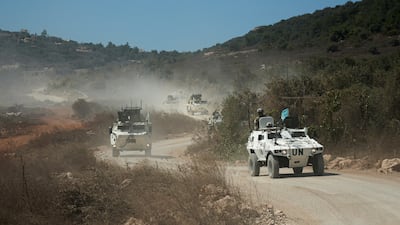

Lebanon has urged the UN to reconsider plans to end the Unifil peacekeeping mission, warning that its withdrawal could create a security vacuum as conditions in Lebanon and the wider Middle East have changed sharply.
In an August 26 letter, seen by The National, circulated to the UN Security Council, Lebanon’s UN ambassador, Ahmad Arafa, said terminating the mission appeared “premature” in light of developments since March 2.
“The security context both in Lebanon and across the Blue Line, but also in the Middle East, has shifted drastically since then, and it is Lebanon’s conviction that this termination requires a careful re-examination, to avoid any security vacuum that would be detrimental to the efforts of the Lebanese Government, and those of other actors tirelessly promoting stability in the region,” Mr Arafa said.

Hezbollah and Israel resumed fighting on March 2 as a wider regional conflict intensified, sharply changing the security environment in which Unifil operates.
Israeli forces have since occupied a strip of southern Lebanon extending about 10km from the border, which Israel describes as a buffer zone necessary to prevent Hezbollah attacks on communities in northern Israel. Israeli strikes have killed more than 4,300 people in Lebanon since March, according to Lebanon’s Health Ministry.

Lebanon said it remained committed to fully implementing Security Council Resolution 1701, which provided the framework for ending the 2006 war between Israel and Hezbollah.
Beirut said it was also committed to the November 2024 cessation-of-hostilities agreement and a US-Israel-Lebanon Trilateral Framework signed on June 26, both of which it said were intended to advance the objectives of Resolution 1701.
Lebanon also challenged existing UN planning for the period after Unifil, saying options outlined in a June 1 report by UN Secretary General Antonio Guterres were based on consultations conducted before the March developments and the signing of the Trilateral Framework.
“Lebanon believes that the said options may no longer reflect the new realities that have emerged since,” Mr Arafa said.
He added that extending Unifil for a limited period was the most practical option, citing its operational expertise, logistical infrastructure and acceptance among local communities and the Lebanese government.
The Lebanese government said Unifil had played a key role in maintaining stability in southern Lebanon, supporting the Lebanese Armed Forces and monitoring Resolution 1701.
Last week, Israel said it opposes efforts to maintain a large international force in southern Lebanon after the UN peacekeeping mission’s mandate ends, arguing the Lebanese army should assume responsibility for securing the border.
“Our position is very clear. We think that the decision that was passed in the Security Council on Unifil finishing its mandate by the end of the year should be respected,” Danny Danon told reporters at UN headquarters.
Unifil has operated in southern Lebanon since 1978, monitoring the cessation of hostilities and supporting the Lebanese army in maintaining security along the Blue Line with Israel. Pushed by the United States, the UN Security Council voted in August 2025 to end the more than 7,000 strong peacekeeping mission on December 31, 2026, after nearly five decades of operations.

