One of the strongest earthquakes recorded has struck Russia’s far east, sending tsunami waves into Japan, Hawaii and the west coast of the US.
No substantial damage has been reported so far, but authorities warned people to stay away from shorelines and said the risk could last more than a day.
Ports on the Kamchatka peninsula in Russia near the 8.8-magnitude quake’s epicentre flooded as residents fled inland, and frothy, white waves washed up to the shore in northern Japan. Cars jammed streets and motorways in Hawaii’s capital after warnings were issued, with standstill traffic even in areas located away from the shoreline.
People went to evacuation centres in affected areas of Japan with memories fresh of the 2011 earthquake and tsunami that caused reactor meltdowns at a nuclear power plant. No abnormalities in operations at Japan's nuclear plants were reported.

Russian authorities said several people were injured, without giving a figure. In Japan, at least one person was injured.
A tsunami height of three to four metres was recorded in Kamchatka, 60cm on Japan's northern island of Hokkaido, and up to 30cm above tide levels were observed in Alaska's Aleutian Islands.
Hours after the quake on Wednesday morning, Hawaii downgraded its tsunami warning to an advisory, while Japan’s meteorological agency also lowered its alert to an advisory in the Pacific coast south of Fukushima. The alert remained in place farther north.
Hawaii's defence department said the advisory means there is the potential for strong currents and dangerous waves, as well as flooding on beaches or in harbours.
Alaska tsunami warning co-ordinator Dave Snider said the impact of the tsunami could last for hours or perhaps more than a day.
“A tsunami is not just one wave,” he said. “It’s a series of powerful waves over a long period of time. Tsunamis cross the ocean at hundreds of miles an hour – as fast as a jet aeroplane – in deep water. But when they get close to the shore, they slow down and start to pile up. And that’s where that inundation problem becomes a little bit more possible there.
“In this case, because of the Earth basically sending out these huge ripples of water across the ocean, they’re going to be moving back and forth for quite a while.”
Hawaii Governor Josh Green said data from Midway Atoll, between Japan and Hawaii, measured waves from peak to trough of 1.8m. He said waves hitting Hawaii could be bigger or smaller and it was too early to tell how large they would be. A tsunami of that size would be akin to a 90cm wave riding on top of surf, he said.
“This is a longitudinal wave with great force driving through the shoreline and into land,” he said.
-

The epicentre of an 8.8-magnitude earthquake off Russia's far eastern Kamchatka Peninsula on July 30 that caused tsunamis across the Pacific. AFP -

Rescuers among the debris from a damaged building following the earthquake, in Petropavlovsk-Kamchatsky, Kamchatka Krai, Russia. EPA -

Ala Moana Boulevard is almost deserted after a tsunami warning in Honolulu, Hawaii. AFP -

Evacauted people shelter on the roof of a building in Kushimoto, western Japan. Reuters -
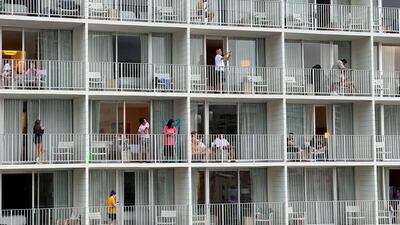
Holidaymakers at the Alohilani Resort in Honolulu look towards Waikiki Beach following the warning. Reuters -
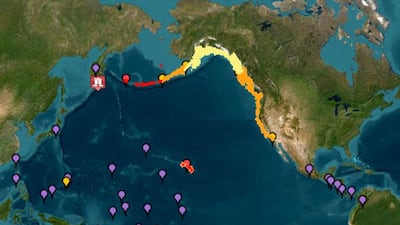
Tsunami warnings (red), advisories (orange), watches (yellow) and threats (purple) were put in place after an 8.8 earthquake hit off of Russia's far east on Wednesday morning. AFP -

The aftermath of the tsunami hitting the Russian Kuril Islands. AP -

A tsunami alert coming through on a mobile photo in Honolulu. AP -

People wave warning flags to beachgoers in Shirahama, western Japan. AP -

Evacuated people on the roof of a fire station in Hokkaido, Japan. Reuters -

A shopper in Hawaii stocks up on supplies after authorities sounded the alarm. Reuters -

Traffic builds near downtown Honolulu after the warning in Hawaii. Reuters -

People on higher ground look for signs of the tsunami in Ishinomaki, northern Japan. AP


Mr Green said Black Hawk helicopters had been activated and high-water vehicles were ready to go in case authorities need to rescue people. “But please do not put yourself in harm’s way,” he said.
The Oregon emergency department said small tsunami waves were expected along the coast, starting at about 11.40pm local time. It urged people to stay away from beaches, harbours and marinas and to remain in a safe location away from the coast until the advisory is lifted.
“This is not a major tsunami, but dangerous currents and strong waves may pose a risk to those near the water,” the department said.
Much of American west coast, spanning California, Washington state and the Canadian province of British Columbia, was also under an advisory.
A tsunami of less than 30cm was forecast to hit parts of Canada's Vancouver Island in British Columbia. The province’s emergency preparedness agency said waves were expected to reach remote Langara Island at about 10.50pm on Tuesday and Tofino at 11.30pm. The agency said “multiple waves over time” were expected.
The quake at 8.25am Japan time had a preliminary magnitude of 8.0, seismologists said. The US Geological Survey later updated the magnitude to 8.8 and the depth to 20.7km.
The quake was centred about 119km east-southeast from the Russian city of Petropavlovsk-Kamchatsky, which has a population of 180,000, on the Kamchatka Peninsula. Multiple aftershocks as strong as 6.9 magnitude followed.
Severokurilsk Mayor Alexander Ovsyannikov said the port in the city was flooded, washing fishing boats into the sea. He said that no major damage was recorded.
Power supplies have been shut and the authorities were checking the power network after the flooding.

