India and Pakistan traded accusations of ceasefire breaches early on Sunday, hours after US President Donald Trump announced the nuclear-armed neighbours had stepped back from the brink of war.
India's Foreign Secretary Vikram Misri said his country retaliated after Pakistan's “repeated violations” of the truce, while Pakistan said it “remains committed” to the ceasefire and that its forces were handling violations by India with “responsibility and restraint”.
On Saturday, the two countries had agreed to a full and immediate ceasefire after days of deadly jet fighter, missile, drone and artillery attacks that have killed at least 60 people and forced thousands from their homes along the border, including in divided Kashmir.
“After a long night of talks mediated by the United States, I am pleased to announce that India and Pakistan have agreed to a full and immediate ceasefire. Congratulations to both countries on using common sense and great intelligence,” Mr Trump wrote on Truth Social.
His announcement followed intensive talks between the US and the two countries, as well as diplomacy from dozens of other nations.
Mr Misri said both sides would “stop all firing and military action on land, air and sea”. He later accused Pakistan of “repeated violations” and said the Indian armed forces “are giving an adequate and appropriate response”.
A spokesman for Pakistan's Ministry of Foreign Affairs said his country “remains committed to faithful implementation” of the truce.
“Notwithstanding the violations being committed by India in some areas, our forces are handling the situation with responsibility and restraint,” he said.
Military clashes during the past week have pushed India-Pakistan relations to the most dangerous levels in years.
The countries, which govern a divided Kashmir, fired missiles at each other on Saturday before the truce announcement, escalating the violence for a fourth day.
US Secretary of State Marco Rubio said he had been engaged along with Vice President JD Vance with senior Indian and Pakistani officials to put an end to the conflict.
“I am pleased to announce the governments of India and Pakistan have agreed to an immediate ceasefire and to start talks on a broad set of issues at a neutral site,” said Mr Rubio. “We commend Prime Ministers Modi and Sharif on their wisdom, prudence, and statesmanship in choosing the path of peace.”
The US announcement of the truce follows diplomatic efforts by several nations including Gulf states to encourage India and Pakistan to pull back from a wider conflict.
Saudi Foreign Minister Prince Faisal bin Farhan had spoken to his Indian and Pakistani counterparts on efforts to de-escalate tensions and end military confrontations. Sheikh Abdullah bin Zayed, UAE Deputy Prime Minister and Minister of Foreign Affairs, also stressed the need for diplomacy and dialogue in talks with senior ministers from the two countries.
-

A child looks on after taking refuge at a school in Jammu, Indian-administered Kashmir, following an exchange of shelling and small arms fire across the border. Getty Images -
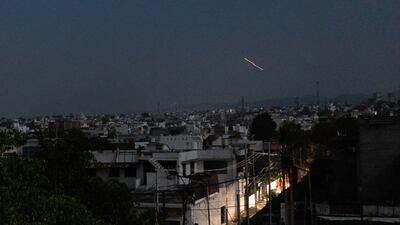
Streaks of light in the skies over the city of Jammu in Indian-administered Kashmir, during a suspected drone attack from the Pakistan side. Getty Images -
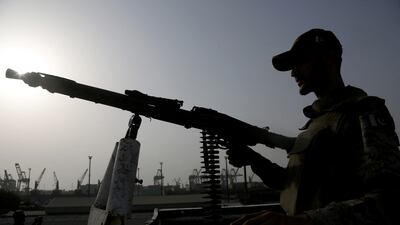
A Pakistani paramilitary trooper keeps guard at Karachi Port. Reuters -
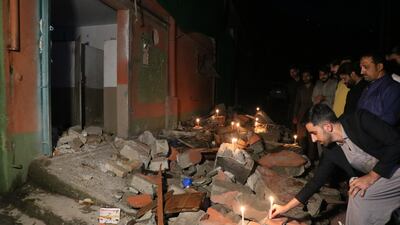
A candlelight vigil for victims of a Indian missile strike on Bilal Mosque in Muzaffarabad, Pakistani-administered Kashmir. EPA -
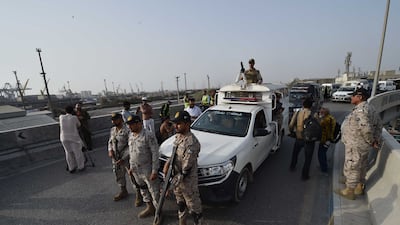
Security personnel at Karachi Port, southern Pakistan. EPA -
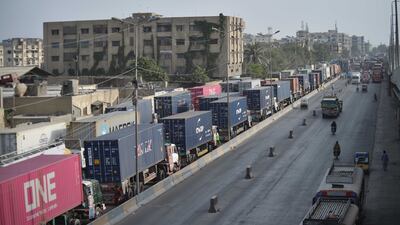
Lorries gridlocked near Pakistan's Karachi Port following the military escalation between New Delhi and Islamabad. EPA -
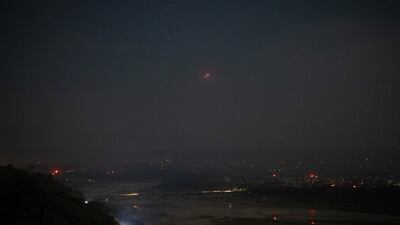
India's air defence system intercepts objects during a blackout following blasts in the city of Jammu, in Indian-administered Kashmir. Reuters -
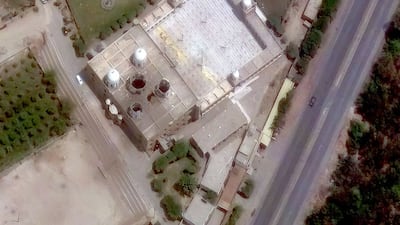
The damaged Jamia Masjid Subhan Allah compound after an Indian strike on the outskirts of Bahawalpur in Pakistan's Punjab province. AFP -
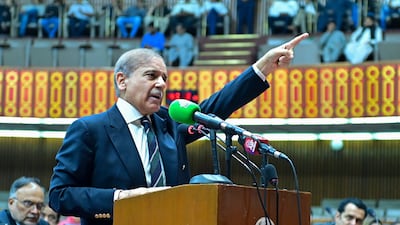
Prime Minister Shehbaz Sharif addressing the special session at the National Assembly in Islamabad. AFP -

Villagers carry their belongings as they move to safer areas after authorities evacuated residents living near the border at Jeora Farm on the outskirts of Jammu. AFP -
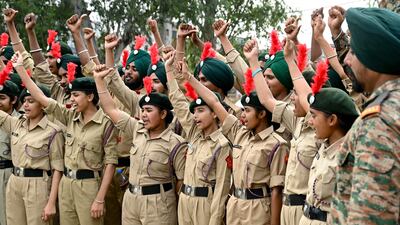
National Cadet Corps cadets shout slogans after conducting an emergency simulation drill as part of the nationwide civil defence mock drills in Amritsar. AFP -
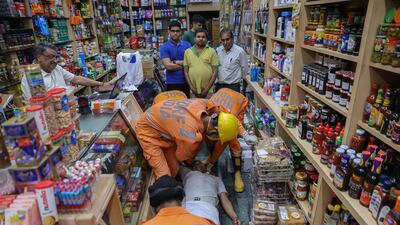
National Disaster Response Force, civil defence and fire personnel conduct an air raid drill at Khan market in New Delhi. EPA -
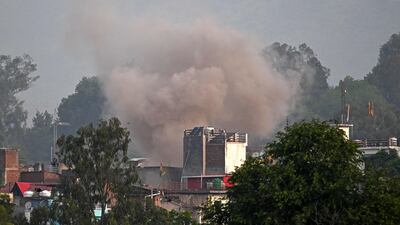
An artillery shell lands in the main town of Poonch district in India's Jammu region on Wednesday as Pakistani troops launch shells from across the Line of Control in retaliation for Indian missile strikes. AFP -
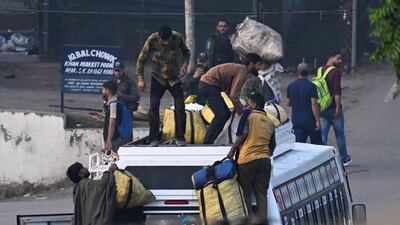
Poonch locals load their belongings on a bus as they flee the shelling. AFP -
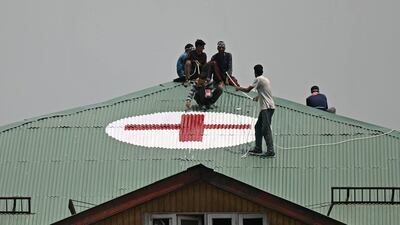
Workers paint a red cross symbol on the roof of a hospital to deter a potential attack in Srinagar, in Indian-administered Jammu and Kashmir. AFP -

Indian school pupils take part in a drill at Rajkiya Sarvodaya Vidyalaya in New Delhi. EPA -
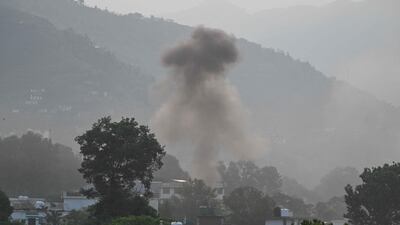
Another Pakistani shell hits Poonch. AFP -
Rescuers search for survivors after India struck a building in a government-run complex in Muridke, Pakistan, about 30km from Lahore. AFP -
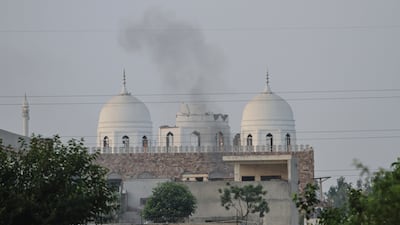
The mosque of an Islamic seminary partially damaged by an Indian missile attack, on the outskirts of Bahawalpur, Pakistan. AP -

Residents are evacuated from an area close to the site of an Indian missile attack, near Muzaffarabad. AP -
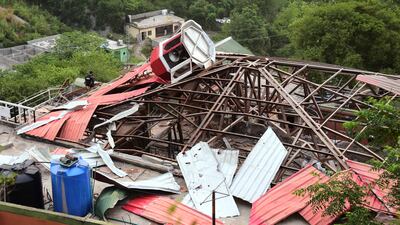
Bilal mosque lies in ruins after being struck by Indian missiles in Muzaffarabad, capital of Pakistan-administered Kashmir. AP -
Volunteers load a body into an ambulance after recovering it from the rubble of a mosque building damaged by a suspected Indian missile attack near Muzaffarabad. AP -
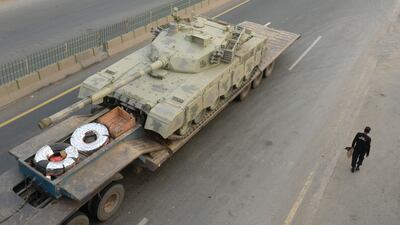
A lorry transports an army tank on a road in Muridke, about 30km from Lahore. AFP -
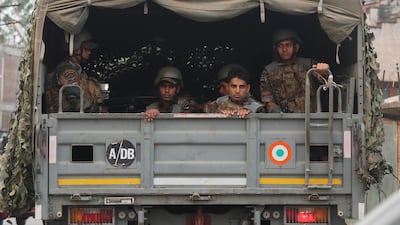
Indian Air Force personnel patrol on the outskirts of Srinagar. EPA -
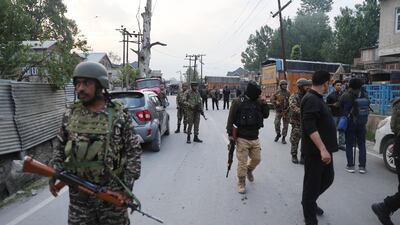
Indian troops patrol a security checkpoint on the outskirts of Srinagar. EPA -
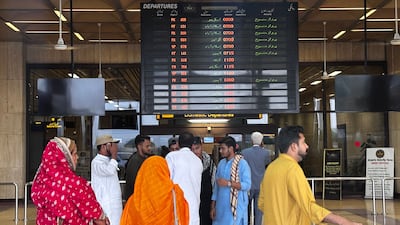
Passengers stranded at Jinnah International airport after all domestic and international flights were cancelled in Karachi. AFP -
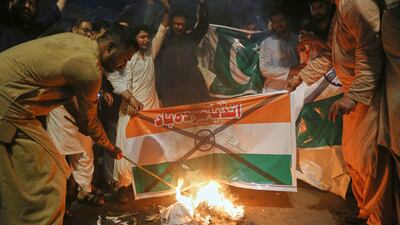
Protesters burn an Indian flag during a demonstration condemning Indian missile strikes in Hyderabad, Pakistan. AP


On Saturday Sheikh Abdullah welcomed the ceasefire and commended the efforts of the US. He also held phone conversations with the Indian and Pakistani foreign ministers.
UN Secretary General Antonio Guterres said the UN “stands ready to support efforts aimed at promoting peace and stability in the region”.
David Lammy, the UK Foreign Secretary, said: “Today's ceasefire between India and Pakistan is hugely welcome. I urge both parties to sustain this. De-escalation is in everybody's interest.”
Pakistan Foreign Minister Ishaq Dar had earlier told broadcaster Geo news that three dozen countries were involved in diplomacy to secure the ceasefire. Prime Minister Shehbaz Sharif said on X that his country – which has long sought international mediation in Kashmir – “appreciates” the intervention by the US.

On Saturday Pakistan reopened its airspace, cancelling a pause planned until at least Sunday. Passengers were also awaiting updates on the status of dozens of Indian airports which had been due to remain closed into next week.
The latest outbreak of cross-border violence comes after armed gunmen killed 26 people in the Himalayan tourist spot of Pahalgam in the Kashmir valley last month. India accused Pakistan of backing the attack, which Islamabad has denied.
Travellers whose plans had been disrupted by the escalating dispute were given hope that airlines will restart operations soon. The violence had forced the cancellation of many international flights, including to and from the UAE's hubs in Abu Dhabi and Dubai.
Mohammad Ali, a resident of Jhelum, in Pakistan's Punjab, was on his way to Islamabad when the news of the truce broke.
He was heading there with his family, who live in Abu Dhabi, to get closer to the airport once flights resume and to escape shelling nearby.
“Thousands want to leave the country. Finding tickets would be impossible,” he told The National.

