

Live updates: Follow the latest on Israel-Gaza
A tense Israel-France football match on Thursday became an outlet for French Jews to assert their support of Israel amid heavy security and calls for a boycott over Israel's wars in Gaza and Lebanon.
Crowds carrying Israeli flags chanted "long live Israel" and waved yellow balloons to signal their support for the scores of Israeli hostages that are still believed to be held alive in Gaza.
France supporters could be heard saying: "I don't know if you noticed, but there's a match going on" – before cheering loudly for their team in an attempt to drown out overtly political slogans from the Israeli side.
Shortly after the start of the match, the pro-Israel crowd appeared to be caught up in a fist fight in the top section of the stand, which lasted several minutes before it was brought under control. It is unclear what started the skirmish.
-

French police officers patrol on horses before the Uefa Nations League Group A football match between France and Israel outside the Stade de France stadium, in Saint-Denis, in the northern outskirts of Paris, on November 14. AFP -
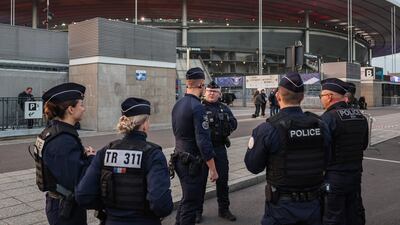
French police officers patrol outside the Stade de France stadium. AFP -

Police check a man draped in an Israeli flag next to the Stade de France. AP -
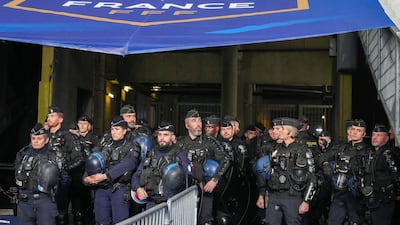
Police officers stand near the pitch before the match between France and Israel. AP -

Police officers watch spectators arriving outside the Stade de France. AP -
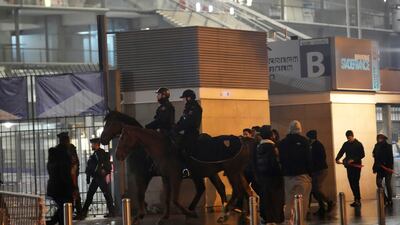
Mounted police patrol by the Stade de France. AP -

Protesters in Aubervilliers, in the northern outskirts of Paris, rally against holding the football match between Israel and France. AFP -
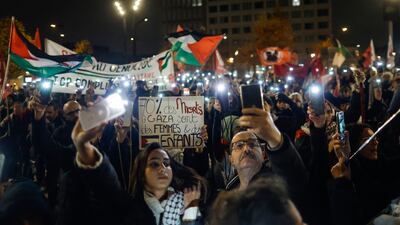
The demonstrators hold up smartphones with lights activated in Aubervilliers. AFP -

Protesters hold a Palestinian flag as they face French police officers after the demonstration. AFP -
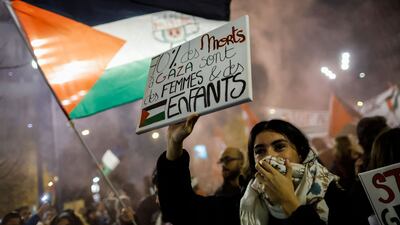
A protester holds a placard reading: "Seventy per cent of the dead in Gaza are women and children." AFP -
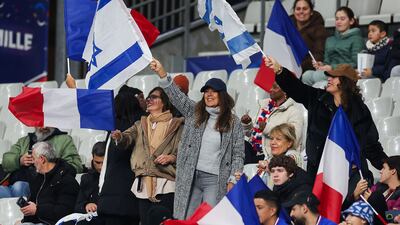
French and Israeli supporters wave flags before the match at the Stade de France. AFP -
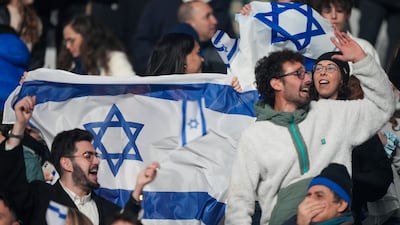
Israel supporters react during the match. AP -
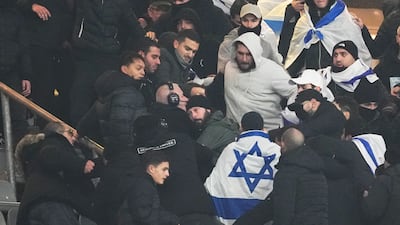
Fans argue in the stands during the match. AP -
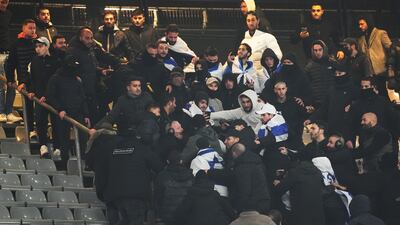
Fans jostle in the stands during the France-Israel match. AP -

Israeli and French supporters leave after the game. AP -

Riot police officers patrol by the Stade de France after the match. AP


Israel supporters said they were French Jews who did not hold Israeli nationality and wanted to celebrate their Jewish identity without fear against a backdrop of a surge in anti-Semitic attacks in the past year.
"Jews find it hard to own up to the fact that they're Jewish and take a clear stand on the Israel-Palestine conflict," said Kevin Elbaze, 33, a pharmacist. "It feels good to be together."
"Many Jews were too afraid to come due to what happened in Amsterdam last week," Mr Elbaze told The National. "I think that those who came anyway have a very strong sense of identity."
French authorities posted nearly three times more security than usual – 4,000 policemen and gendarmes – to ensure that there would be no repeat of the violence of last week in Amsterdam, in connection with a Europa League match between Ajax and Maccabi Tel Aviv.
France has the largest Jewish and Muslim population in Europe, and the October 7 Hamas-led attacks against Israel, as well as Israel's ensuing wars in Gaza and Lebanon, have become a political topic.
There was a large presence of anti-riot police inside the stadium, who closed off much access to the area where most Israel supporters were seated. At half-time, the supporters sang songs in support of Israel as well as France's national anthem.
"We finally have the opportunity in France to be able to show that we support Israel," said doctor Dan Bensa, 30, as he walked draped in an Israeli flag towards his seat. "Tonight we are here to show that we are not here for violence, we are not here for hatred, we just want to support our people and the only Hebrew state in the world, Israel."
On the pro-France benches, it was a message that was broadly understood but that did not gather much enthusiasm. "It's a pity. This was supposed to be about sports that it's been spoiled by politics," said Jeremy Malet, 30, a jurist. "We're not here to judge what [Israeli Prime Minister Benjamin] Netanyahu does."
Some pro-Israel supporters said that chants about hostages were directed at President Emmanuel Macron, who had come to watch the match alongside cabinet members and his predecessors, Nicolas Sarkozy and Francois Hollande. Two of the remaining hostages hold French nationality.
Mr Malet said he had bought tickets to the match because they were cheap and he was surprised at how empty the stadium was. Only 17,000 out of 80,000 people attended the game. His seats cost €29 ($30) and were close to the front rows that had been closed to the public with metal grids fitted with spikes.
"I think a lot of people were too afraid to come," he said.
Speaking shortly before the end of the match, Mr Malet struggled to find something positive to say but hoped for a good score for France. The 0-0 was probably an additional disappointment.
The match also drew criticism from some left-wing politicians and activists who had called for a boycott over the Israeli military's conduct in Gaza and Lebanon.
At a pro-Palestine protest a few kilometres away from the Stade de France, dozens of protesters gathered to express their opposition to the match before the event.
"There's a problem with the fact that a country like Israel, which is committing a genocide that we can all see on our smartphones, is coming to play a match in France," said Raafet Gad Elhak, a Frenchman who said his father was Palestinian.
He was referring the International Court of Justice's finding in January that it was "plausible" that Israel was committing a genocide in Gaza – a finding that is often heard among pro-Palestinian circles but is rejected by Israel.
More than 43,700 people have been killed by Israel in Gaza since the Hamas-led October 7 attacks against Israel in which 1,200 lost their lives. In Lebanon, where Israel extended its bombing campaign in September, almost 3,500 people have died.
-
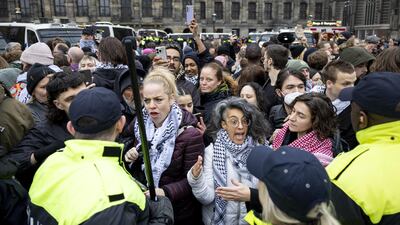
Pro-Palestinian protesters confront Dutch police in Dam Square in Amsterdam on Sunday. EPA -
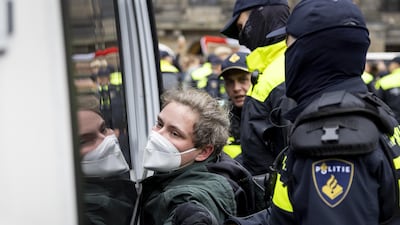
A protester is arrested. Demonstrators called for an end to Israel’s war in Gaza and voiced opposition to a ban on protests. EPA -
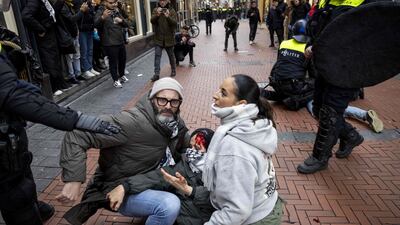
An injured protester near Dam Square. Demonstrations were banned in Amsterdam after Israeli football fans were targeted in attacks on Thursday night after a match between Maccabi Tel Aviv and Ajax. AFP -

Pro-Palestinian protesters on Dam Square. Police said there had also been provocative behaviour from Maccabi Tel Aviv fans in the lead up Thursday’s match. EPA -
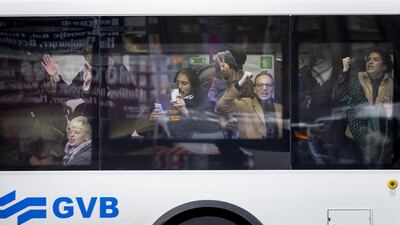
Demonstrators are removed by police in a bus. EPA -

A pro-Palestinian protester with police in Dam Square in Amsterdam. EPA


In the crowd, there were parallels made between Israel and Russia, which was ostracised from the Olympic Games this summer in France because of its invasion of Ukraine. There was also criticism against Mr Macron and France's political leadership for supporting Israel despite recent diplomatic tension between the two countries.
"Macron's line isn't clear. Nothing has actually changed in France-Israel relations. We continue selling them weapons," said Lou, 27, a protester carrying a Palestinian flag.
Around the Stade de France, locals appeared less involved in politics. “This has become a really political game, but the football calendar was set a long time ago,” said Romain Bell, 26.
Ensuring that the game went ahead was welcomed by Nicolas Cornec, a tax inspector who works near the Stade de France.
“I think it is important that despite the tensions, international events concerning Israel are maintained,” Mr Cornec said. "Because life goes on."

