


Solar power is leading the charge towards a more sustainable future with the number of new installations across the globe surging by 83 per cent in 2023 and continuing a remarkable rise this year.
The solar power boom comes amid increasing demand and lower costs as governments and businesses buy into the renewable energy source as a crucial tool in the fight against climate change.
It was during crunch Cop28 talks in Dubai last year that the international community pledged to triple renewable energy capacity by 2030, with solar increasingly being viewed as the way forward to keeping those ambitions on track.
The Global Renewables and Energy Efficiency Pledge, part of the UAE Consensus signed off in Dubai, translates to the world having a renewable energy capacity of 11,000 gigawatts (GW, where one gigawatt is one billion watts) at the end of the decade.
This is considered important if average temperature increases are to be limited to 1.5° C above pre-industrial levels, the target set by the 2015 Paris Agreement.
According to the International Renewable Energy Agency (Irena), at the end of 2023, shortly after Cop28 finished, global renewable energy capacity stood at 3,870GW, of which 1,419GW was solar power, more than any other renewable.
Not far short of one third of the global solar capacity at the end of last year – 450GW – was installed in 2023 alone.
Last year’s total of new solar power installations was 86 per cent more than was installed the previous year and almost twice as much as was forecast at one point by Bloomberg New Energy Finance (BNEF), a research organisation.
China key to solar surge
The upwards trajectory is continuing in 2024, with Ember, another research organisation, recently reporting that 29 per cent more solar power capacity was installed in the first seven months of this year compared to the same period last year. If the trend continues, total new solar power installations for 2024 will reach 593GW.
What happens in China, a country that accounts for around two-fifths of solar capacity and which was responsible for 57 per cent of new solar capacity in 2023, is central to the world meeting the 2030 renewable energy target.

Lauri Myllyvirta, a senior fellow at the Asia Policy Institute and a co-founder of the Centre for Research on Energy and Clean Air, said that from January to August, China alone added 143GW of solar power capacity.
This, he told The National, equals the combined solar power capacity of Germany, Spain and Italy, the EU’s top three countries when it comes to generating energy from the sun.
"The growth is driven by increasing supply and falling price of solar panels, making investments economically attractive and leading to strong interest from local governments, banks, investors and project developers," Mr Myllyvirta said.
"Capacity additions this year continue to be split 50-50 between large, centralised solar farms and distributed solar power on rooftops and industrial premises."
He said that the large solar farms were promoted in China by policies that allocated large swathes of desert, abandoned mining areas and other uninhabited land for solar power and wind power development, and that co-ordinated the building of solar power capacity with the construction of transmission lines and other infrastructure.
The growth in distributed solar power is, he said, enabled by a separate programme that targets a given percentage of rooftops in a particular area, coordinating the engineering, procurement, negotiations and contracting with building owners and sources of finance. It creates what he described as "a social momentum among building owners".
"This is a model that could be widely applicable outside of China as well," Mr Myllyvirta said.
Invest in the future
-

Solar-powered street lights at Modhera village, where a 6-megawatt PV power plant is connected to rooftop solar panels. All photos: Taniya Dutta / The National -
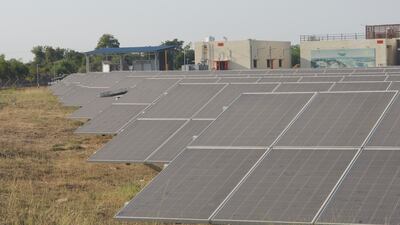
The solar panels are installed on about 1,350 houses in the village, providing round-the-clock electricity -

The Sun Temple in Modhera also runs on solar power in the evenings -
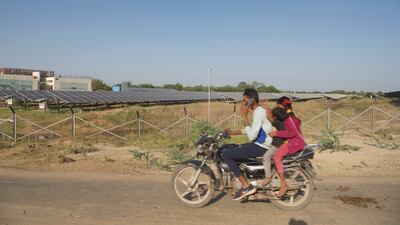
The solar power plant in Sujanpur, near Modhera, is seen in the background -

The 11th-century Sun Temple receives solar-powered electricity every day -
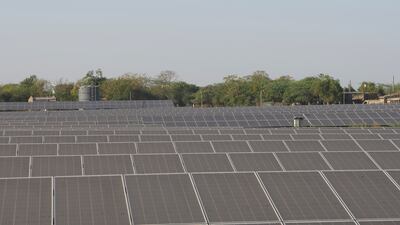
The project was launched after the village, like many others in India, was beset by regular power cuts -
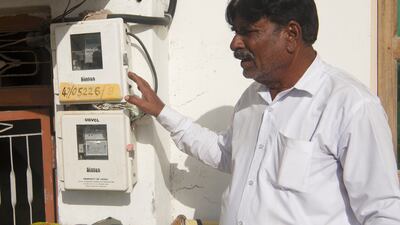
Pathan Sikandar Khan, a farmer in Modhera, shows us the electricity meter at his home -
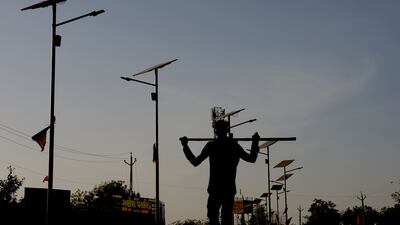
Modhera is the first village in India to run completely on solar power -
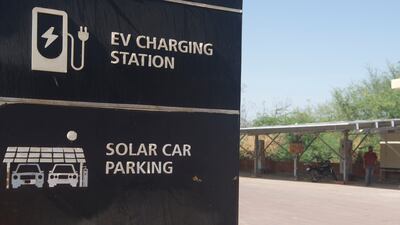
The Sun Temple site has solar-powered electric vehicle charging stations -
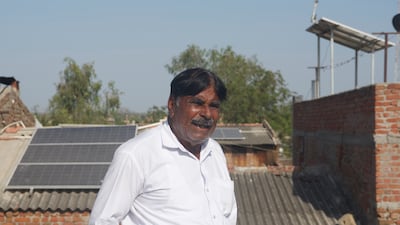
Mr Khan says the installations have reduced power expenses for most households by anything between 40 and 100 per cent -

The scheme has transformed life for the 1,350 families in the village, which now has 24-hour electricity – and no power cuts -

The once dark streets are illuminated by solar-powered lights at night


Tying in with this, Asher Minns, executive director of the Tyndall Centre for Climate Change Research at the University of East Anglia in the UK, said that it was important that large-scale solar power projects were mirrored by many small-scale schemes.
"It’s great that deployment is increasing, but it ought to be on every building, every rooftop that faces in the right way, every piece of land that’s in a particular location," he said. Indeed many analysts say that, for all the rapid roll-out of solar power capacity, there is scope for even greater ambition.
Walter Leal, professor of climate change management at the Hamburg University of Applied Sciences in Germany, and of environment and technology at Manchester Metropolitan University in the UK, said that solar power technology was "mature", but that governments were not providing enough incentives to encourage installations.
"We have the technology; the price has gone down significantly because of economies of scale. We should make much more advantage of solar energy," he said.
" … Tax breaks encourage the companies to invest … By providing financial incentives, we can trigger more investment."
While China is seeing what Mr Myllyvirta described as "unprecedented additions of clean power generation from new solar and wind", it is also experiencing heavy increases in demand for electricity, so the country’s power-sector carbon emissions have stabilised but not declined.
"They have sufficed to cover demand growth, thereby preventing a further increase in power generation from coal and gas and in CO2 emissions," Mr Myllyvirta said, adding, however, that China’s overall carbon emissions, when all sectors were taken into account, were shrinking.
"China’s total CO2 emissions have been falling since March, because emissions outside of the power sector have declined," he said.
"This is due to falling construction volumes, which reduce the demand for steel and cement, and for diesel. As power demand is expected to slow down after the rapid growth period of the past few years, this should lead to power sector emissions starting to fall as well."
Indeed, in part thanks to the energy transition, emissions from energy generation globally are likely to peak this year.
In its Energy Transition Outlook report published this month, the risk-management consultancy DNV said that emissions from energy production "are at the cusp of a prolonged period of decline for the first time since the Industrial Revolution".
Cutting emissions
The organisation forecasts a halving of these emissions by the middle of this century, but cautions that this "is a long way short of requirements of the Paris Agreement" and forecasts global temperatures will rise 2.2°C above pre-industrial levels by 2100.
Nonetheless, the increases in solar power capacity are seen as positive for the climate, with Ember reporting that both BNEF and SolarPower Europe now forecast that the sector will grow fast enough to help the world achieve a tripling of renewable energy capacity by 2030.
Thanks to the past two years having seen very brisk growth in the rate of solar power installations, only single-digit annual percentage increases are needed from next year onwards to achieve the target.
By the end of the decade, solar power could account for a quarter of the world’s electricity generation capacity.
"The massive step up in solar capacity installations in 2023 and 2024 has shifted perceptions around solar’s role in the energy transition," Ember said last month.
So the growth of solar power could be a – perhaps rare – piece of good news as the world wrestles with the challenge of climate change.

