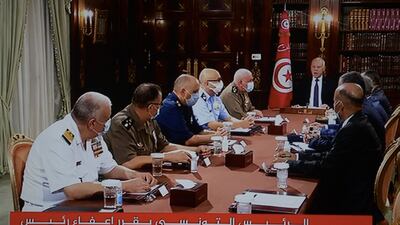
Tunisian President Kais Saied speaking on Monday. Photo: AP

Tunisia's president Kais Saied suspends constitution


Erin Clare Brown
  • English
  • Arabic

Tunisian President Kais Saied on Wednesday announced a partial suspension of the country's constitution and the extension of extraordinary measures which have barred Parliament from performing its duties and revoking the immunity of its members.

The announcement, which was made on the Presidency's Facebook page, stated that sections of the constitution in conflict with the President's extraordinary measures would be suspended, along with the work of Parliament. In its absence presidential decrees can serve as legislation and MPs would no longer be paid their salaries or enjoy any parliamentary privileges, the statement said.

It also said Mr Saied would form a committee to prepare amendments to Tunisia's constitution, one of the leader's primary objectives since the earliest days of his campaign.

Critics accused Mr Saied of a coup in July, when he sacked the prime minister, froze the activities of parliament and assumed sole authority of the country after invoking an article in the constitution which enables the president to implement a 30-day exceptional period in times of imminent danger to the country.

In the absence of a Constitutional Court, which had not been seated in part due to the president's rejection of a law changing how the judges would be appointed, Mr Saied extended those measures indefinitely in August.

Mr Saied has repeatedly affirmed that his actions are in line with the governing principals of the constitution.

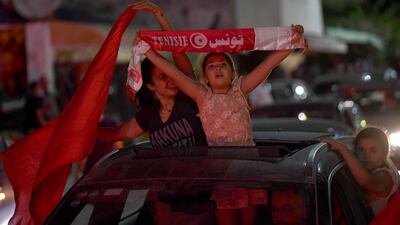
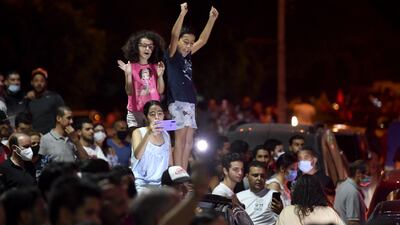
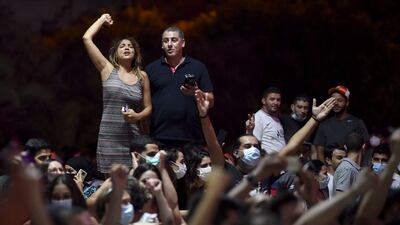
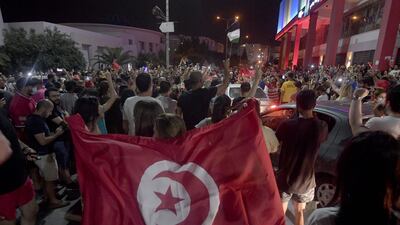
  • People celebrate on the streets after Tunisian President Kais Saied announced the dissolution of parliament and Prime Minister Hichem Mechichi's government in Tunis on July 25, 2021.
    People celebrate on the streets after Tunisian President Kais Saied announced the dissolution of parliament and Prime Minister Hichem Mechichi's government in Tunis on July 25, 2021.
  • The president announced the suspension of Tunisia's parliament following a day of protests against the ruling party.
    The president announced the suspension of Tunisia's parliament following a day of protests against the ruling party.
  • Thousands of Tunisians waved flags and honked horns in cities and towns across the country.
    Thousands of Tunisians waved flags and honked horns in cities and towns across the country.
  • Crowds sang the national anthem.
    Crowds sang the national anthem.
  • Tunisia has been in a political crisis for months, as the country tackles an economic crunch and the pandemic.
    Tunisia has been in a political crisis for months, as the country tackles an economic crunch and the pandemic.
  • The street celebrations were held under the watch of military personnel, reports said.
    The street celebrations were held under the watch of military personnel, reports said.
  • A woman raises the Tunisian flag.
    A woman raises the Tunisian flag.
  • President Kais Saied, flanked by military officials, announces the dissolution of parliament and Prime Minister Mechichi's government.
    President Kais Saied, flanked by military officials, announces the dissolution of parliament and Prime Minister Mechichi's government.
  • Mr Saied said he would assume executive authority with the assistance of a new prime minister.
    Mr Saied said he would assume executive authority with the assistance of a new prime minister.

Monica Marks, an assistant professor of Middle East politics at NYU Abu Dhabi and a close watcher of Tunisia, says that Mr Saied's actions put the country’s first democratically representative constitution in jeopardy.

"Tunisia’s constitution passed in 2014 with near unanimous support after years of parliamentary wrangling and exhaustive consultations with Tunisian civil society," she said.

If the President pushes through changes by decree it risks destroying "something that so many Tunisians fought incredibly hard to achieve after decades of dictatorship".

Earlier this month, palace aide Walid Hajjem told Sky News Arabia that the president intended to put forward amendments to the 2014 constitution, which was drafted by a constituent assembly in the wake of the 2011 revolution, for a nationwide referendum.

The move has been criticised by both allies and opponents of Mr Saied, who are calling for dialogue and inclusion in creating a new political system.

Several parties that initially backed Mr Saied after July 25th have in recent weeks distanced themselves from the president as he has grown more isolated and failed to appoint a new prime minister despite repeated assurances he would do so.

Mohamed Abbou, co-founder of centre-left party Attayar, this week said on Jawhara FM radio that a referendum could render Mr Saied "illegitimate". He criticised the president for casting aside a constitution he swore an oath to defend.

Tunisia's powerful General Tunisian Workers' Union (UGTT) has also rejected unilateral amendments to the country's constitution. Earlier in the month they put forward their own detailed roadmap out of the crisis, including updating electoral law and holding snap elections, but reaffirmed their commitment to the 2014 constitution.


Founders: Abdulmajeed Alsukhan, Turki Bin Zarah and Abdulmohsen Albabtain.

Based: Riyadh

Offices: UAE, Vietnam and Germany

Founded: September, 2020

Number of employees: 70

Sector: FinTech, online payment solutions

Funding to date: $116m in two funding rounds  

Investors: Checkout.com, Impact46, Vision Ventures, Wealth Well, Seedra, Khwarizmi, Hala Ventures, Nama Ventures and family offices

COMPANY PROFILE
Name: HyperSpace
 
Started: 2020
 
Founders: Alexander Heller, Rama Allen and Desi Gonzalez
 
Based: Dubai, UAE
 
Sector: Entertainment 
 
Number of staff: 210 
 
Investment raised: $75 million from investors including Galaxy Interactive, Riyadh Season, Sega Ventures and Apis Venture Partners
How to wear a kandura

Dos

  • Wear the right fabric for the right season and occasion 
  • Always ask for the dress code if you don’t know
  • Wear a white kandura, white ghutra / shemagh (headwear) and black shoes for work 
  • Wear 100 per cent cotton under the kandura as most fabrics are polyester

Don’ts 

  • Wear hamdania for work, always wear a ghutra and agal 
  • Buy a kandura only based on how it feels; ask questions about the fabric and understand what you are buying
THE BIO

Favourite car: Koenigsegg Agera RS or Renault Trezor concept car.

Favourite book: I Am Pilgrim by Terry Hayes or Red Notice by Bill Browder.

Biggest inspiration: My husband Nik. He really got me through a lot with his positivity.

Favourite holiday destination: Being at home in Australia, as I travel all over the world for work. It’s great to just hang out with my husband and family.


Ten tax points to be aware of in 2026

1. Domestic VAT refund amendments: request your refund within five years

If a business does not apply for the refund on time, they lose their credit.

2. E-invoicing in the UAE

Businesses should continue preparing for the implementation of e-invoicing in the UAE, with 2026 a preparation and transition period ahead of phased mandatory adoption. 

3. More tax audits

Tax authorities are increasingly using data already available across multiple filings to identify audit risks. 

4. More beneficial VAT and excise tax penalty regime

Tax disputes are expected to become more frequent and more structured, with clearer administrative objection and appeal processes. The UAE has adopted a new penalty regime for VAT and excise disputes, which now mirrors the penalty regime for corporate tax.

5. Greater emphasis on statutory audit

There is a greater need for the accuracy of financial statements. The International Financial Reporting Standards standards need to be strictly adhered to and, as a result, the quality of the audits will need to increase.

6. Further transfer pricing enforcement

Transfer pricing enforcement, which refers to the practice of establishing prices for internal transactions between related entities, is expected to broaden in scope. The UAE will shortly open the possibility to negotiate advance pricing agreements, or essentially rulings for transfer pricing purposes. 

7. Limited time periods for audits

Recent amendments also introduce a default five-year limitation period for tax audits and assessments, subject to specific statutory exceptions. While the standard audit and assessment period is five years, this may be extended to up to 15 years in cases involving fraud or tax evasion. 

8. Pillar 2 implementation 

Many multinational groups will begin to feel the practical effect of the Domestic Minimum Top-Up Tax (DMTT), the UAE's implementation of the OECD’s global minimum tax under Pillar 2. While the rules apply for financial years starting on or after January 1, 2025, it is 2026 that marks the transition to an operational phase.

9. Reduced compliance obligations for imported goods and services

Businesses that apply the reverse-charge mechanism for VAT purposes in the UAE may benefit from reduced compliance obligations. 

10. Substance and CbC reporting focus

Tax authorities are expected to continue strengthening the enforcement of economic substance and Country-by-Country (CbC) reporting frameworks. In the UAE, these regimes are increasingly being used as risk-assessment tools, providing tax authorities with a comprehensive view of multinational groups’ global footprints and enabling them to assess whether profits are aligned with real economic activity. 

Contributed by Thomas Vanhee and Hend Rashwan, Aurifer

Updated: September 22, 2021, 9:47 PM