

Live updates: Follow the latest news on Israel-Gaza
French President Emmanuel Macron is signalling a hardening of his position on Israel in the war in Gaza as officials increasingly criticise the high death toll after an initial period of support for its military response to the October 7 attacks.
Mr Macron was one of the few western heads of state to publicly blame Israel for the death of 112 Palestinians in the so-called flour massacre last week after Israeli forces opened fire on a crowd gathered around an aid convoy in northern Gaza.
The President's condemnation was followed by strong words from French Foreign Minister Stephane Sejourne, who said Israel was responsible for the “unjustifiable” humanitarian crisis in Gaza.
“This reflects a maturation of the French diplomatic stance driven by its will to preserve good relationships with its partners in the region,“ Karim El Mufti, professor of political science and international law at Science Po Paris, told The National.
former official at the French Ministry of Defence
“Israel's position is increasingly criticised in the West and European elections are looming."
For many, however, France’s attempts at maintaining a distinctive voice in Europe on the Israel-Palestine conflict has been diluted by a series of muddled reactions to the latest war.
“France has tried to maintain this double messaging where initially – particularly in October and November – it stood clearly with Israel,” said Nadim Houry, director of Paris-based think tank Arab Reform Initiative.
“Then once it became clear in France’s view that Israel is killing a large number of civilians, it has tried to recalibrate that message. But this has not necessarily helped France find a voice in the region.”
Mr Macron’s initial unconditional support for Israel, and particularly a proposal for an anti-Hamas coalition modelled on the international alliance fighting ISIS in Iraq and Syria, was viewed by many diplomats and Arab partners as disconnected from realities on the ground.
A partial pivot
Many say this initial response has largely overshadowed attempts to recalibrate official messages on the conflict.
Yet over the past few months, France has repeatedly called for a ceasefire. Paris has also co-ordinated with Qatar to send medical aid to Gaza, while also working with Jordan to drop humanitarian aid into the enclave by parachute.
Last month, Mr Macron hosted Arab leaders critical of Israel's military operation in Gaza, including King Abdullah and Qatar's Emir Sheikh Tamim.
At a state dinner, Mr Macron listened to Sheikh Tamim give a speech mentioning the “genocide” of Palestinians in Gaza – a claim that has gained traction since the International Court of Justice said in late January that describing Israel's actions in Gaza as genocide was “plausible”.
Mr Macron, who did not use the term genocide, thanked Qatar for its diplomatic role in the conflict. Doha is involved in ceasefire and hostage negotiations.
France and Qatar jointly stated their opposition to Israel expanding its military operation to Rafah in southern Gaza, where more than a million people have sought refuge.

French tradition
Proposals such as the anti-Hamas coalition also represented further distancing from France’s so-called “Gaullist foreign policy." France was never a heavyweight in terms of the Israel-Palestine conflict, compared with the US, but it has in the past tried to assert a an independent voice.
The last French president to embody such a position was Jacques Chirac. His sharp reprimand in October 1996 of Israeli security services for barring him access to Palestinians during a walk through Jerusalem’s Old City cemented his country’s pro-Arab reputation.
Although they strengthened relations with Gulf countries, his successors Nicolas Sarkozy and Francois Hollande were never viewed as strongly pro-Palestinian.
Today, voices that used to be mainstream, such as that of former prime minister Dominique de Villepin, are reportedly viewed with nostalgia by some diplomats. though not publicly endorsed by his former centre-right political family.
Under Mr Chirac's presidency, Mr de Villepin, at the time foreign minister, addressed the UN Security Council in 2003 to oppose the war in Iraq. The US-led invasion is believed to have cost the lives of hundreds of thousands of Iraqis.
A few days after the Hamas-led attacks that killed about 1,200 people in Israel triggered the deadly bombings of Gaza, Mr de Villepin was a lone voice when he warned Israel against “indiscriminate revenge”.
He also recognised the deep trauma caused by the attacks in Israel and parallels with the Holocaust in the Second World War.
Israel’s response has so far killed more than 30,500 people and wounded at least 71,000.
Mr de Villepin was recently accused of anti-Semitism for saying that “financial rules” in the cultural sector had led to the ostracisation of pro-Palestinian actresses in the US such as Susan Sarandon and Bella Hadid.
Mr Macron’s positioning in the first weeks of the war also caused frustration among French diplomats.
Newspaper Le Figaro revealed a dozen ambassadors to the Middle East had taken the unprecedented move to write a letter, which was not publicised, to the Elysee Palace and the Foreign Ministry expressing their regret at Mr Macron’s apparent pro-Israel bias.
Daily Le Monde reported difficult conversations between Mr Macron and Arab leaders including with Jordan’s King Abdallah in late October.
“There is an increasing and unprecedented dissent between the political class and French society; opinion-makers, intellectuals, NGOs are taking an openly staunch stance against Israel,” Pierre Conesa, a former high official at the Ministry of Defence, told The National.
Mr El Mufti said French foreign policy in the Levant suffered from a marginalisation of diplomats’ expertise and Mr Macron’s centralised decision-making style. “It's a total failure,” he said.

Some say that distinguishing French policy from other Western players has become difficult as they adopt similar policies. Like the US, Paris has imposed sanctions on extremist Israeli settlers in the West Bank.
Mr Sejourne told Le Monde on Saturday that targeting 28 settlers was “more than other countries have done." But France has not publicised their names, unlike Washington which sanctioned four Israelis for violent behaviour towards Palestinians in the occupied West Bank.
While French airdrops caused little comment, a similar recent US move triggered criticism from humanitarian organisations that described the parachuted aid delivery as ineffective and hypocritical due to the US blocking resolutions at the UN Security Council calling for a ceasefire.
At EU level, France has also sought to maintain a middle ground. It has not backed more critical voices of Israel such as Ireland that have pushed for retaliatory European measures, including the review of a trade agreement with Israel, due to suspicions of human rights breaches in Gaza.
The bloc is divided on the conflict. Germany remains Israel’s strongest ally on the continent.
But the death of at least 112 Palestinians in northern Gaza as they tried to access food being distributed under the supervision of the Israeli army seemed to trigger a stronger response from France than from its Western partners.
Unlike others, Mr Macron laid the blame squarely on Israel.
“Deep indignation at the images coming from Gaza where civilians have been targeted by Israeli soldiers,” Mr Macron wrote on X on Friday. “I express my strongest condemnation of these shootings and call for truth, justice and respect for international law.”
Humanitarian organisations say a famine is spreading in the area due to Israel blocking the entrance of aid.
The Israeli army has said an initial review showed most Palestinians died as a result of a stampede. This contradicts reports from Palestinian doctors, who said they saw dozens of civilians with gunshot wounds.
Other western leaders have issued carefully worded statements that did not point the finger at Israel and called for an investigation. UK Foreign Secretary David Cameron said “the deaths of people in Gaza waiting for an aid convoy … were horrific”.
Mr Conesa said: “Mr Macron is a pragmatic. This affords him the flexibility to shift his stance and return to a more Gaullist approach to diplomacy at any given moment."
Yet France’s stronger condemnation of Israel compared to others is viewed by others as too little, too late.
“France has become emblematic of unstructured, amnesic foreign policy: each move belongs to a news cycle, with no overall coherence,” Peter Harling, director of the Beirut-based Synaps think tank, told The National.
“People will remember what France did to egg Israel on over several months. Putting the blame on Israel for behaviour that France endorsed for so long won't make much of a dent on people who are not, precisely, amnesiacs.”
Hezbollah tensions
The consequences of Mr Macron's choices in the Levant are also apparent in Lebanon where, despite decades of experience in maintaining an open dialogue with Hezbollah's political wing, relations are becoming increasingly tense as fears of a spillover of the war in Gaza increase.
This comes about four years after Mr Macron unsuccessfully tried to resolve Lebanon's financial crisis and endemic corruption after a fatal explosion at the port of Beirut in August 2020.
Lebanese politicians, including Hezbollah leaders, reportedly dismissed a recent French proposal for the group to pull back to about 10km from the border, with Israel to allow the enforcement of UN Resolution 1701 that ended a 2006 war with Hezbollah but was never fully put in place.
“France is about to become an enemy,” wrote Ibrahim Al Amine, editor-in-chief of pro-Hezbollah newspaper Al Akhbar in an opinion headline from December 19.

He criticised France's “war against the Resistance in Lebanon and in Palestine” and accused it of acting as a “proxy” for the West, led by the US and Israel.
In a speech in December, Hezbollah leader Hassan Nasrallah drew a comparison between the resistance of Palestinians and that of Algeria when it was a French colony from 1830 to 1962.
“Today's Algeria would continue to be subjected to slavery, colonialism, oppression and occupation,” Mr Nasrallah said.
Mr El Mufti said this was “not an innocent reference”.

“The mention of France colonialism past was a deliberate jab. France is becoming, for the first time, persona non grata,” he said.
Political tensions between France and the Arab world have so far been contained.
A senior executive at a French conglomerate, who works in the Middle East, said although some French retail businesses had been affected by a popular boycott of western consumer brands, the official position from Paris had not changed.
“It would be a whole different ball game if, for example, Arab countries started cancelling French weapons orders or stopped awarding them large infrastructure or oil contracts,” said the executive.
The popular moral outrage, they said, “may have stopped some people from buying French cheese but otherwise French-Arab ties are unaffected”.
Latest from the Israel-Gaza war – in pictures
-
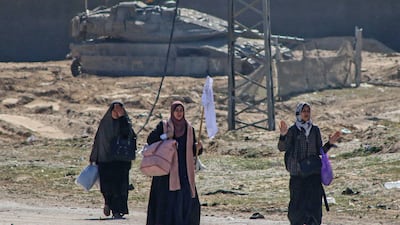
Displaced Palestinians hold a white flag as they pass an Israeli tank position while fleeing the Hamad Town district of Khan Younis. Bloomberg -
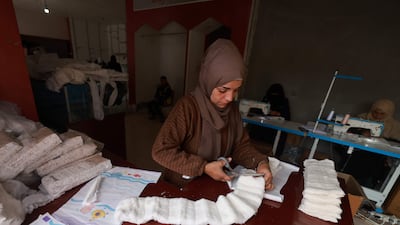
A Palestinian woman cuts material to be used for sewing nappies at a workshop in Rafah. AFP -
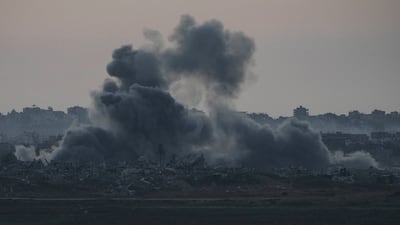
Smoke rises following an explosion in Gaza, as seen from southern Israel. AP -

Parachutes carrying relief for Palestinians drop from an Egyptian Air Force cargo plane over central Gaza. Bloomberg -
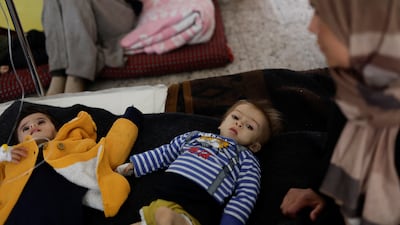
A Palestinian boy who is suffering from malnutrition is treated at a healthcare centre amid widespread hunger. Reuters -
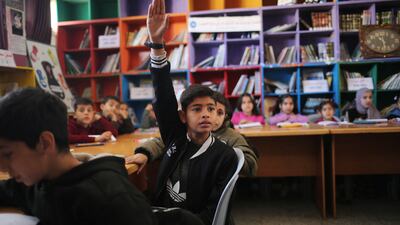
Palestinian children attend an English class in the library of the school housing displaced people in Rafah, the southern Gaza Strip. AFP -
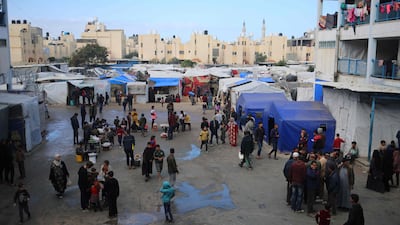
An UNRWA-run school housing displaced Palestinians in Rafah. AFP -
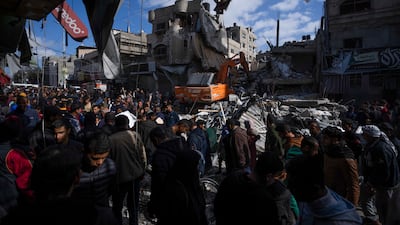
Palestinians search for bodies and survivors in the rubble of a residential building destroyed in an Israeli air strike in Rafah. AP -
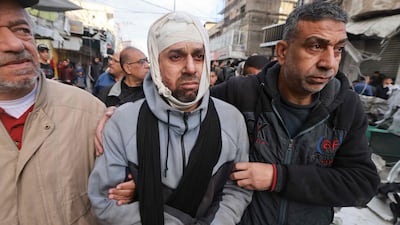
A wounded Palestinian man who lost his wife and daughter walks past a neighbours' house destroyed by Israeli bombing in Rafah. AFP -
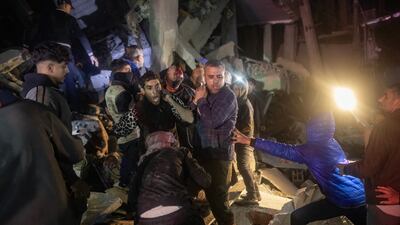
An injured man is rescued from the rubble after an Israeli air strike on the Rafah camp in Gaza. EPA -
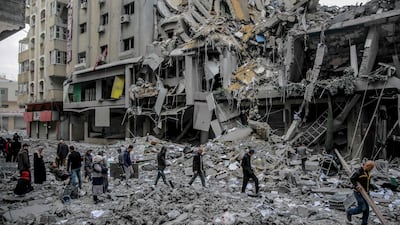
Palestinians walk amid the rubble of houses destroyed by the Israeli bombardment of Gaza city. AFP -

Aid is dropped into Gaza from US military aircraft. Reuters -
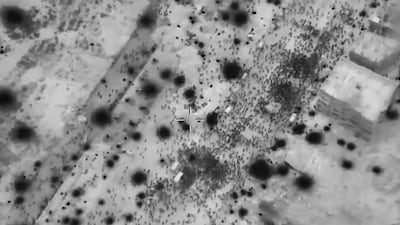
Palestinians gather at air lorries in Gaza. More than 100 were killed when Israeli troops opened fire. AP -
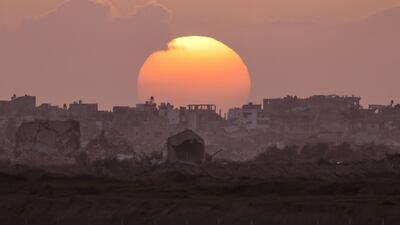
The sun sets behind destroyed buildings in Gaza. AFP -

A Palestinian man enters a heavily damaged house following an Israeli strike in Rafah, in the southern Gaza Strip. AFP -
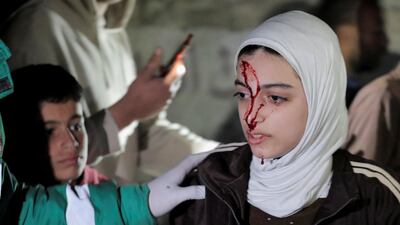
A wounded Palestinian is assisted at the site of an Israeli strike in Deir Al Balah, in the central Gaza Strip. Reuters -
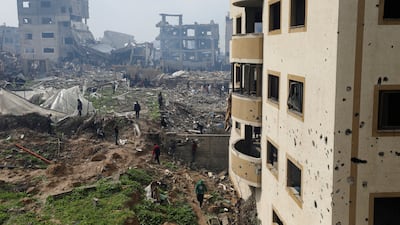
Palestinians gather in the hope of getting bags of flour carried by air lorries near an Israeli checkpoint in Gaza city, as the enclave's residents face crisis levels of hunger. Reuters -

Palestinian children wait to receive food cooked by a charity kitchen as the conflict between Israel and Hamas continues in Gaza. Reuters -
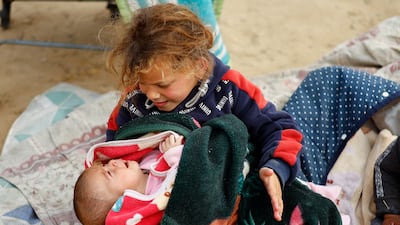
A displaced Palestinian child holds a crying baby in a camp in Rafah, in the southern Gaza Strip. Reuters



