


Live updates: Follow the latest news on Israel-Gaza
Hamas's attack on Israel was the product of a meticulously planned operation that was set in motion at least a year ago and made possible largely due to financial support, weapons knowledge and training from Iran, experts and former intelligence officials have said.
While publicly praising Hamas's Al Aqsa Flood operation that has led to the deaths of more than 2,000 people in Israel and Gaza, Tehran has denied any involvement. So far, the US has said there is no “smoking gun” linking Tehran directly to the attack, though it has said Iran is “complicit”.
Tehran's lengthy and somewhat complex ties to Hamas are well documented.
The militant group temporarily distanced itself from Iran for several years due to Tehran's backing of Syria's President Bashar Al Assad during the Syrian civil war in 2011.
Tension between Hamas and Tehran escalated in 2015, when Hamas signalled its backing for the Saudi Arabia-led military campaign in Yemen against the Houthis, a militant rebel group supported by Iran.
Eventually, Hamas realigned itself with Tehran and has openly engaged in dialogue with Iran regarding its military objectives.
According to the Washington-based research institute the Foundation for Defence of Democracies, Iran has built a network of at least 19 armed groups on Israel’s borders, including in Gaza, the West Bank, Lebanon and Syria.
The largest of these organisations are Hamas and Islamic Jihad, which are based in Gaza, and Hezbollah in Lebanon.
Military co-operation between Hamas and Iran grew over the past decade under the control of two prominent figures: Yahya Sinwar, the head of the organisation in Gaza, and Saleh Aruri, the head of Hamas in the West Bank.
“They both promote extreme radical and militant policy and therefore promote relations with Iran,” Michael Milshtein, the former head of the Department for Palestinian Affairs in the Israeli military’s intelligence directorate, told The National.
Mr Sinwar, who once led Hamas's military wing and spent 22 years in an Israeli prison for the killing of two Israeli soldiers, currently oversees the group’s affairs in Gaza.
However, Mohammed Deif, the supreme military commander of the military wing of Hamas and Israel’s most wanted man, is said to be the architect behind the unprecedented assault on Israel.
A survivor of seven Israeli assassination attempts, most recently in 2021, Mr Deif never appears in public.
He is a military man who “opposes political solutions with Israel and disdains the political game of compromise and co-operation”, Omri Brinner, Middle East expert at the International Team for the Study of Security, told The National.
Seized power in 2006
A spin-off of the Palestinian branch of the Muslim Brotherhood, Hamas, a US-designated terrorist organisation, has controlled the Gaza Strip ever since it ousted loyalists of Palestinian President Mahmoud Abbas in elections in 2006.
Established in 1987 during the First Intifada by Sheikh Ahmed Yassin, a Palestinian cleric, Hamas became a prominent political force, with Fatah as its primary adversary.
The group's relationship with Iran developed in 1992, when Israel carried out a mass expulsion of 400 Hamas and Palestinian Islamic Jihad leaders to southern Lebanon.
“They made initial contacts with Hezbollah at that time and were in Lebanon for about a year,” Michael Eisenstadt, director of the Washington Institute’s Military and Security Studies Programme, told The National.
The relationship, which was more an “alliance of convenience”, ramped up after the Oslo Accords in 1993, he noted. Both Hamas and Islamic Jihad sought to undermine and scuttle peace negotiations between the Palestinians and Israel.
Hamas wanted an independent Palestinian state along the pre-Arab-Israeli War of 1967 “Green Line” and Iran was willing to help them militarily to undermine the peace process – and they were willing to take help from wherever it came, said Mr Eisenstadt.
The militant Palestinian group “that relies on repression and savagery, both internal and external, in order to survive” carried out a suicide bombing for the first time in April 1993, five months before Palestine Liberation Organisation leader Yasser Arafat and Israeli Prime Minister Yitzhak Rabin signed the Oslo Accords.
For nearly two decades, Iranian rockets and weaponry were transported from to Sudan, and then smuggled through tunnels underneath the Egyptian border into Gaza.
But in 2014, the Egyptian military closed numerous tunnels linking Sinai to Gaza, prompting Iran to assist Hamas in developing “indigenous” capabilities so they would be able to continue weapons production.
Iran's role under scrutiny
While there is “no doubt” that Hamas’s military capabilities came about as a result of Iranian assistance, said Mr Eisenstadt, it is not clear if Iran had a role in the planning of Saturday's assault – although they “may have” encouraged Palestinian militants to conduct these kinds of operations.
Mr Brinner believes the timing of the attacks points towards Iranian involvement.
“The gathering of intelligence, the application of tactical manoeuvres and the extremely well-planned attack on the music festival require many months of planning and training, which supports the assertion that stronger and more experienced forces than Hamas, such as Hezbollah and the IRGC [Islamic Revolutionary Guard Corps], were involved in the process,” he said.
More pressure came on Iran after the US withdrew from the nuclear deal, giving Tehran an incentive to invest in upgrading Hamas’s capabilities, Vali Nasr, who served as senior advisor to US Special Representative for Afghanistan and Pakistan, ambassador Richard Holbrooke, told The National.
If the Israelis had not “blundered” in their treatment of Palestinians, “Iran would not have had the opportunity with Hamas”, he added.
“Undeniably the so-called international community has failed the Palestinians, it has accelerated this descent into hell because when you let the situation rot for so long, it could have been easy to anticipate this new outburst of violence,” said Karim Bitar, associate research fellow at the Institute for International and Strategic Affairs in Paris.
Israel's understanding of Hamas has been fundamentally flawed due to its reliance on western assumptions and perspectives, argued Mr Milshtein.
“We used to believe that every radical ideological organisation like Hamas which takes control over a state or any other political entity becomes moderate and that if you improve its economic and civil situation, its basic militant ambitions will be restrained,” he said.
Hamas proved on October 7, said Mr Milshtein, how wrong our perception of the Palestinian militant group was and how lethal Hamas is.
Israel-Gaza war latest – in pictures
-
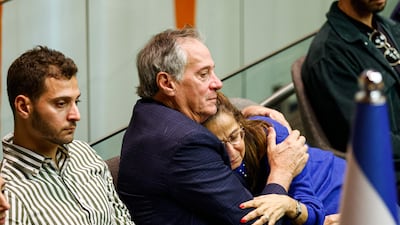
At UN headquarters in New York City, Rachel Zeitchik, right, and Jay Zeitchik attend an event for families of Israelis kidnapped by Hamas. AFP -
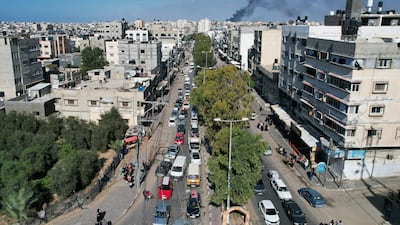
Palestinians flee from northern Gaza towards the south after the Israeli army demanded the population of more than a million people leave before a ground invasion. AP -

Demonstrators at a rally in support of Palestine face a counter-demonstration in support of Israel near Times Square in New York. EPA -
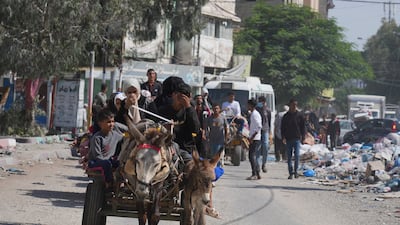
Palestinians flee from northern Gaza to the south after the Israeli army issued an evacuation warning. AP -
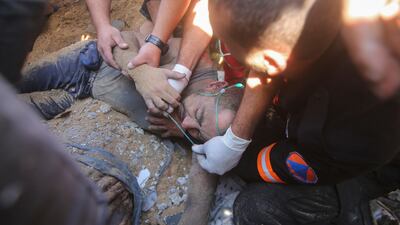
An injured man is rescued from the rubble of a building following an Israeli airstrike in Rafah, Gaza Strip. AP -
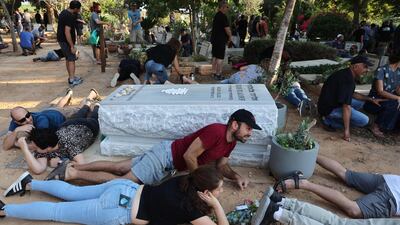
Mourners take cover as sirens sound during the funeral of Tom Godo, killed during the attack by Hamas militants on the Kibbutz Kisuffim last week, in Kibbutz Naan near Tel Aviv. AFP -
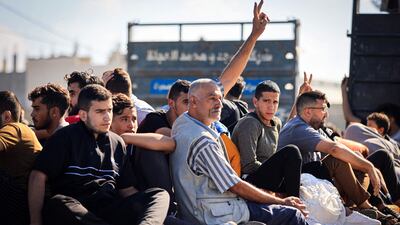
A Palestinian man flashes the victory sign as he and others leave northern Gaza before an expected Israeli ground offensive. AFP -
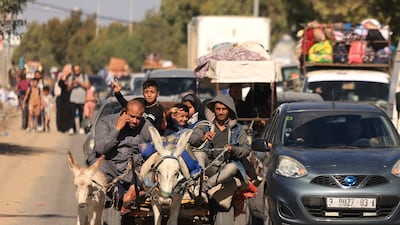
Palestinians head south with their belongings after being ordered by Israel to leave northern Gaza on Friday. AFP -

Israel ordered more than a million Palestinians to head south within 24 hours. Reuters -

The UN criticised the directive, saying forcing such a large number of people to flee en masse would be catastrophic. Reuters -

Gazans have to travel about 15km if they live in the northernmost part of the strip to reach the area south of the Wadi Gaza. Reuters -

The UN said that more than 423,000 people have already fled their homes in the territory, with a sizeable number making the more than 10km journey on foot. Reuters -
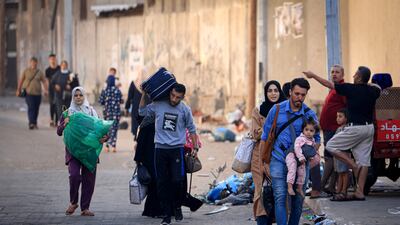
Palestinians with their belongings flee to safer areas in Gaza City. AFP -

An Armoured Personnel Carrier drives near Israel's border with the Gaza Strip. Reuters -
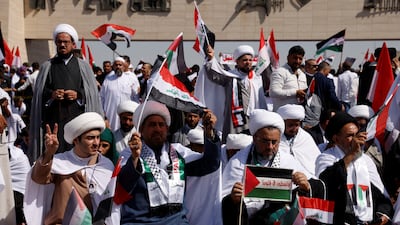
Supporters of Iraqi Shi'ite cleric Moqtada al-Sadr gather for mass Friday prayer during a protest in solidarity with Palestinians in Gaza, in Baghdad, Iraq. Reuters -
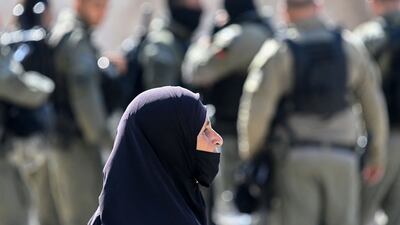
A Palestinian woman waits to cross into Jerusalem's Old City through Damascus Gate next to Israeli soldiers. AFP -
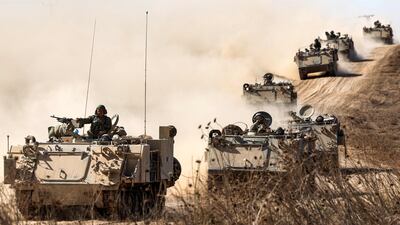
Israeli army infantry fighting vehicles deploy along the border with the Gaza Strip in southern Israel. AFP -
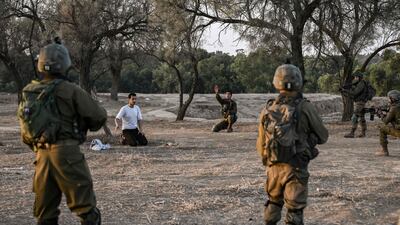
Israeli soldiers detain a man while on patrol near Kibbutz Beeri, near the Gaza Strip. AFP -
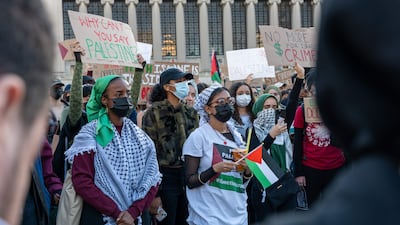
Students hold in a rally in support of Palestine at Columbia University in New York. Getty Images -

Family and friends mourn Valentin Ghnassia, 23, who was killed in a battle with Palestinian militants at Kibbutz Beeri near the Israeli border with the Gaza Strip. Getty Images -
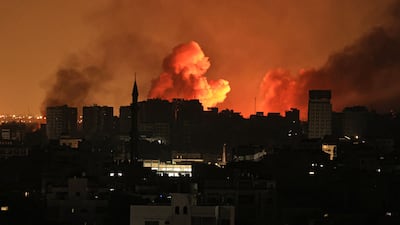
A ball of fire erupts in Gaza city after an Israeli air strike. AFP -
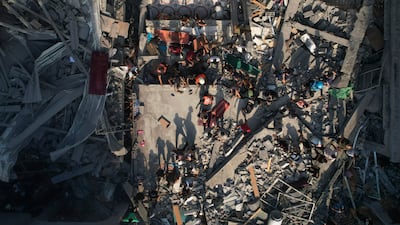
Palestinians inspect the rubble of buildings hit by an Israeli air strike at Al Shati refugee camp. AP -
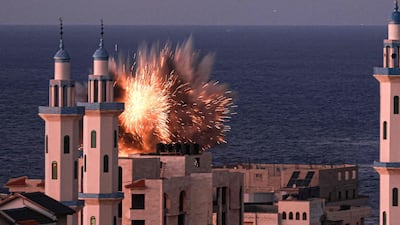
A fireball erupts from an Israeli air strike in Gaza city. AFP -

People waiting for news of victims outside the morgue at Al-Shifa hospital in Gaza City. AFP -
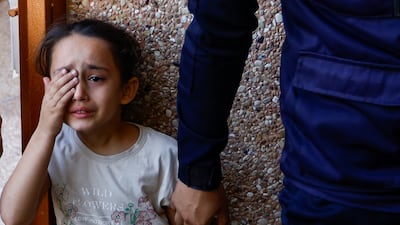
A girl mourns the death of members of the Samour family, who were killed in Israeli strikes on their house in Khan Younis in the southern Gaza Strip. Reuters -

Israelis arrive to sign up at a weapons distribution point for people allowed to carry arms, at the Ayyelet HaShahar Kibbutz in northern Israel, near the Lebanese border. AFP -
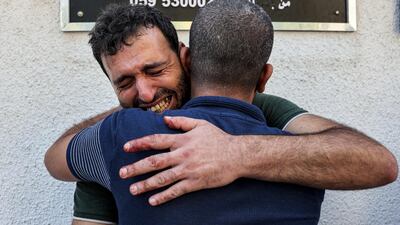
Mourners outside the morgue at Al-Shifa hospital in Gaza City as battles between Israel and the Hamas movement continue for a sixth consecutive day. AFP -
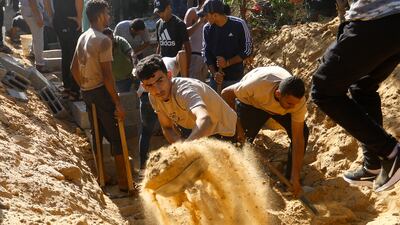
Men dig graves to bury members of the Samour family, who were killed in Israeli strikes on their house in Khan Younis. Reuters -

Palestinian children who fled their homes during Israeli strikes, play at a United Nations-run school in Gaza City. Reuters -
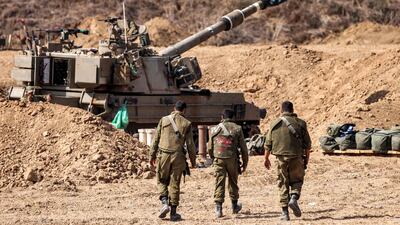
Israeli soldiers near a self-propelled howitzer near the border with Gaza in southern Israel. AFP -

Israel's Foreign Minister Eli Cohen, left, welcomes US Secretary of State Antony Blinken upon arrival at Israel's Ben Gurion Airport. AFP -

Palestinian children in a makeshift shelter at Al-Shifa hospital in Gaza City. Reuters -
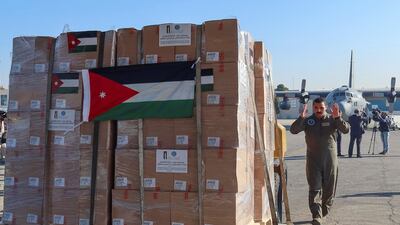
Boxes of humanitarian aid and supplies from Jordan Hashemite Charity Organisation destined for Gaza, in Amman, Jordan. Reuters -
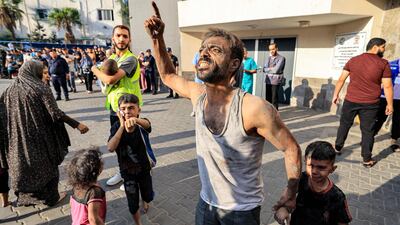
Palestinians outside Al-Shifa hospital in Gaza City on the sixth day of fighting between Israel and Hamas. AFP -
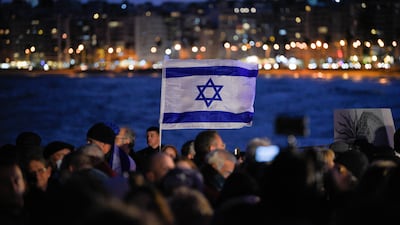
A pro-Israel vigil in Montevideo, Uruguay. EPA



