

Lebanon's departing government announced its National Vaccination Plan against the coronavirus in a session held at the Grand Serail on Wednesday.
Health Minister Hamad Hassan said the target is to vaccinate between 70 per cent and 80 per cent of the population by the end of 2021, with committees devoted to ensure transparency and order.
"We aim to curb the spread of the virus, protect the vulnerable groups, ease the burden on the health sector, and reduce the mortality rate," Mr Hassan said.
Lebanon has secured 2.1 million doses of the Pfizer-BioNTech vaccine, which are expected to arrive gradually starting mid-February over a period of five weeks.
The vaccination plan is divided into two phases, each covering 35 per cent of the population. The first phase prioritises high-risk healthcare workers, elderly citizens, people with comorbidities and staff in retirement homes and prisons.
-
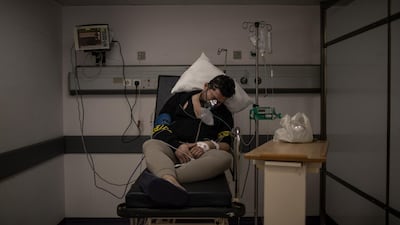
A Lebanese person sleeps inside a room for COVID-19 patients inside Rafik Hariri University Hospital, in southern Beirut, Lebanon. Getty Images -
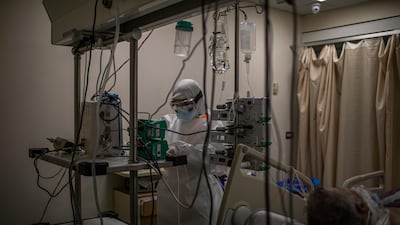
A Lebanese nurse takes care of a COVID-19 patient inside the Intensive Care Unit of Rafik Hariri University Hospital. Getty Images -
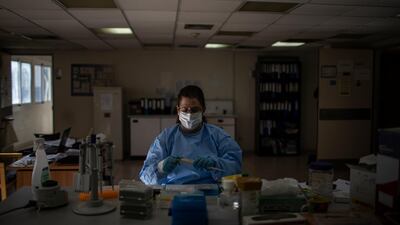
A Lebanese doctor conducts PCR test results inside the laboratory of the Rafik Hariri University Hospital. Getty Images -
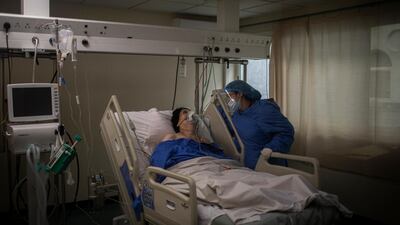
A Lebanese woman takes care of her mother with COVID-19 inside the Intensive Care Unit of Rafik Hariri University Hospital. Getty Images -

Lebanese nurses take care of COVID-19 patients inside the Intensive Care Unit of Rafik Hariri University Hospital. Getty Images -
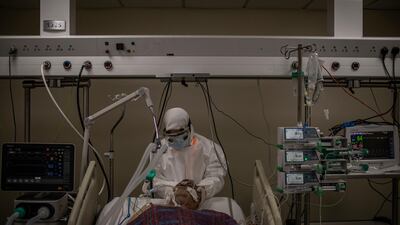
A Lebanese nurse takes care of a patient inside the Intensive Care Unit of Rafik Hariri University Hospital. Getty Images -
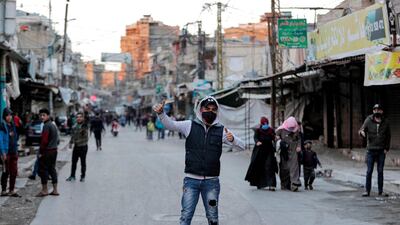
A mask-clad man gestures as he stands in the middle of a street while behind people walk past shuttered shops and stalls in Souk Sabra in the southern suburbs of the Lebanon's capital Beirut, despite a national total lockdown as a measure against the COVID-19 coronavirus pandemic. AFP -

Lebanese army soldiers patrol as they try to enforce a total lockdown as a measure against the COVID-19 coronavirus pandemic, in Souk Sabra in the southern suburbs of the Lebanon's capital Beirut. AFP -

A woman argues with policemen as Lebanese army soldiers (green berets) and policemen (grey berets) try to enforce a total lockdown as a measure against the COVID-19 coronavirus pandemic, in Souk Sabra in the southern suburbs of the Lebanon's capital Beirut. AFP -
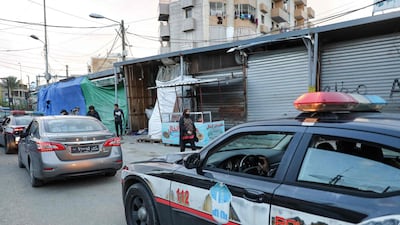
People walk past Lebanese police patrol cars, as authorities try to enforce a total lockdown as a measure against the COVID-19 coronavirus pandemic, in Souk Sabra in the southern suburbs of the Lebanon's capital Beirut. AFP -

A mask-clad woman and boy walk past shuttered shops and stalls in Souk Sabra in the southern suburbs of the Lebanon's capital Beirut, despite a national total lockdown as a measure against the COVID-19 coronavirus pandemic. AFP -
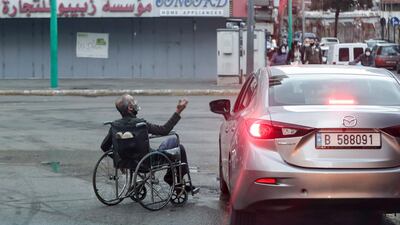
A wheelchair-bound beggar is seen next to a car stopping at a red light, in Lebanon's capital Beirut, despite a total lockdown due to the COVID-19 coronavirus pandemic. AFP -

A woman argues with policemen trying to enforce a total lockdown as a measure against the COVID-19 coronavirus pandemic, in Souk Sabra in the southern suburbs of the Lebanon's capital Beirut. AFP -
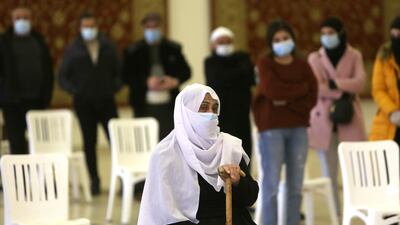
A woman sits as she waits to get tested for the coronavirus disease in the town of Hasbaya, Lebanon. Reuters -
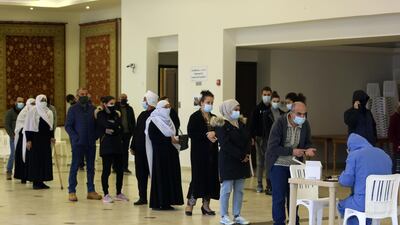
People wait in line to get tested for the coronavirus disease in the town of Hasbaya, Lebanon. Reuters -
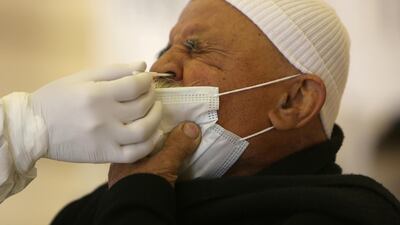
A health worker takes a swab from a man to be tested for the coronavirus disease in the town of Hasbaya, Lebanon. Reuters


The second phase covers "other vulnerable populations", including school teachers and staff, childcare workers, family caregivers, other healthcare workers, employees in high-risk jobs, and anyone else who wishes to be vaccinated.
All vaccines administered through the Ministry of Health will be free of charge at public and private centres. On average, the ministry aims to vaccinate 400 people on a daily basis.
Vaccination centres will be set up at hospitals across Lebanon, which will receive their share of vaccines from designated storage units at Beirut's Rafik Hariri University Hospital and other private and public hospitals in cities across Lebanon, including Byblos, Zahle, Saida, Nabatieh and Tripoli.
The Pfizer-BioNTech vaccine needs to be stored at minus 70°C, which requires special freezers and safe transport from one facility to another.
Lebanon has secured 13 ultra low thermal freezers and 12 compatible vehicles.
Vaccination processes will be administered and overseen by trained pharmacists, alongside the Lebanese Red Cross and other health organisations, said Ghassan Al Amine, head of Lebanon's order of pharmacists, expressing optimism about the strategy and praising its transparency.
Jade Khalife, a Lebanese physician, was warier.
"Overall, it's a very good strategy. But we can't rely on the vaccines alone to end the crisis this year," Mr Khalife said.
His main concerns were public readiness to be vaccinated amid a surge of misinformation and the uncertainty of Covid-19 vaccine supplies.
“The government is promising ahead, but so far what vaccines do we actually have?”
Aside from the deal with Pfizer-BioNTech, Lebanon has its hopes on securing an additional 20 per cent of an unnamed Covid-19 vaccine through Covax and is in discussions to secure 1.5 million doses of the AstraZeneca vaccine, bringing the total number of vaccine doses to 6.33 million.
But some of Lebanon’s leaders bought vaccines on their own account.
Last week, billionaire businessman Fouad Makhzoumi was granted a permit by the Ministry of Health to import Covid-19 vaccines and administer them through the Makhzoumi Foundation, an NGO founded by the politician in 1997. Similarly, entrepreneur and member of parliament Michel Daher announced that he was working to secure 10,000 vaccine doses, to be administered through the Michel Daher Social Foundation, free of charge.
"They're doing this to polish their image," said Bachir Ramadan, 31. "They're using vaccines as a political tool for their own benefit, just like they do with everything else."

