


A server containing photographs documenting Lebanon's history since 1961 was stolen from the state news agency's headquarters in Beirut, Information Minister Ziad Makary said on Monday.
He called the theft a crime “of national proportions”.
“The National News Agency’s archive server that includes pictures of all occasions since 1961 was subjected to theft, in addition to the theft of five computers from the archive room,” said Mr Makary.
Mr Makary later clarified that only a small part of the archive was stolen.
An Information Ministry source told The National that the stolen archives were backed up elsewhere.
Mr Makary said the employees of the National News Agency in Beirut's Hamra area in west Beirut were “surprised” to find the door broken and the room's contents taken. The information ministry is situated near to the interior and tourism ministry's, as well as well as Lebanon's central bank.
The Internal Security Forces’ director general, Maj Gen Imad Othman, was called to investigate and find the perpetrators, he said.
“We will spare no effort to help those concerned to uncover the whole truth until the perpetrator is punished,” said Mr Makary.
He said the repercussions of the robbery were “both moral and material”.
The Lebanese civil war — in pictures
-
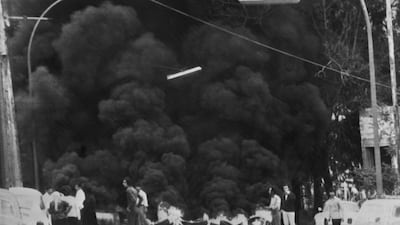
Smoke rises in a Beirut street during clashes between Palestinians and members of Christian militia the Lebanese Forces, backed by Lebanon's Christian Kataeb Phalangist party, on April 15, 1975. AFP -
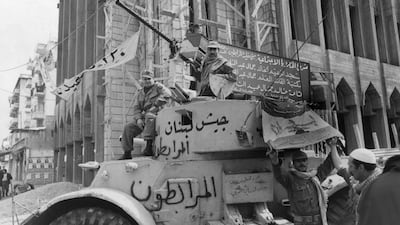
Guerrilla fighters on a tank in a street in Beirut during Lebanon's civil war, in December 1975. Getty Images -
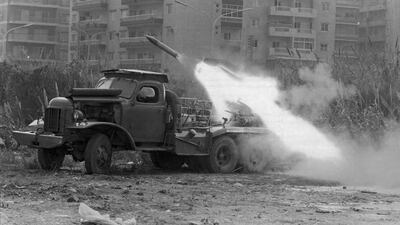
A Katyusha rocket is fired from the back of an army lorry into an apartment complex during the first year of the Lebanese civil war, in 1975. Getty Images -
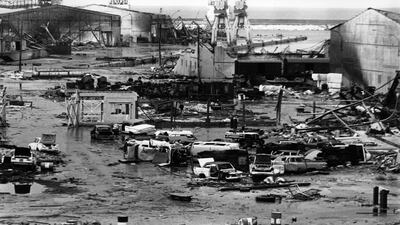
A mass of burnt vehicles in the harbour area of Beirut after the outbreak of civil war in 1975. Getty Images -
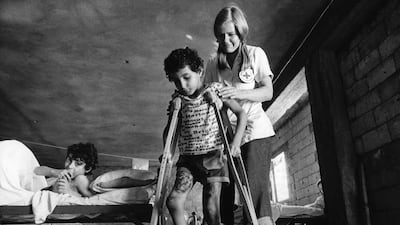
A Red Cross nurse from Sweden takes care of a boy shot in the heel by a sniper, on September 9, 1976, at a hospital in the Coral Beach Hotel, on the road between Beirut and Saida. AFP -
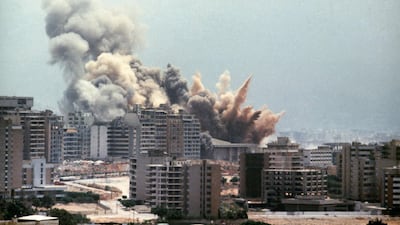
Israeli shelling on west Beirut on August 2, 1982. AFP -
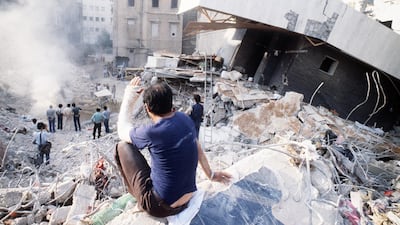
A man sits on rubble in a desolated area of west Beirut on August 20, 1982. AFP -
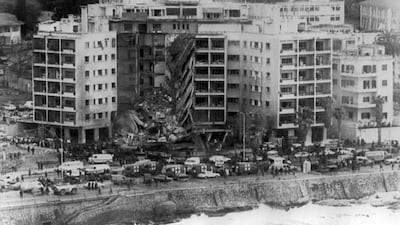
The US embassy in Beirut on April 18, 1983, after a bomb destroyed part of the building. AFP -
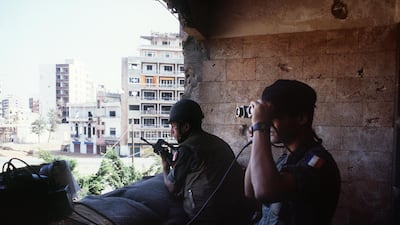
French soldiers watch the skyline in Beirut on September 26, 1983. The troops were part of the Beirut security multinational force sent to keep security after the Israeli invasion of 1982. AFP -
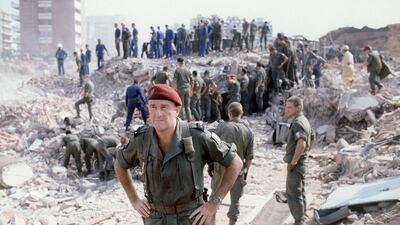
General Francois Cann, commander of the French troops of the multinational forces, on October 23, 1983, as rescuers search for survivors in Beirut through the rubble of a building that was destroyed by a suicide lorry bomber overnight. Fifty-eight French soldiers and five Lebanese were killed in the attack. AFP -
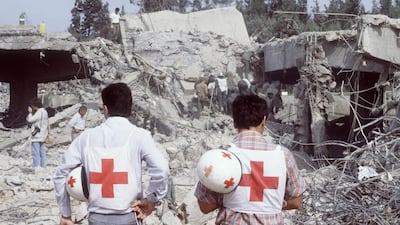
Rescuers continue to search on October 31, 1983, for corpses and identify the victims of the attack on October 23 on the headquarters of US troops from the multinational force in Beirut. AFP -
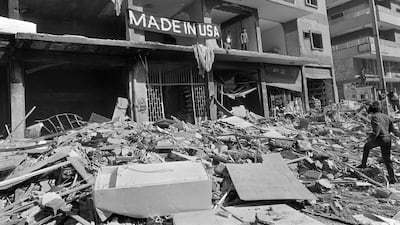
Rescuers search for victims on March 8, 1985, 15 minutes after a car, packed with an estimated 250kg of TNT, exploded in a crowded street of the southern Bir Al Aabed district in mainly Shiite southern suburb of Beirut. At least 75 people were killed and 256 injured in the explosion. AFP -
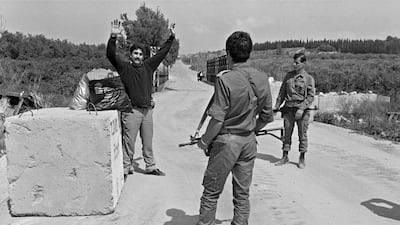
Israeli Defence Force soldiers on March 19, 1985, confront a civilian at Kasmyah bridge after troops the month before evacuated about 500 sq km around Saida. AFP -
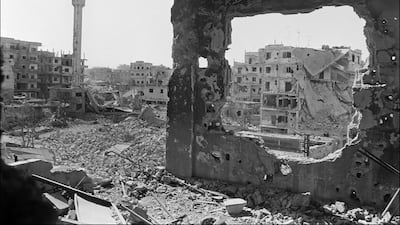
Tripoli, in northern Lebanon, on October 4, 1985, after a ceasefire between pro-Palestine and pro-Syrian militias was agreed to in Damascus. AFP -
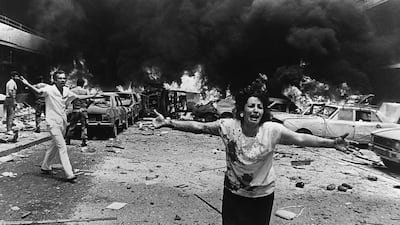
A woman cries in shock, minutes after a car bomb exploded in a crowded neighbourhood of mainly-Muslim west Beirut on August 8, 1986, killing 13 people, including three children, and wounding at least 92. AFP -
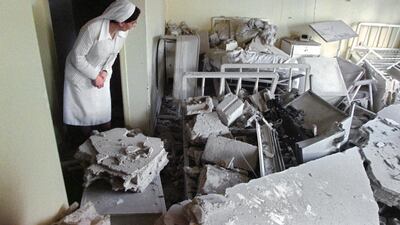
A nun inspects a damaged room in the Hotel Dieu Hospital in east Beirut on February 25, 1990, after a break in the battle between rival Christian factions. AFP


The National News Agency was founded in 1961 and the stolen photo archive includes pictures of the country's 1975-1990 civil war, which saw around 120,000 people die and many more leave Lebanon.
Lebanon's economic crisis, which first became apparent in 2019, has been called one of the worst in recent world history by the World Bank.
The Lebanese pound has lost more than 98 per cent of its value on the parallel market against the dollar and continues to slip further into the abyss.
Soaring inflation has meant the real value of civil servant's salaries, including those of the security forces, have plummeted. Public sector workers, including staff of the National News Agency, have often gone on strike over their working conditions.
Many ministries are frequently without power.
The situation has pushed many civil servants to take on a second job or go to the office sporadically to save on commuting costs amid surging fuel prices. Some members of the army have taken to moonlighting as taxi drivers.
The crisis, which has essentially led to the collapse of Lebanon's middle classes, has pushed much of the population into poverty, with widespread shortages of state-supplied electricity, clean water and medicine.
Informal capital controls, introduced by the banks in 2019, have locked depositors out of their life savings. The measure has seen some, including one MP and an ex-senior diplomat, resort to taking the situation into their own hands by entering banks and demanding access to their trapped savings.
Amid Lebanon's economic collapse, it is engulfed in governance vacuum. The deeply divided parliament has yet to agree on the next president after 11 sessions, while the cabinet of Prime Minister Najib Mikati is in caretaker status and thus severely stripped of its powers.

