
Banks in Lebanon will continue with their open-ended strike, as banking chiefs hit out at “arbitrary” and haphazard judicial decisions against the sector.
Initially, the Association of Banks in Lebanon had issued a short statement refuting reports that operations would soon resume, saying that the strike would continue “until further notice”.
Later, the organisation released a longer statement that hit out at a string of recent judicial orders against banks.
Senior prosecutor Ghada Aoun on Monday charged two senior bankers from Bank Audi and Audi Group with money laundering for failing to lift banking secrecy on the accounts of senior figures at the firm.
The move was described as “vengeful” by the ABL, which argued that Bank Audi was co-operating with investigators, despite assertions by prosecutors to the contrary.
Late in 2022, the Lebanese parliament approved an amended banking secrecy law, a key demand of a $3 billion bailout out from the International Monetary Fund.
The ABL argued that prosecutors could not retroactively view accounts dated before the law was passed. Ms Aoun wanted to view accounts from 2016 and believed she had the power to do so.
Lebanon's economic collapse, which first became apparent in 2019, has been described by the World Bank as one of the worst in modern history. The local currency has plummeted in value by about 98 per cent against the US dollar on the parallel market and continues to tumble to new lows.
The financial meltdown has been blamed on decades of mismanagement by Lebanon’s ruling classes, including the leaders of its banking system and the central bank.
The indefinite strike was announced last week following a general meeting of the ABL, although ATMs have remained open.
It had met last Monday to discuss “recent decisions” and judicial measures and “their impacts on banking workflow and the rights of depositors”.
The ABL had also called for Lebanon to pass a capital control law, formalising the informal cash withdrawal restrictions that have been in place since the economic crisis began.
Lebanon power plant sparks cancer fears — in pictures
-

After losing four relatives to respiratory illness, Zeina Matar fled her hometown north of Lebanon's capital Beirut, where she says a decaying power plant generates little electricity but very deadly pollution. Thick black smoke sometimes billows from its red and white chimneys, leaving a grey haze in the air above the Zouk Mikael industrial district, where the toxins remain trapped by a nearby mountain chain. All photos: AFP -

Ms Matar, 40, says she lost her younger sister and a cousin to pulmonary fibrosis and that two of her uncles died of lung cancer years earlier. They all lived near the plant where, experts and residents believe, air pollution means people are more likely to develop cancer and respiratory disease than anywhere else in the crisis-torn country. -

A Greenpeace study found that the surrounding Jounieh area was ranked fifth in the Arab world and 23rd globally for cities most contaminated by nitrogen dioxide, a dangerous pollutant released when fuel is burnt. The environmental group's 2018 study singled out the Zouk plant, built in the 1940s, as well as cars on a busy motorway and privately owned electricity generators as the main causes of pollution. -

The walls of Ms Matar's balconies in her old Zouk Mikael home are blackened by the smoke, and laundry she used to hang outside would be damaged by toxic chemicals emanating from the plant, she said. 'Whenever they refilled the station with fuel oil, we would close the windows,' she said. 'The smell was unbearable.' -

Another former resident is Paul Makhlouf, a lung doctor at the Notre Dame du Liban Hospital in Jounieh, who said he abandoned his local apartment after noticing a rise in respiratory disease among patients. In 2014, he found that lung ailments had increased by 3 per cent in patients living near the plant, compared with the previous year, an annual rise he estimates has now doubled. 'When I saw the results, I moved from there,' he said. 'I fled.' -
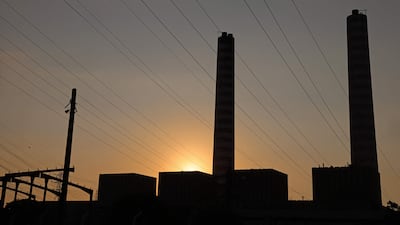
Pictures went viral online last month of thick black smoke again billowing from the Zouk plant as it burnt low-quality fuel oil to produce only one hour of power that day. The energy ministry said the plant had been forced to use heavy fuel to 'keep supplying the airport, hospitals and other vital institutions' with electricity. Since then, the plant has mostly operated at night. -

Elie Beaino, who heads the Zouk municipality, said a second plant, which built without authorisation in 2014, runs somewhat more cleanly on higher-quality fuel or gas. However, it stopped working as its operators cannot afford higher-quality hydrocarbons. 'Most residents want the power plants to close down,' he said. -

Member of Parliament Najat Saliba, an atmospheric chemist, said residents near Zouk are at least seven times more likely to develop cancer than those in Beirut, citing a 2018 study she helped write for the American University of Beirut. -

She said the heavy fuel oil it uses releases harmful chemicals. 'The solution is to import quality fuel oil and gas,' Ms Saliba said. However, she noted that Lebanon cannot afford those fuels. -

"We have two options today," she said. "To switch the lights off at the airport and in hospitals, or to sit under a black cloud in Zouk."



