

On the evening of August 4, 2020, two young Lebanese soldiers pulled up to a storage hangar in Beirut’s port in a military jeep. Their superiors sent them to check on a fire. They did not know they had been sent to their death.
Hamza Iskandar, 25, a sergeant in the Lebanese army, was at the wheel, and officer Ayman Noureddine, 27, was alongside him. They stopped near hangar 12, where firefighters were trying to extinguish the inferno.
Noureddine stepped out of the car to snap some pictures on his phone to send to the colonel sitting in barracks just outside the port.
Seconds later, hundreds of tonnes of improperly stored chemicals exploded. The blast killed Noureddine, Iskandar and all 10 firefighters, as well as more than 200 others across the capital.
For more than a year, the explosion brought together families of the dead in their quest for justice. It was a rare example of unity among sectarian communities in a deeply divided country that still carries the scars of a bloody 15-year civil war.
The families of Noureddine and Iskandar, both Shiite Muslims, called for justice in the streets of Beirut alongside Sunnis, Christians and Druze. Some families were well-off, some less so, while others had political affiliations that they decided to set aside.
“We are one hand,” families would tell journalists during their regular protests at the port or outside the Justice Ministry, to support the investigative judge as politicians filed lawsuits against him to avoid questioning.
-
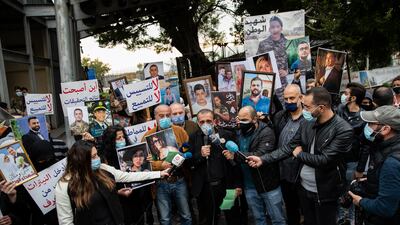
Ibrahim Hoteit, surrounded by the families of the victims of the Beirut blast, addresses the media outside the port of Beirut on the sixth-month anniversary of the explosion in February 2021. -
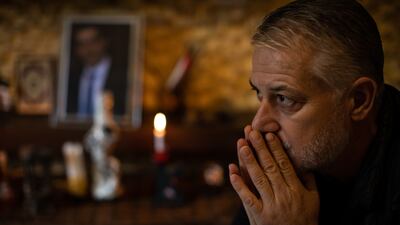
Kayan Tleiss sits in front of the shrine dedicated to his brother in his living room in Khalde, in the southern suburbs of Beirut. -

A photograph of Mohammad Tleiss is flanked by an image of the Virgin Mary and a copy of the Quran in Kayan Tleiss’s living room in Khalde in Beirut. -
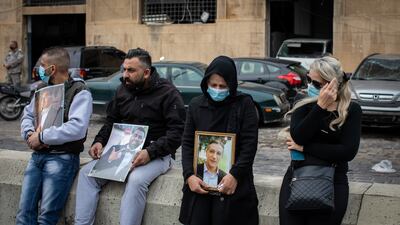
Kayan’s mother, holding a photograph of her son, Mohammed, sits outside the port of Beirut on the sixth-month anniversary of the explosion. -
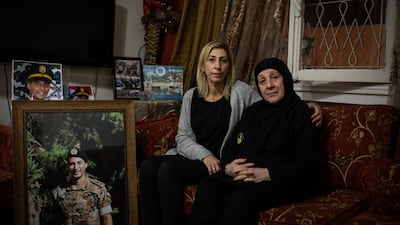
Tharwat and Nada Noureddine sit in their living groom in Mar Elias in Beirut surrounded by photographs of Tharwat’s brother and Nada’s son, Ayman. -

Tharwat Noureddine holds a photograph that Ayman kept on his desk in Beirut. The frame was damaged during the explosion. -

Photographs of Tharwat’s brother and Nada’s son, Ayman, adorn the family's living room in Mar Elias in Beirut. Ayman had returned from five months of training in the US right before the explosion. -

Salam Iskandar, her husband, Jaber, and their son, Ali, sit in their living room in Borj El Brajneh in the southern suburbs of Beirut, surrounded by photographs of Salam's brother, Hamza, who died in the Beirut port blast. All photos: Oliver Marsden / The National -
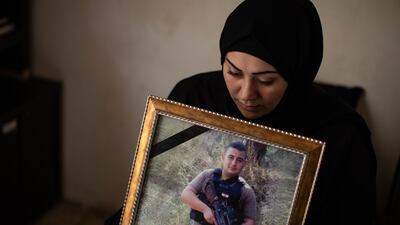
Salam Iskandar holds a photograph of her brother, Hamza, on her lap.


This unity lasted a little more than a year.
It splintered in mid-October amid deadly sectarian clashes in Beirut that pitted supporters of a Christian political party, the Lebanese Forces, against members of Shiite Muslim parties, Hezbollah and Amal, along a former civil war frontline.
The fighting, in which seven people were killed, came after weeks of Hezbollah-led accusations against the judge leading the investigation, Tarek Bitar, and just two days after Hezbollah ministers started boycotting government meetings. The Cabinet has been paralysed since.
Although Mr Bitar has never directly summoned a party member for questioning, he has called in top politicians allied to Hezbollah. The Shiite militant group accuses the judge of political bias. In a country where power is shared along sectarian lines, this is an indirect accusation of sectarianism.
Since the October 14 clashes, an increasing number of the country’s leaders, including Prime Minister Najib Mikati, have publicly given their support to a parliamentary investigation of the blast, which would weaken Mr Bitar’s power. Many families see this as an attempt to shield suspects, including sitting legislators, from the judge’s questioning. So far, lawsuits have forced Mr Bitar to suspend his probe four times.
Postwar order at stake
Once united in the same struggle, Noureddine and Iskandar’s families do not talk to each other today. Noureddine's family remained with the larger group that still supports the investigative judge, while Iskandar's relatives now oppose him.
Yet all families say they still share the same goal: justice.
“We need to know a little bit of the truth to alleviate our pain,” said Noureddine's sister Tharwat, 40. The small flat she shares with her parents is cluttered with pictures of her brother, smiling in his military uniform, and his training certificates from the US and Lebanon.
Their falling-out is widely viewed as political parties’ successful attempt to undermine their quest for accountability, analysts say. While politicians from various parties have stayed united, and in some cases file lawsuits together against the judge, the families appear weaker and more fragmented.
Legal documents, interviews and statements previously seen by The National show that the finance and interior ministries, security agencies – including the Lebanese army, State Security, and General Security – as well as the Higher Defence Council chaired by the president and vice-chaired by the prime minister, were all informed of the danger posed by the ammonium nitrate stored at Beirut port since 2013.
-
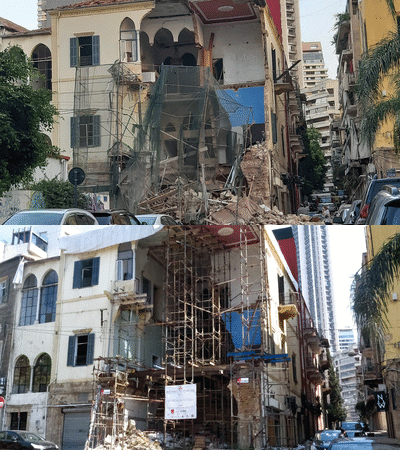
These images show various sites in Beirut on August 5, the day after the blast, and how they look now, one year on. This building has only been partially repaired. -
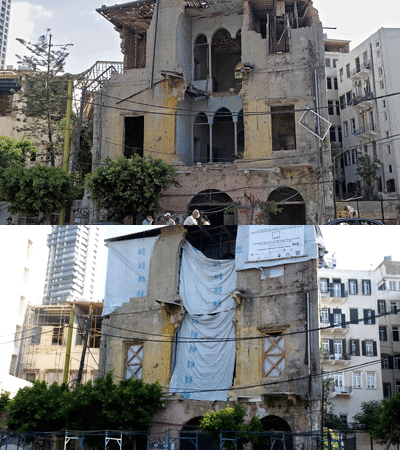
The damage to this house in Beirut has been partially covered. -
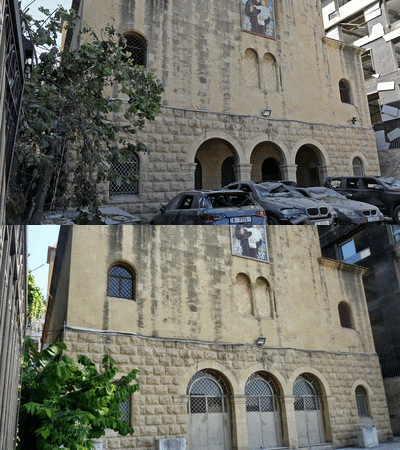
Cars were destroyed next to this church in the blast area. -
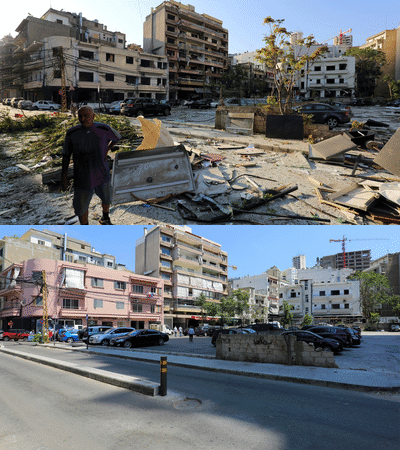
Damage near the site of the explosion and how it looks now. -
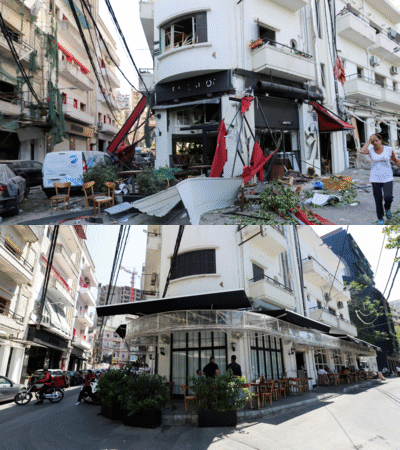
A restaurant damaged by the explosion has been largely repaired and restored. -

A view of the port on the day of the explosion and how it looks today. -

A petrol station and buildings in Al Rmeil area in Beirut. -
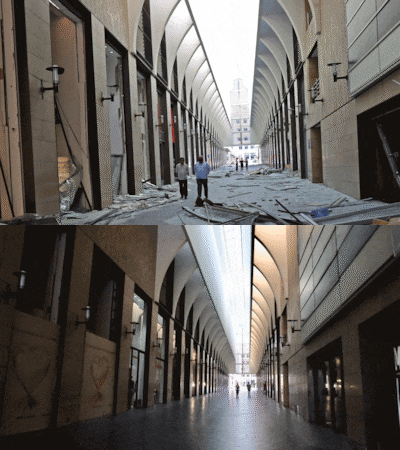
The damage to Beirut Souks in the downtown area of the city has been repaired. -
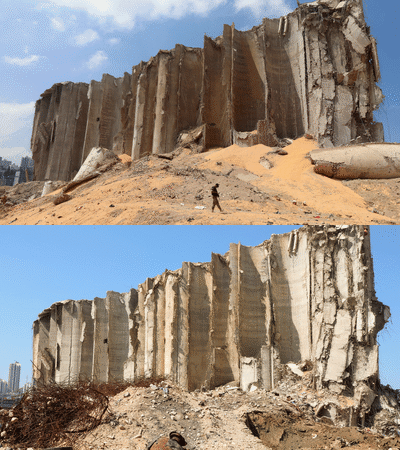
The grain silo at Beirut Port the day after the blast and how it looks now. -
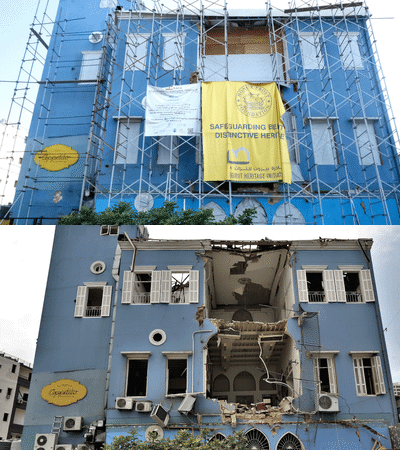
A street in Beirut the day after the blast and how it looks now. -
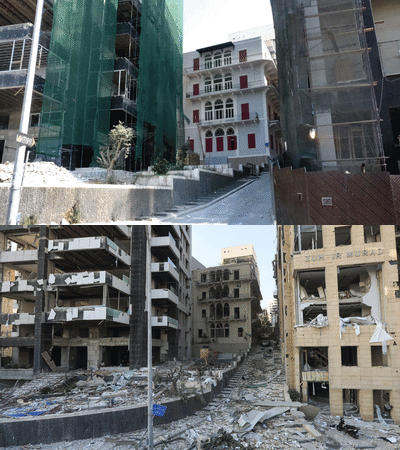
A street in Beirut the day after the blast and how it looks now.


Many of Lebanon’s current politicians are former warlords from the 1975-1990 civil war who stayed in power thanks to a blanket amnesty. Despite widespread corruption in postwar Lebanon, only a handful of the country’s leaders have ever faced legal sanction. Each time accusations spring up, they are represented as an attack on the sect of the suspected politician, and a possible cause for renewed sectarian fighting, which no one wants.
This weaponisation of sectarianism enabled the country’s postwar political class to reap benefits from the state while never being held accountable for their “disastrous” policies and practices, said Bassel Salloukh, associate professor of political science at the Doha Institute for Graduate Studies.
Today, they cling to power as opposition grows, fuelled by the 2019 financial collapse. “If they give in to demands for accountability, then the whole edifice of immunity built after the war will start to collapse. What is at stake is Lebanon’s postwar order,” Mr Salloukh told The National.
The only time that families of victims fought together for justice in Lebanon’s recent history was to know the fate of the 17,000 who disappeared during the civil war. After more than four decades of struggle, a 2018 law gave their families the right to know the truth.
Yet their activism was less threatening to Lebanese politicians than the fight of families of the victims of the blast, said Lynn Maalouf, regional deputy director for Amnesty International. The latter want to see those responsible for the explosion behind bars, which represents a direct threat to the power and survival of the country’s political elite.
“It’s about a hard call for justice and accountability. This is a scary call,” she said. “It’s happening in a context of anti-government movements whereas in the post-civil war context there was no talk of justice. Families were practically on their own.”

Nizar Saghieh, a lawyer who heads a local NGO, Legal Agenda, said that it is the trans-sectarian nature of victims that poses the biggest risk to the country’s rulers.
“The postwar sectarian system aims to have a hegemonic control on everything related to public interest. Politicians perceive a nonsectarian victim as a threat because the sectarian leader will not be able to compromise with leaders of other sects,” he said.
Unity broken by video
The recent splintering among those fighting for justice in the port blast case came as a surprise. On October 15, Ibrahim Hoteit, the families’ spokesman, published a video demanding Mr Bitar’s resignation that quickly went viral on social media. A small group of mostly Shiite Muslim families have since publicly sided with him.
“I received 50 phone calls that night,” said Kayan Tleiss, a member of the committee of the larger group of families – that includes representatives of all sects, including Shiites – that stayed loyal to Mr Bitar. “No one believed me when I said that I didn’t know what was going on.”
In the video, Mr Hoteit affirmed his support for Hezbollah, or the “resistance”, as it is also called. “We are convinced that brothers in Hezbollah want the truth and accountability,” he said. “This is what Hezbollah leader Hassan Nasrallah said clearly and we, as families of victims, thank him for standing by us."
Some speculate that Mr Hoteit, 52, was threatened or bribed by Hezbollah, but he denies such claims, and The National found no proof to back them. Like many political parties, including Hezbollah, Mr Hoteit and his supporters now argue that Mr Bitar is politicising the investigation by selectively trying to interrogate politicians from some political groups and not others.
Iskandar's sister Salam, 34, says that she does not trust Mr Bitar, whom she accuses of hiding behind the secrecy of the investigation. Referring to the October 14 clashes, she said: “What is he waiting for to tell us what he knows? There’s blood on the street!”
Local media reported that all those killed that October day were Shiite Muslims and included members of Hezbollah and its ally Amal. “That day, I saw a civil war coming,” Mr Hoteit said.
Mr Hoteit said that he and his supporters were pushed out of the families’ association specifically because they were Shiite – a claim the other families reject.
“They targeted a certain sect and kicked them out of the group,” he told The National on November 4. That day, the two groups held for the first time their monthly commemoration of the blast a few hundred metres away from each other near Beirut’s port.

Viewed as a traitor by many other family members, Mr Hoteit seemed isolated. Hezbollah-affiliated Al Manar was one of the few television channels filming the gathering that he organised, while the rest of the media flocked to the other group. Hezbollah did not respond to a request for comment.
Speaking in his home more than a month later, Mr Hoteit said that his conscience is clear.
“A traitor changes his words, but my requests have remained the same: the judge should call in all of Lebanon’s most important officials for questioning, with no exception," he said.
Mr Hoteit said that his pro-Hezbollah words in his viral video were spoken in the heat of the moment, one day after the “massacre” of October 14.
“The neighbourhood was boiling,” he said. “I wanted to avoid being hurt. We didn't know what could happen.”
Mr Hoteit accused the other families of victims of the blast of being controlled by a political party that he did not name. Families close to him, including Salam, hinted several times at the Lebanese Forces, headed by Samir Geagea. He was the only warlord imprisoned at the end of the civil war, albeit in controversial circumstances.
A spokesperson for the party told The National that “the only people politicising the case are the people in power today, under full sponsorship and leadership of Hezbollah”.
“Hezbollah is orchestrating a wide campaign to 'oust' Bitar and kill the case,” they said.
On December 10, Mr Hoteit accompanied Youssef Al Mawla, who lost his son in the blast, to file a transfer request against Mr Bitar at the Court of Cassation in the presence of Salam and Hassan Al Amine, whose brother died in the port silos.
The lawsuit was a “warning” to the judge to change course, Mr Hoteit said, rejecting comparisons between his lawsuits and those filed by politicians.
A 15-minute phone conversation with Mr Bitar the day after the Beirut clashes convinced him to jump ship, he said.
“He spoke to me in a political manner, not like a judge should talk. He said: we have a problem with this group of politicians, and then we’ll have a problem with the others,” he said. The judge cannot speak to the media.
Mr Hoteit was threatened this year, but not by Hezbollah, he said. The threats came from Amal supporters after a families' protest that turned violent near the headquarters of the party's leader, Nabih Berri, Lebanon's veteran parliament speaker.
Hezbollah and Amal both have a strong influence in Mr Hoteit's neighbourhood of Bourj Al Barajneh, south of Beirut. Although the parties always collaborate during elections, their supporters sometimes disagree.
“People stopped me in the street and warned me: don't continue like this," he said.
For a month and a half, Mr Hoteit stayed home in the sweltering summer heat, kept his curtains closed, and stopped working with his wife. They own a small business – home delivery of beauty products. “I got to a point where I ran out of patience," he said.

The end result is that both groups of families say that they are fighting for the same cause and accuse each other of the same ills.
At the end of the interview, Mr Hoteit walked ahead to open the door to his flat. Its mechanism was complicated, he said, as he unlocked a second door that had been installed in front of the first one. “Back-up,” he said with a grin when asked why he had two doors.
Sectarianism as a political tool
For Mr Salloukh, the fact that Shiites are divided over Mr Bitar is proof that the split is not religious but purely political. “Sectarianism is invoked to deflect attention from the real issue: accountability,” he said.
“Sectarianism becomes weaponised not only by the political elite, it also creeps into the discourse of the victims of the sectarian political system. And this is because the language of sectarianism is so readily available.”
The oft-heard line of “all of them or none of them”, which is used by those working against Mr Bitar, is reminiscent of arguments put forward when families of the disappeared of the war got too close to finding out the truth.
Only one mass grave has so far been excavated, in 2005. Political pressure stopped further excavations, said Maytham Kassir, whose grandfather disappeared in 1976.
"Truth is so hard to get. It’s always about compromise to keep the sectarian system propped up,” Mr Kassir said. His parents eventually asked for a death certificate, but his grandfather's grave is still without a body.
Today, the country's economic collapse is pressuring Lebanon's political class more than ever.
“The polarisation in the country is horrible,” Mr Saghieh said. “Divisions are paralysing institutions. In such a context, you might understand that a lot of energy is spent on dividing families and putting an end to their unity.”
Carmen Abou Jaoudeh, a lecturer at Lebanon’s Saint Joseph University, sees in the current hostilities between the families of victims of the blast a reflection of a larger fallback on sectarian identities after massive 2019 anti-government protests triggered by the country’s financial collapse.
The movement’s most popular chant was “all of them means all of them”, signalling the rejection of Lebanon’s sectarian politics in its entirety.
“The political class is trying to gain back the power it lost during the 2019 revolution,” said Ms Abou Jaoudeh, who is a member of the national commission for the missing and forcibly disappeared from the civil war. “This is not a Christian-Muslim affair. It’s a strategy used by politicians to make families less effective and supportive of each other,” she told The National.
The tensions between families have caused Noureddine's mother to pause her participation in protests. “I want to see what happens,” said Nada Noureddine, 65. “I’m tired.”
Like Ms Noureddine, most families say that they are shocked by Mr Hoteit’s behaviour.
“We don’t talk about Ibrahim,” said George Bezjian, a member of the families’ committee, describing him as “an agent of one or two political parties”.
“We work for the victims. That’s it,” he said.
Mr Tleiss pleaded for unity.
“Let’s continue working with our minds, logically,” said Mr Tleiss, 45, who works at the Lebanese customs directorate. “Sectarianism should end. It must be erased from people's spirits before it is abolished from constitutional texts," he said.
His words echoed calls made in the decades following the end of the civil war by both Mr Berri and Mr Nasrallah. Yet their political parties have actively derailed attempts at reducing sectarianism in the country, including by opposing civil marriage laws or by galvanising sectarian feelings during electoral campaigns.
Mr Tleiss’s family is from a mixed sectarian background. In his flat, he keeps a shrine to his brother Mohammed. A Shiite Muslim, Mohammed worked at the port’s container terminal company and was married to a Christian woman. They had two young children.

For some, even discussing divergences between families is a waste of time. “I am sad to see that a journalist wants to write about this case,” said Antonella Hitti, who lost three relatives in the blast, all firefighters: her brother Charbel Hitti, her cousin Najib Hitti, and her brother-in-law, Charbel Karam.
“The case is only about our brothers who died on the 4th of August. It’s not about families being divided or mistrust between them. If someone does not want to continue with us on the journey of fighting for justice, this is secondary,” said Ms Hitti, 22, a university student. "The most important thing is to support judge Bitar."
As the investigation drags on, economic hardships add to the pain of the families of the dead, who receive little support in their struggle.
As a soldier, Hamza Iskandar was one of his family’s main breadwinners. His sister Salam said that the monthly compensation handed out to state-recognised victims of the blast, currently worth a little under $40, all goes to their father. He was injured in the civil war and has not worked in more than three decades.
“Hamza was everything to us,” she said, tearing up. She lives with her husband, unemployed because of health reasons, and seven relatives in the same two-room flat south of Beirut.
She has little hope that her brother’s killers will be brought to justice. “There’s no solution. There’s only God,” she said.
Although her disagreements with Salam run deep, Noureddine's sister Tharwat was cautious about passing judgment. She said that her job as a lawyer’s assistant has maybe helped her have a more informed understanding of how the judiciary works and believes that an overload of information and accusations from politicians and the media have misled a part of the public.
“You hear a thousand opinions in the media,” she said. “Because of all the sects, political parties and interferences in Lebanon, we can’t all have the same opinion, unfortunately.”
Tharwat said she would remain immune to outside pressure. “The investigation must continue. This case is bigger than politics, bigger than Lebanon or anything else. I can’t let go of my fight for the truth just because a politician says something,” she said.
Her voice trailed off as she tried to explain why she would never cave in. She recalled her search for her brother’s body after the explosion.
“I was alone as I looked for him in several hospitals. I only found him on the second day. What’s important is the truth. Who killed Ayman?”

