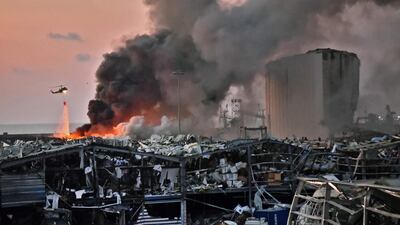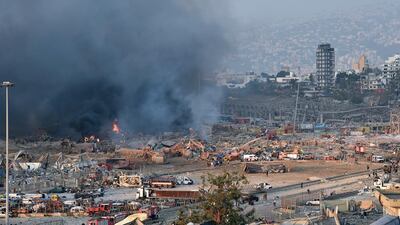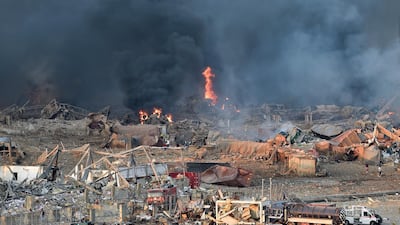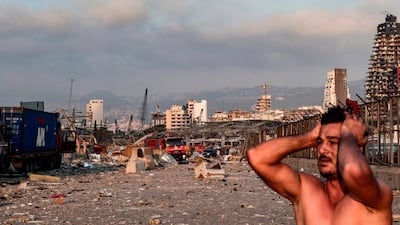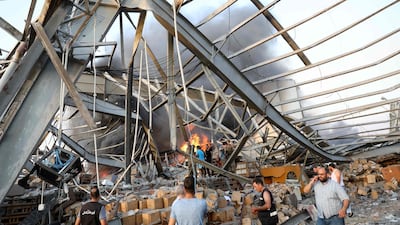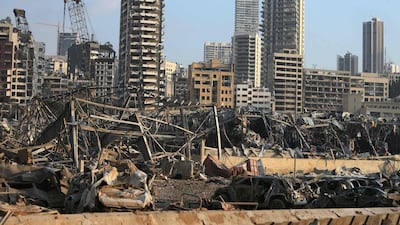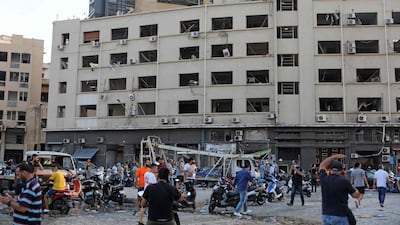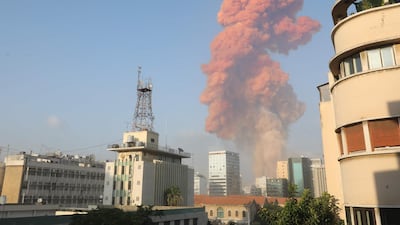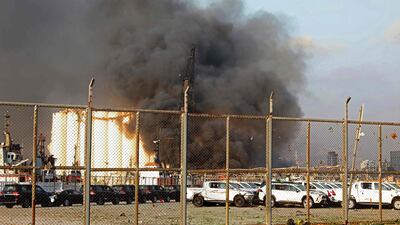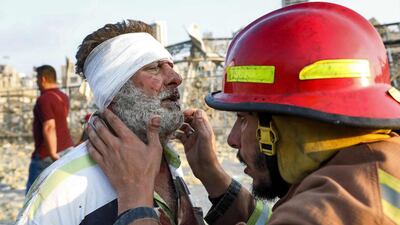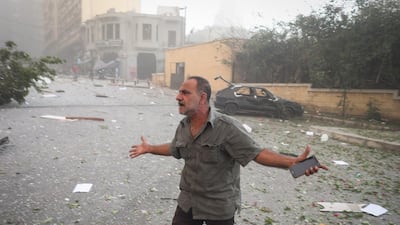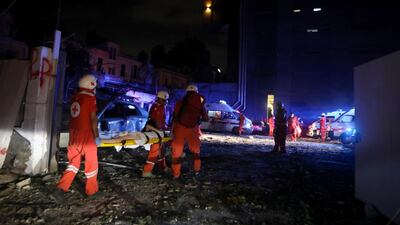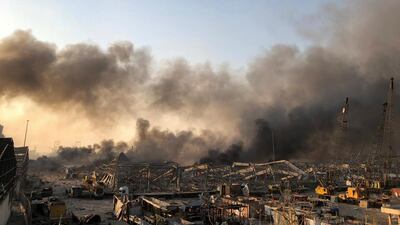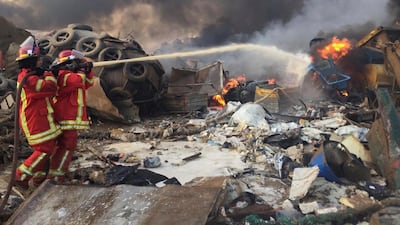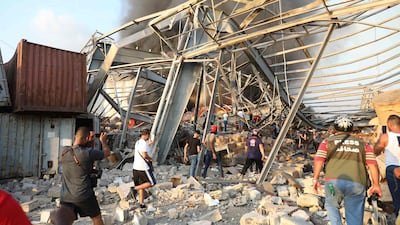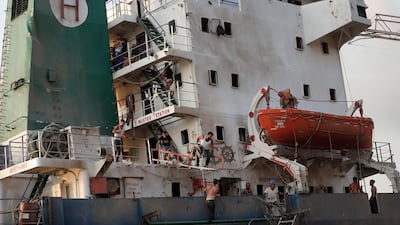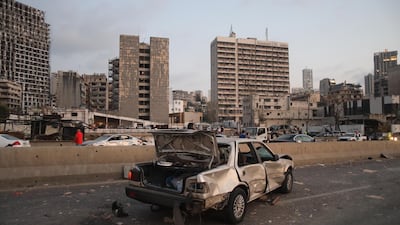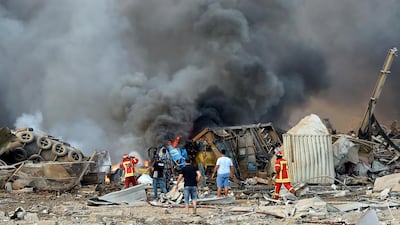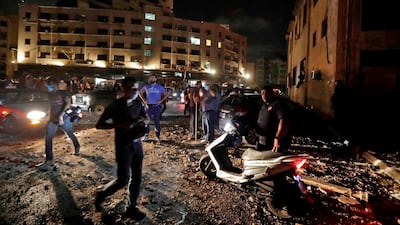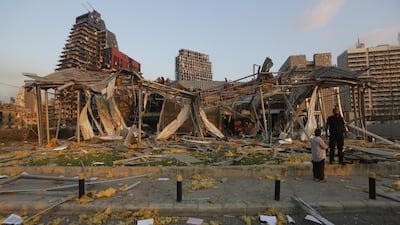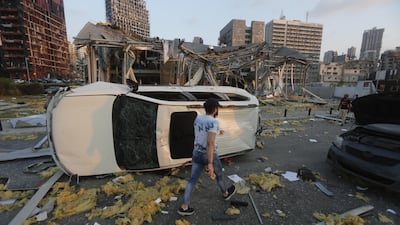
Families of victims of the Beirut port explosion say they are desperate for answers and financial help, but the judge in charge of the investigation refuses to hold influential politicians accountable, a local watchdog told The National on Wednesday.
“I came here to know who killed my father,” said Ahmad Lazekani, 23.
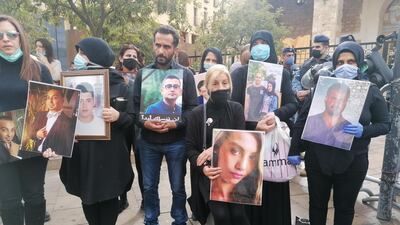
The third-year data science student on Wednesday took part in a small protest near the Lebanese Parliament with two dozen other friends and relatives of people who died in the blast on August 4.
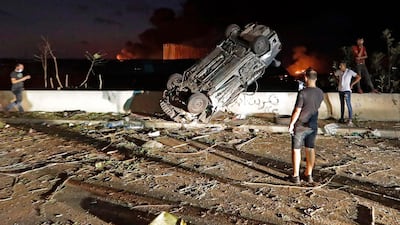
Local officials have blamed poor security measures for the ignition of 2,750 tonnes of ammonium nitrate stored at the port, in one of the largest non-nuclear explosions in recent history.
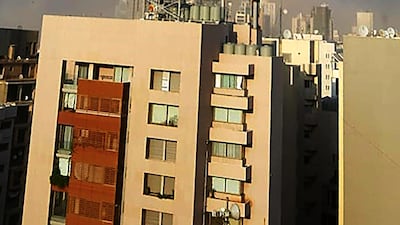
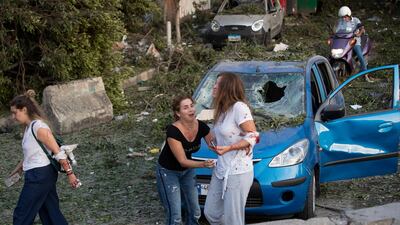
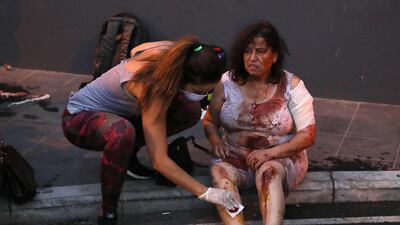
About 205 people died and thousands were injured in the blast, which devastated large parts of Beirut, destroying tens of thousands of homes.
“We were at home and the door fell and broke in front of him," Mr Lazekani said of his father Mohammad, 55.
"He had bleeding in his head and all his bones broke. They cut his fingers."
He said he did not trust the Lebanese judiciary to hold those responsible accountable for his father’s death.
“For 30 years they have been in power and they are all thieves,” Mr Lazekani said.
He was referring to the country’s political class, which has ruled since the end of the civil war in 1990.
“My biggest hope is to leave Lebanon when I finish my studies. I’ll throw my ID away in the garbage.”
Several politicians, including President Michel Aoun and caretaker Prime Minister Hassan Diab, said they had been made aware of the dangerous chemicals stored at the port but had been unable to do anything about it.
The judge responsible for the probe into the blast, Fadi Sawan, asked Parliament in a letter to investigate caretaker Public Works and Transport Minister Michel Najjar, Finance Minister Ghazi Wazni and Justice Minister Marie-Claude Najm, AFP reported on Wednesday morning.
“Honestly, I couldn’t care less," Mr Lazekani said. "Even if he asked [parliamentary Speaker] Nabih Berri to come, he would go and come back without a problem.
"It’s been three months, and no-one has been held accountable."
Shushan Bezdjian, 53, echoed Mr Lazekani’s anger.
"Is it possible that no one asks about us? What are we, dogs? Not a single politician offered his condolences for my daughter," Ms Bezdjian told The National.
“Shame on them. They knew."
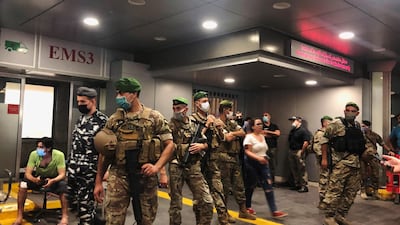
Her daughter Jessica, 22, was a nurse at the Greek-Orthodox hospital in Beirut.
On August 4, she went to work early for a shift that started at 7pm. When the explosion happened at 6.08pm, the hospital entrance door flew across the room, killing her on the spot.
Mr Sawan has so far arrested 25 people as part of the continuing investigation, including top port and Customs officials.
He has heard several political figures as witnesses but not opened investigations against them.
Lebanon’s judiciary is notoriously sensitive to political pressure.
Nizar Saghieh, the founder of local watchdog Legal Agenda, previously said Mr Sawan caved in to political pressure at least twice in his previous career at Beirut's Military Court.
Mr Saghieh raised doubts about his ability to conduct an independent investigation into the port explosion.
Mr Sawan’s attempt on Friday to involve Parliament in the investigation into the Beirut port blast was “unacceptable”, Mr Saghieh said.
“I’m afraid to say that we were right about everything we said,” he said.
Asking for Parliament’s intervention is like declaring himself incompetent to investigate politicians, Mr Saghieh said.
“He’s trying to transfer responsibility to Parliament and tell Parliament, 'Go ahead, you are responsible for investigating ministers, not us'.”.
Ministers in Lebanon can only be tried by a special court that requires the approval of two thirds of Parliament. This has never happened before.
Mr Sawan does not speak to the media and The National's previous attempts to contact him yielded no results.
Ms Najm and Mr Najjar declined to comment.
Victims’ families hope to obtain compensation from the government on similar terms to the allowances given to soldiers’ families if they die on duty.
“They receive a monthly allowance, [free] medicine and schools,” said Ibrahim Hoteit, a spokesman for the victims’ families, who lost his brother in the explosion.
The government gave the families of those killed in the blast a one-off sum of 30 million Lebanese pounds each, or $3,750 at the black market rate and $20,000 at the defunct official rate.
But there were significant delays and it took two months to reach many of them, Mr Hoteit said.
He said he believed the monthly allowance was a little more than one million Lebanese pounds.
That is $133 at the black-market rate, which has been in use since the local currency lost about 80 per cent of its value.
Lebanon’s economy has collapsed in the past year and the IMF expects it to contract by a further 25 per cent in 2020.
Mr Hoteit told The National that MP Ali Hassan Khalil received a delegation of victims' families on Friday afternoon and promised that this week or next, Parliament would sign the law allowing them to receive an allowance.
Mr Hoteit said the law had already been signed by Mr Aoun, Mr Diab, who resigned on August 11 after the blast, and Mr Berri, and that it only needed to be ratified by Parliament.
But Mr Saghieh warned that a caretaker government could not sign off draft laws.
“I think they are playing a very nasty games with the victims, by promising some things that are not valid,” he said.
Mr Khalil did not respond to phone calls on Wednesday.

The%20Letter%20Writer
%3Cp%3E%3Cstrong%3EDirector%3A%3C%2Fstrong%3E%20Layla%20Kaylif%3C%2Fp%3E%0A%3Cp%3E%3Cstrong%3EStars%3A%3C%2Fstrong%3E%20Eslam%20Al%20Kawarit%2C%20Rosy%20McEwen%2C%20Muhammad%20Amir%20Nawaz%3C%2Fp%3E%0A%3Cp%3E%3Cstrong%3ERating%3A%3C%2Fstrong%3E%202%2F5%3C%2Fp%3E%0A
ABU%20DHABI%20CARD
%3Cp%3E%0D%3Cstrong%3E5pm%3A%3C%2Fstrong%3E%20Al%20Rabi%20Tower%20%E2%80%93%20Maiden%20(PA)%20Dh80%2C000%20(Turf)%201%2C400%0D%3Cbr%3E%3Cstrong%3E5.30pm%3A%3C%2Fstrong%3E%20Wathba%20Stallions%20Cup%20%E2%80%93%20Handicap%20(PA)%20Dh70%2C000%20(T)%201%2C600m%0D%3Cbr%3E%3Cstrong%3E6pm%3A%3C%2Fstrong%3E%20Abu%20Dhabi%20Championship%20%E2%80%93%20Listed%20(PA)%20Dh180%2C000%20(T)%201%2C600m%0D%3Cbr%3E%3Cstrong%3E6.30pm%3A%3C%2Fstrong%3E%20Hili%20Tower%20%E2%80%93%20Handicap%20(PA)%20Dh80%2C000%20(T)%202%2C200m%0D%3Cbr%3E%3Cstrong%3E7pm%3A%20%3C%2Fstrong%3EUAE%20Arabian%20Derby%20%E2%80%93%20Prestige%20(PA)%20Dh150%2C000%20(T)%202%2C200m%0D%3Cbr%3E%3Cstrong%3E7.30pm%3A%3C%2Fstrong%3E%20Abu%20Dhabi%20Championship%20%E2%80%93%20Listed%20(TB)%20Dh380%2C000%20(T)%202%2C200m%3C%2Fp%3E%0A
What to watch out for:
Algae, waste coffee grounds and orange peels will be used in the pavilion's walls and gangways
The hulls of three ships will be used for the roof
The hulls will painted to make the largest Italian tricolour in the country’s history
Several pillars more than 20 metres high will support the structure
Roughly 15 tonnes of steel will be used
Results
6pm: Dubai Trophy – Conditions (TB) $100,000 (Turf) 1,200m
Winner: Silent Speech, William Buick (jockey), Charlie Appleby
(trainer)
6.35pm: Jumeirah Derby Trial – Conditions (TB) $60,000 (T)
1,800m
Winner: Island Falcon, Frankie Dettori, Saeed bin Suroor
7.10pm: UAE 2000 Guineas Trial – Conditions (TB) $60,000 (Dirt)
1,400m
Winner: Rawy, Mickael Barzalona, Salem bin Ghadayer
7.45pm: Al Rashidiya – Group 2 (TB) $180,000 (T) 1,800m
Winner: Desert Fire, Hector Crouch, Saeed bin Suroor
8.20pm: Al Fahidi Fort – Group 2 (TB) $180,000 (T) 1,400m
Winner: Naval Crown, William Buick, Charlie Appleby
8.55pm: Dubawi Stakes – Group 3 (TB) $150,000 (D) 1,200m
Winner: Al Tariq, Pat Dobbs, Doug Watsons
9.30pm: Aliyah – Rated Conditions (TB) $80,000 (D) 2,000m
Winner: Dubai Icon, Patrick Cosgrave, Saeed bin Suroor
THE%20STRANGERS'%20CASE
%3Cp%3E%3Cstrong%3EDirector%3C%2Fstrong%3E%3A%20Brandt%20Andersen%3Cbr%3E%3Cstrong%3EStarring%3A%20%3C%2Fstrong%3EOmar%20Sy%2C%20Jason%20Beghe%2C%20Angeliki%20Papoulia%3Cbr%3E%3Cstrong%3ERating%3A%3C%2Fstrong%3E%204%2F5%3C%2Fp%3E%0A
Napoleon
%3Cp%3E%3Cstrong%3EDirector%3C%2Fstrong%3E%3A%20Ridley%20Scott%3Cbr%3E%3Cstrong%3EStars%3C%2Fstrong%3E%3A%20Joaquin%20Phoenix%2C%20Vanessa%20Kirby%2C%20Tahar%20Rahim%3Cbr%3E%3Cstrong%3ERating%3C%2Fstrong%3E%3A%202%2F5%3Cbr%3E%3Cbr%3E%3C%2Fp%3E%0A
THE BIO
Age: 33
Favourite quote: “If you’re going through hell, keep going” Winston Churchill
Favourite breed of dog: All of them. I can’t possibly pick a favourite.
Favourite place in the UAE: The Stray Dogs Centre in Umm Al Quwain. It sounds predictable, but it honestly is my favourite place to spend time. Surrounded by hundreds of dogs that love you - what could possibly be better than that?
Favourite colour: All the colours that dogs come in
Specs
Engine: Dual-motor all-wheel-drive electric
Range: Up to 610km
Power: 905hp
Torque: 985Nm
Price: From Dh439,000
Available: Now
Dolittle
Director: Stephen Gaghan
Stars: Robert Downey Jr, Michael Sheen
One-and-a-half out of five stars
COMPANY%20PROFILE
%3Cp%3E%3Cstrong%3EName%3A%3C%2Fstrong%3E%20SupplyVan%3Cbr%3E%3Cstrong%3EBased%3A%3C%2Fstrong%3E%20Dubai%2C%20UAE%3Cbr%3E%3Cstrong%3ELaunch%20year%3A%3C%2Fstrong%3E%202017%3Cbr%3E%3Cstrong%3ENumber%20of%20employees%3A%3C%2Fstrong%3E%2029%3Cbr%3E%3Cstrong%3ESector%3A%3C%2Fstrong%3E%20MRO%20and%20e-commerce%3Cbr%3E%3Cstrong%3EFunding%3A%3C%2Fstrong%3E%20Seed%3C%2Fp%3E%0A
SPECS
Toyota land Cruiser 2020 5.7L VXR
Engine: 5.7-litre V8
Transmission: eight-speed automatic
Power: 362hp
Torque: 530Nm
Price: Dh329,000 (base model 4.0L EXR Dh215,900)
More on Quran memorisation:
Who's who in Yemen conflict
Houthis: Iran-backed rebels who occupy Sanaa and run unrecognised government
Yemeni government: Exiled government in Aden led by eight-member Presidential Leadership Council
Southern Transitional Council: Faction in Yemeni government that seeks autonomy for the south
Habrish 'rebels': Tribal-backed forces feuding with STC over control of oil in government territory
Queen
Nicki Minaj
(Young Money/Cash Money)
Mercer, the investment consulting arm of US services company Marsh & McLennan, expects its wealth division to at least double its assets under management (AUM) in the Middle East as wealth in the region continues to grow despite economic headwinds, a company official said.
Mercer Wealth, which globally has $160 billion in AUM, plans to boost its AUM in the region to $2-$3bn in the next 2-3 years from the present $1bn, said Yasir AbuShaban, a Dubai-based principal with Mercer Wealth.
“Within the next two to three years, we are looking at reaching $2 to $3 billion as a conservative estimate and we do see an opportunity to do so,” said Mr AbuShaban.
Mercer does not directly make investments, but allocates clients’ money they have discretion to, to professional asset managers. They also provide advice to clients.
“We have buying power. We can negotiate on their (client’s) behalf with asset managers to provide them lower fees than they otherwise would have to get on their own,” he added.
Mercer Wealth’s clients include sovereign wealth funds, family offices, and insurance companies among others.
From its office in Dubai, Mercer also looks after Africa, India and Turkey, where they also see opportunity for growth.
Wealth creation in Middle East and Africa (MEA) grew 8.5 per cent to $8.1 trillion last year from $7.5tn in 2015, higher than last year’s global average of 6 per cent and the second-highest growth in a region after Asia-Pacific which grew 9.9 per cent, according to consultancy Boston Consulting Group (BCG). In the region, where wealth grew just 1.9 per cent in 2015 compared with 2014, a pickup in oil prices has helped in wealth generation.
BCG is forecasting MEA wealth will rise to $12tn by 2021, growing at an annual average of 8 per cent.
Drivers of wealth generation in the region will be split evenly between new wealth creation and growth of performance of existing assets, according to BCG.
Another general trend in the region is clients’ looking for a comprehensive approach to investing, according to Mr AbuShaban.
“Institutional investors or some of the families are seeing a slowdown in the available capital they have to invest and in that sense they are looking at optimizing the way they manage their portfolios and making sure they are not investing haphazardly and different parts of their investment are working together,” said Mr AbuShaban.
Some clients also have a higher appetite for risk, given the low interest-rate environment that does not provide enough yield for some institutional investors. These clients are keen to invest in illiquid assets, such as private equity and infrastructure.
“What we have seen is a desire for higher returns in what has been a low-return environment specifically in various fixed income or bonds,” he said.
“In this environment, we have seen a de facto increase in the risk that clients are taking in things like illiquid investments, private equity investments, infrastructure and private debt, those kind of investments were higher illiquidity results in incrementally higher returns.”
The Abu Dhabi Investment Authority, one of the largest sovereign wealth funds, said in its 2016 report that has gradually increased its exposure in direct private equity and private credit transactions, mainly in Asian markets and especially in China and India. The authority’s private equity department focused on structured equities owing to “their defensive characteristics.”
Frankenstein in Baghdad
Ahmed Saadawi
Penguin Press
MATCH INFO
What: 2006 World Cup quarter-final
When: July 1
Where: Gelsenkirchen Stadium, Gelsenkirchen, Germany
Result:
England 0 Portugal 0
(Portugal win 3-1 on penalties)
Ten tax points to be aware of in 2026
1. Domestic VAT refund amendments: request your refund within five years
If a business does not apply for the refund on time, they lose their credit.
2. E-invoicing in the UAE
Businesses should continue preparing for the implementation of e-invoicing in the UAE, with 2026 a preparation and transition period ahead of phased mandatory adoption.
3. More tax audits
Tax authorities are increasingly using data already available across multiple filings to identify audit risks.
4. More beneficial VAT and excise tax penalty regime
Tax disputes are expected to become more frequent and more structured, with clearer administrative objection and appeal processes. The UAE has adopted a new penalty regime for VAT and excise disputes, which now mirrors the penalty regime for corporate tax.
5. Greater emphasis on statutory audit
There is a greater need for the accuracy of financial statements. The International Financial Reporting Standards standards need to be strictly adhered to and, as a result, the quality of the audits will need to increase.
6. Further transfer pricing enforcement
Transfer pricing enforcement, which refers to the practice of establishing prices for internal transactions between related entities, is expected to broaden in scope. The UAE will shortly open the possibility to negotiate advance pricing agreements, or essentially rulings for transfer pricing purposes.
7. Limited time periods for audits
Recent amendments also introduce a default five-year limitation period for tax audits and assessments, subject to specific statutory exceptions. While the standard audit and assessment period is five years, this may be extended to up to 15 years in cases involving fraud or tax evasion.
8. Pillar 2 implementation
Many multinational groups will begin to feel the practical effect of the Domestic Minimum Top-Up Tax (DMTT), the UAE's implementation of the OECD’s global minimum tax under Pillar 2. While the rules apply for financial years starting on or after January 1, 2025, it is 2026 that marks the transition to an operational phase.
9. Reduced compliance obligations for imported goods and services
Businesses that apply the reverse-charge mechanism for VAT purposes in the UAE may benefit from reduced compliance obligations.
10. Substance and CbC reporting focus
Tax authorities are expected to continue strengthening the enforcement of economic substance and Country-by-Country (CbC) reporting frameworks. In the UAE, these regimes are increasingly being used as risk-assessment tools, providing tax authorities with a comprehensive view of multinational groups’ global footprints and enabling them to assess whether profits are aligned with real economic activity.
Contributed by Thomas Vanhee and Hend Rashwan, Aurifer
Lexus LX700h specs
Engine: 3.4-litre twin-turbo V6 plus supplementary electric motor
Power: 464hp at 5,200rpm
Torque: 790Nm from 2,000-3,600rpm
Transmission: 10-speed auto
Fuel consumption: 11.7L/100km
On sale: Now
Price: From Dh590,000