


Since Prime Minister Benjamin Netanyahu rose to dominate Israeli politics in the 1990s, Jordan has sought to enlist US help in handling a man with the power to affect their stability in his drive to remain in power.
His ascendancy to the premiership in 1996 marked a blow to prospects for lasting peace between Israel and the Palestinians.
Jordan regards the failure to agree to such a peace as being the main cause of political ills in the Middle East and a time bomb that could eventually result in another wave of Palestinian refugees fleeing to the kingdom, where tribes who regard themselves as indigenous form the bulwark of the state's support.
So, when King Abdullah meets President Joe Biden in Washington on Thursday, just days after US Secretary of State Antony Blinken was in the West Bank and Israel, the discussion will probably focus on the boiling tensions and bloodshed already worrying officials before Mr Netanyahu's far-right government took office in December.
King Abdullah and Mr Biden have already met twice since the US leader took office. First was in July 2021, when the monarch became the first Arab head of state to meet the new US commander-in-chief and then a year later in Jeddah for a regional security forum in which Mr Biden sought to assure allies that Washington was still very much committed to the Middle East's security.
-
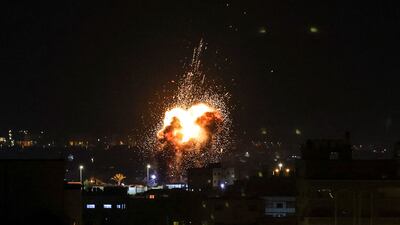
Fire and smoke rise above buildings in Gaza City after Israel launched air strikes. AFP -

Palestinians demonstrate in the Jabalia refugee camp following an Israeli raid. AFP -

Palestinians burn tyres and wave the national flag during a protest against the raid. AP -
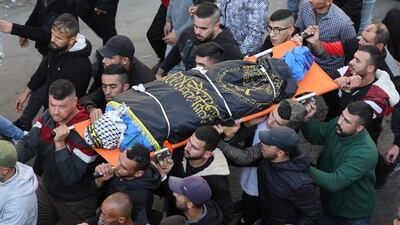
The funeral of one of the victims of the Israeli raid. AFP -
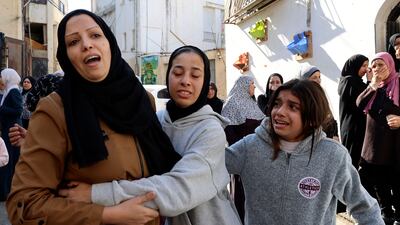
Relatives mourn during the funeral in the occupied West Bank. AFP -

Israeli soldiers aim at Palestinians protesting over the expropriation of their land near the Jewish settlement of Beit El. AFP -
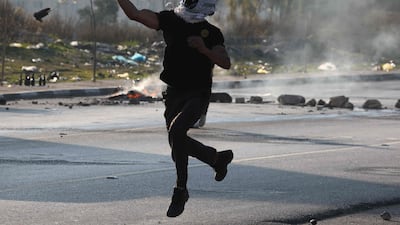
A protester throws a stone at Israeli forces during the demonstration. AFP -
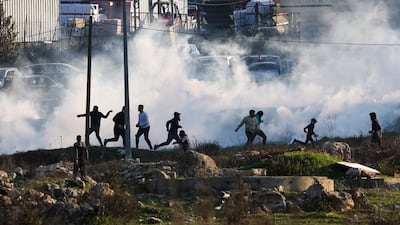
Israeli forces fire tear gas to disperse demonstrators near Beit El in the occupied West Bank. AFP -
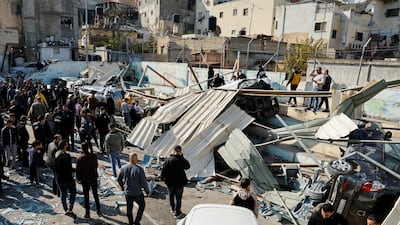
Palestinians inspect the damage following the Israeli raid in Jenin. Reuters -
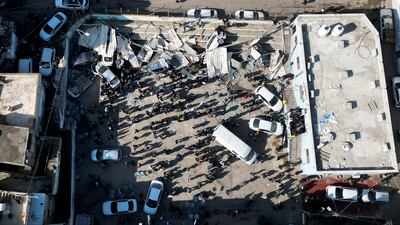
An elderly woman was among those killed in fighting with Israeli troops. Reuters -
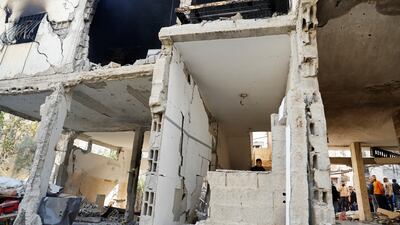
The operation in the flashpoint town is the deadliest Israeli raid in recent months. Reuters -
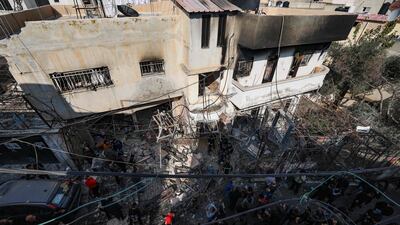
People gather around a building damaged and burned by Israeli troops during the raid. AFP -
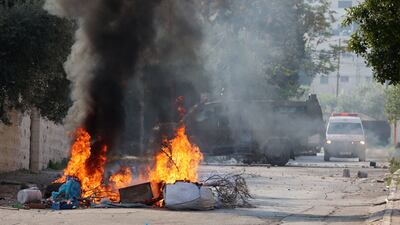
An ambulance drives past an Israeli military vehicle as smoke rises from a fire set by Palestinian demonstrators. AFP -
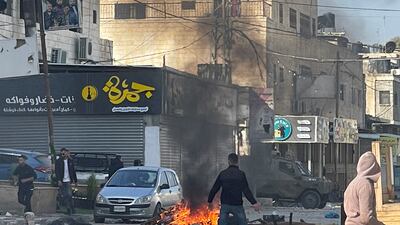
Palestinian stone-throwers gather amid confrontations with Israeli troops during a raid in Jenin in the occupied West Bank. Reuters -

Israeli military vehicles during the raid in Jenin. Reuters -

Palestinians run for cover. AFP -
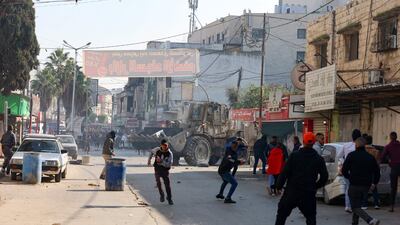
Palestinians in Jenin confront Israeli forces. AFP -

A Palestinian hurls a canister during the raid in the occupied West Bank. Reuters -
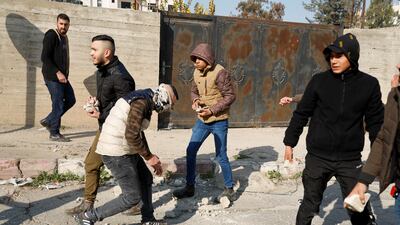
Palestinian stone-throwers gather amid the raid in Jenin. Reuters


Jordan is one of the region's largest recipients of US aid, after Israel and Egypt, and has a defence agreement with Washington. Just last week, Jordan signed a deal to buy new fighter jets from America at a cost of $4.2bn.
Aid and development ties will also feature heavily given global inflation and energy price increases since the start of the Ukraine-Russia war have hit the kingdom hard despite IMF reforms driving faster growth in 2022 than expected. Jordan has previously said that the US will provide $845 million in annual financial support to “finance development projects and implement economic reforms in different sectors”.
Last September, the US committed to providing Jordan with $10.15 billion in aid between 2023 and 2029.
But talks will probably focus on Israel and Palestine.
Although Mr Biden has not placed any political capital on resuming the long-stalled Middle East peace process as Jordan had hoped, the US leader may well share Mr Abdullah's concern that Mr Netanyahu has over-reached with heavy-handed policies towards Palestinians and appeasement of his far-right coalition colleagues, says University of Jordan professor Hasan Al Momani.
While Mr Blinken's message this week was of America's unwavering commitment to Israel and its security, even describing the most right-wing government in the country's history as an illustration of a vibrant democracy, the Biden administration has also made clear that respect for the status quo of religious sites and a halt on settlement building are key.
Mr Blinken arrived in the region with a mission of trying to avert another outbreak of violence between Israel and Gaza or a third intifada following some of the worst violence in years after a month-long crackdown on the West Bank by Israeli security.
Israeli soldiers killed more Palestinians in the West Bank in 2022 than any year since 2005 when the UN began to record fatalities after the Second Intifada.
Mr Netanyahu is a "hostage to the internal Israeli dynamics", Prof Al Momani said on his approach to the Palestinians, pointing out that he had to build a coalition with even more right-wing figures than himself.
He said the Israeli right is not putting any emphasis on peace negotiations ― indeed Mr Netanyahu told CNN on Tuesday that he was less interested in talking to Palestinian leaders as with making peace with Israel's regional neighbours. The policy makes it easier for Mr Netanyahu to keep his focus on Iran and strengthening ties with the Gulf states and Morocco who signed the Abraham Accords to establish ties with Israel.
"Netanyahu has always been a problem for Jordan. His ascendancy [originally] came on a platform of lowering Palestinian expectations," said Prof Al Momani, who teaches international relations at the University of Jordan.
Despite giving Mr Netanyahu the cold shoulder on occasion, Amman has maintained open channels with Israel, which provides Jordan with a significant proportion of its water and gas supplies. The security apparatuses in the two countries also co-operate closely.
Last week, the king was the first Arab leader to meet Mr Netanyahu since he returned to office in December, even though Amman shunned him at the end of his previous term in 2020.
King Abdullah told Mr Netanyahu of the need to "maintain calm and cease all acts of violence to pave the way for a political horizon for the peace process", the Royal Palace said.
Then as violence flared in the West Bank and Jerusalem, Mr Netanyahu told CNN that he wasn't “hung up” on peace talks. Instead, he said that continuing the normalisation process with Arab states could eventually help Palestinian-Israeli talks take off.
Prof Al Momani said that Jordan "does not take this line".
He said that regardless of the outcome of the meeting between the king and Mr Biden, Jordan will remain the strongest Arab advocate that normalisation cannot substitute for a solution to the Palestinian problem.
"The crux of the problem is the Palestinian issue," he said.

