

Iraq hit one of its lowest points during the final weeks of Saddam Hussein's Baath government.
Saddam's regime had been accused of killing more than 200,000 Iraqis in prisons, reprisals and repression.
But despite the misery caused by the regime, and worries about a pending invasion, citizens tell The National that there was a level of security. Those wanted by the state were persecuted ruthlessly, but for others, daily life was generally safe.
-
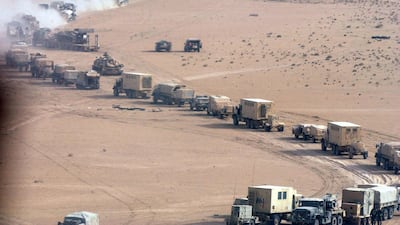
A long US military convoy moving inside an unspecified area of southern Iraq on March 21, 2003. US and British forces were poised to capture the city of Basra on day two of the war to topple President Saddam Hussein. AFP -
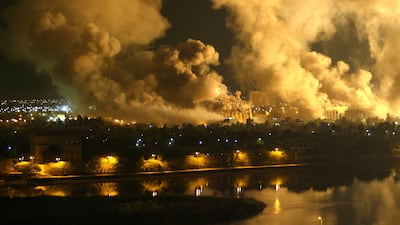
Smoke covers the presidential palace compound in Baghdad on March 21, 2003 during a massive US-led air raid on the Iraqi capital. Smoke billowed from a number of sites, including one of President Saddam Hussein's palaces, an AFP correspondent said. AFP -

Members of Britain's 16 Air Assault Brigade on patrol during a sandstorm in the deserts around the oil fields of Rumaila in southern Iraq on March 25, 2003. AFP -
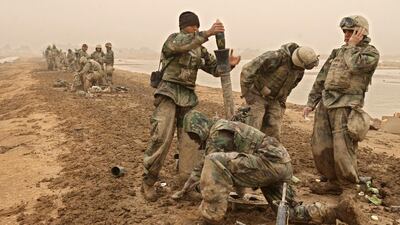
US Marines from the 2nd Batallion 8th Regiment load mortar shells into launchers in Nasiriyah, about 360 kilometres south-east of Baghdad, as they pound Iraqi positions early on March 26, 2003. AFP -
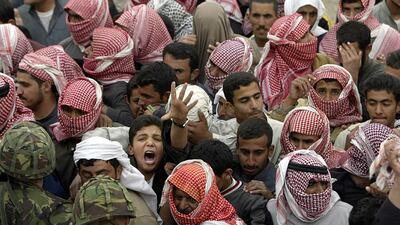
An Iraqi boy struggles amid a crowd to reach for giveaways thrown from a lorry in the southern city of Safwan on March 26, 2003. AFP -

Residents flee the burning town of Basra in southern Iraq on March 28, 2003. British soldiers said the fleeing refugees had described a city still in the grip of an Iraqi military that had hidden large amounts of artillery tanks in civilian and commercial areas. AFP -

Iraqi Republican guards cheer as they pass a wrecked US army Abrams tank, south of Baghdad, on April 6, 2003. AFP -
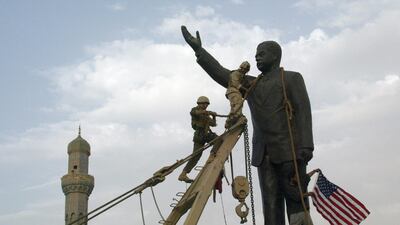
US Marines chain the head of a statue of Saddam Hussein before pulling it down in Baghdad's Firdous Square on April 9, 2003, while an Iraqi waves the US flag. US troops moved into the heart of the Iraqi capital meeting little resistance. AFP -
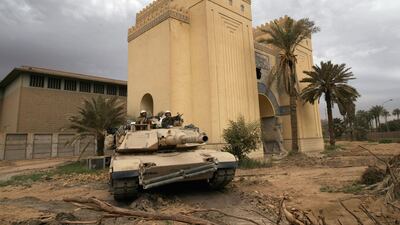
A US tank takes up position outside the plundered Iraqi National Museum in Baghdad on April 16, 2003. Getty Images -
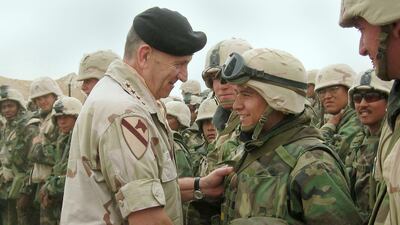
Gen Tommy Franks shakes hands with US Marines of the 1st Marine Expeditionary Force in the Iraqi city of Numaniyah, about 140 kilometres south-east of Baghdad, on April 7, 2003. Getty Images -
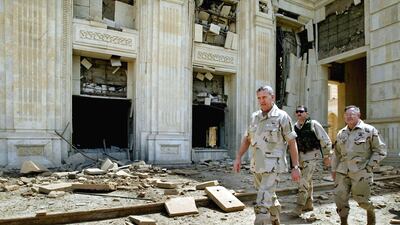
Gen Tommy Franks (c) visits a palace of Saddam Hussein in Baghdad on April 16, 2003. Getty Images -

US Secretary of Defence Donald Rumsfeld (c) is saluted by US Army Lt Gen William Wallace as he arrives at Baghdad International Airport on April 30, 2003. Getty Images -
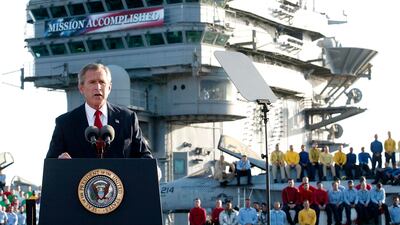
US President George W Bush addresses the nation aboard the nuclear aircraft carrier USS Abraham Lincoln on May 1, 2003. Mr Bush declared that major fighting was over in Iraq, calling it "one victory in a war on terror". AFP


People remember leaving cars unlocked and doors open at night, even as crime rose in the 1990s, amid growing poverty, which the government blamed on international sanctions.
That era would vanish in a matter of weeks as the US-led invasion that began on March 20, 2003, left a power vacuum, with crumbling police forces and a hastily disbanded army.
39, from Baghdad
A crime wave swept Iraq including robberies, looting, tribal conflicts and – before long – sectarian chaos.
This wiped out any hope that the country could quickly prosper in a post-Saddam Iraq without sanctions.
Mohammed, 40, from Anbar, says in the months leading up to the invasion, Baghdad was calm, although very tense.
“We didn’t know what was going to happen,” he says.

“Life seemed somewhat normal except for what we were seeing on the news.
“On the ground, things continued, daily life went on but the public wasn’t at ease. We knew something was coming but had no idea that things would drastically change.”
Within a couple of months, Iraqis were “exchanging horror stories about the latest killings, rapes, carjacks and robberies”, reported the International Crisis Group from Baghdad in the summer of 2003.
Poverty, crime and chaos
Life had deteriorated across much of the country at the end of the 1990s, amid sanctions, but for some Iraqis it was improving, particularly in Baghdad and cities Saddam prioritised for their relative loyalty.
But starting in 1998, the UN eased sanctions, lifting oil export restrictions under Security Council Resolution 1153.
The Oil for Food programme – under which Iraq’s oil exports were managed in exchange for food – was found by UN auditors to have been riddled with corruption, but its expansion helped alleviate the severe humanitarian crisis.

Several Arab countries, particularly Jordan and Syria, had also decided to bypass sanctions.
Mushtaq, a former police commander in Baghdad, remembers how Iraq reconciled with Syria and the nations opened the border for trade.
“This created a much better situation and we depended on Syria for everything, for the last five years before the war, things such as medicine. Jordan as well,” he says.
Within a month of the fall of the regime, trade routes to Syria and Jordan would be plagued by bandits and labelled unsafe by NGOs reporting to the UN.
Iraq's long decline
Mohammed Al Hilli, 40, was a student at a veterinary college near Abu Ghraib in 2003.
He remembers that, during the 1980s, his father would leave his car after work “in the car park, sometimes even open, and he would come home by taxi.”
“In the 1990s you couldn’t do that. It wasn’t secure enough outside your house,” he says.
Poverty brought by sanctions drove up crime, Mr Al Hilli says, but it was nothing compared to the chaos after 2003.
His hometown of Yusufiyah, south of Baghdad, was in an area that would come to be called “the triangle of death” after 2003. He says his own tribe, which has both Sunni and Shiite members, became embroiled in a conflict with Al Qaeda on one side and hardline Shiite militias opposing them on the other.

Mushtaq says that people who were loyal to the government before 2003 had secure lives – escaping periodic Baath party crackdowns – but organised crime rose noticeably during the era of sanctions.
Crime rose as per capita income dropped to about $500 for most of the 1990s. By one estimate, it had risen to $760 in 2002, a similar level to Angola and a far cry from Iraq’s rising prosperity in the late 1970s.

As many as four million Iraqis left the country before the war.
The invasion only accelerated that trend: the number of displaced, internally and outside of Iraq would swell to nine million by 2020.
Hope for the future
Child malnutrition was rife, affecting as many as one in five children, according to Save the Children ― a disaster blamed on sanctions and Saddam, although estimates of how many perished vary widely.
Mr Al Hilli looks back on an impoverished childhood.
“I remember at that time, even though we had our own farms, we didn’t have anything like wheat,” he says.
They would try to find substitutes for wheat flour.
“We would even mix in things that I would never eat now, just to have enough food.
“After Saddam agreed to the oil for food deal there was an improvement, especially when we started having rations through the government.”
But unemployment was still high, as it is now.
“You either get employed by the government, and then you get a very small salary, like tens of dollars per month, or you would have very few opportunities to do anything,” he says.
According to the International Labour Organisation, most Iraqis still hope for a government job and the private sector remains weak.
Reem Hassan, 39, from Baghdad, says many were hoping for new lives after the invasion.
“We had mixed feelings but we hoped for the best. Iraqis at the time of 2002-2003 needed a change from the situation we were in but we didn’t expect how this kind of change was brought about,” she says.
“The change the Americans brought us was not the one Iraqis wanted”, she adds.
The looming disaster of war
Mr Mohammed says a lot of the corruption that would come to define post-2003 Iraq began during the sanctions period. He points to the education sector, where some impoverished teachers earning around $40 a month took bribes to give children better grades.
“Some teachers forced children to pay them indirectly, for example, by saying, ‘I won’t teach you very well in class.’ So you would be forced to take special private classes, after school or during weekends or breaks, and then you pay for those,” he says.

Despite these problems, Mushtaq looks back on the months before the war with some fondness.
“I could sleep with my outside garden door open, I could sleep deeply if I don’t have any issues with the Baath party, I'm safe. I could live 400, 200 years without any problems.”
But he remembers his badly-resourced local police force trying to tackle “more organised crime after the economic blockade” as black market activity, especially smuggling, surged.
That problem paled into insignificance after the invasion, when he found himself fighting for his life in Iraq's new police force.
Mafia rule
“Looking back, although we have, on paper, a functioning government with ministers and officials and have made many elections where we can vote, life before March 2003 is the one Iraqis are craving and this is the life we have always wanted”, says Mr Mohammed from Anbar.
“We need security, we need a good education system, good governance with officials who want the best for the country. We had security during the Baathist era as long as we didn't cross lines with the regime, but now the situation is dysfunctional on all levels”.
Habeeb, a professor in Dhi Qar, tells of how Saddam ruined what he remembers as “a golden age” in the 1970s when he came to power in 1979. But he also recalls how militias came to rule his home province after 2003.
“My point of view on the Baath era, there was a system and a state of institutions, but on the other hand, there was a dictatorship with the fateful decisions of the country being taken by Saddam.”
“Before regime change, everyone aspired to a democratic state with national leadership. But after the change, everyone is shocked that we are being led by a group of traitors, mafias, and a state of corruption”, he says.

