

Iraq’s Independent High Electoral Commission has confirmed that the manual count for a sample of polling boxes matched the initial results released on Monday.
It has moved to reassure those sceptical of Sunday’s national election results, which were based on an electronic tally.
The early parliamentary election was the fifth since the 2003 US-led invasion that toppled Saddam Hussein’s regime.
It was one of numerous demands of the pro-reform, youth-led protest movement that engulfed the country in October 2019.
The turnout, 41 per cent, was the lowest participation in any Iraqi election since 2005, underlining the growing lack of interest among Iraqis for a political system that is widely seen as broken.
In the 2018 election, the turnout was 44.5 per cent.
The chairman of Ihec Board of Commissioners, Judge Jalil Adnan Khalaf, said one box was picked up randomly from each polling centre in the country, providing 8,547 boxes to be counted manually.
“It was a 100 per cent match,” he said.
Mr Khalaf said results from 3,681 polling boxes had been sent to Ihec headquarters in Baghdad, following a failure in the transmission process or a delay in sending memory sticks.
The manual tallying of the ballots was completed on Wednesday afternoon, leading to a small change in seat numbers for the competing parties but, as expected, the change did not overturn the Sadrist dominance of the results, or the poor performance of the Iran-linked Fatah Alliance.
Moqtada Al Sadr’s followers, the Sadrist bloc, was ahead of others, with more than 72 seats.
-
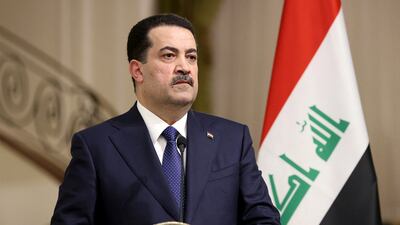
Iraq's Prime Minister Mohamed Shia al-Sudani. AFP -

Hadi al-Amiri leader of the Badr Organisation attends an election rally, along with his Fatih bloc supporters, ahead of the parliamentary election in Baghdad, Iraq October 5, 2021. REUTERS/Ahmed Saad -
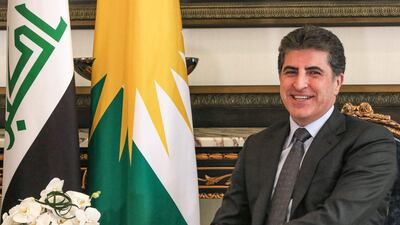
Nechirvan Barzani, President of Iraq's autonomous Kurdistan Region, meets with the Iraqi prime minister in Erbil, the capital of the northern Iraqi Kurdish autonomous region, on March 14, 2022. AFP -
Shiite Muslim cleric Moqtada Sadr gives a speech in Iraq's central holy shrine city of Najaf. AFP -
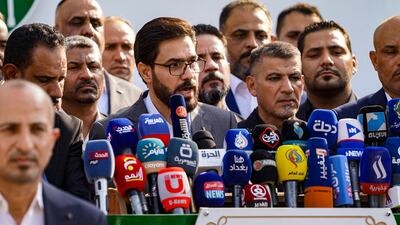
A member of the Iraqi Sadrist bloc (of Shiite leader Moqtada Sadr) announces the party's electoral programme for the upcoming elections, in the central city of Najaf, on September 30, 2021. - Iraq will hold parliamentary elections on October 10, a year early to appease an anti-government protest movement, at a time of simmering anger over graft and economic crisis. (Photo by Ali NAJAFI / AFP) -

Ammar al-Hakim, Leader of the Hikma movement and accompanied by his children, shows his inked finger at a polling station in Baghdad, as Iraqis go to the polls to vote in the parliamentary election, in Iraq, October 10, 2021. REUTERS/Thaier al-Sudani -

Former Iraqi Prime Minister Nouri al-Maliki shows his inked finger at a polling station in Baghdad, as Iraqis go to the poll to vote in the parliamentary election, in Iraq, October 10, 2021. REUTERS/Thaier al-Sudani


Sunni Parliament Speaker Mohammed Al Halbousi’s Taqadum party came second, with 37 seats, while former prime minister Nouri Al Maliki’s State of Law bloc was third, with about 35.
Independent candidates, mainly those linked to the protest movement, are expected to gain at least 30 seats.
The Iran-backed Fatah bloc led by paramilitary leader Hadi Al Amiri – comprising an array of politicians and militia commanders linked to Tehran – looked likely to suffer significant losses, securing only 17 seats.
Fatah are expected to gain at least four more seats as government formation talks continue and smaller parties decide to join their alliance.
Any new coalition to create the largest bloc could pose a challenge for the Sadrists, but opposing groups will need to strive hard for compromise.
Mr Al Sadr had said a day earlier that a delay in announcing the final results and disagreements over ballot boxes would only harm the Iraqi public.
“We call on everyone to exercise restraint and to show a patriotic spirit for the sake of the country and to abide by the legal methods regarding electoral objections,” Mr Al Sadr said on Twitter.
The initial results sparked accusations of electoral fraud.
Fatah and several other Shiite political parties, as well as some independent candidates, contested the results, saying paper ballots did not match the electronic results received earlier.
Mr Khalaf said the discrepancy occurred because the initial results covered only 94 per cent of the votes.
“The procedures adopted by the commission are accurate and watched closely,” he said.
International and local monitors said they had not registered any serious breaches during the election process that could call into question the accuracy of the results.
On Tuesday, the EU election observers said the election had been “peaceful, calm and orderly”.
Chief EU observer Viola von Cramon commended Iraq and its people for the conduct of the election, with 95 per cent of polling stations visited by EU observers rated positively.
The US said late on Tuesday that once results are confirmed it hopes the new government will reflect “the will of the Iraqi people” and work to address the country’s “governance, security and economic challenges”.
“These elections included hundreds of international monitors and observers from the UN and EU, in addition to thousands of domestic observers. We look forward to reviewing their reports,” White House Press Secretary Jen Psaki said.
Ms Psaki congratulated Iraq on fulfilling its promise to hold early elections and meeting the demands of protesters.

