Iraq elections 2021: results to come Monday afternoon amid fears of low turnout


  • English
  • Arabic

Latest: Iraq election turnout was 41%

The results of Iraq's first elections under new electoral law will be revealed at 3pm local time on Monday afternoon, within 24 hours of polls closing, the Iraqi electoral commission has said.

They are likely to be overshadowed by the confirmation of a low voter turnout, despite Iraq's prime minister hailing the process as "safe and fair" – a verdict echoed by the electoral commission chairman.

"Elections were completed in a fair manner, the results will be released within 24 hours and the voter turnout numbers will be released within two hours," judge Jalil Adnan said.

Officials and mosques urged residents to head to polling stations throughout the day, but very few responded.

“The turnout has reached more than 20 per cent of the registered voters,” the head of the elections commission, Galeel Adnan, told the state-run Iraqi News Agency.

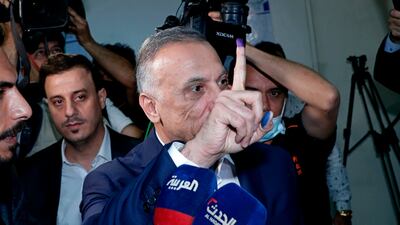
Prime Minister Mustafa Al Kadhimi tweeted as polls closed: "Thank God, we have fulfilled our duty and our promise to hold fair and safe elections."

Mr Al Kadhimi was the first senior official to cast his vote and he appealed to all Iraqis to do the same.

“We have passed the middle of the day and the electoral process has been smooth," he said.

"I thank all those who participated in the polls, and I call on the voters who have not yet voted to quickly head to the polling station and choose their representatives.

“We all have to work to change our reality,” Mr Al Kadhimi said earlier after casting his ballot in Baghdad. “Go out and vote, for the sake of Iraq and your future.”

The vote was held months ahead of schedule under a new electoral law, introduced in response to the demands of the pro-reform, youth-led protest movement that began in October 2019,prompted by rampant corruption, poor services and a lack of jobs.

The election is the fifth since the toppling of Saddam Hussein’s dictatorship by a US-led invasion in 2003.

A total of 3,249 candidates are vying for the 329 seats in parliament. Among them are 951 women, who are guaranteed 25 per cent, or 83, of the seats under the new law.

Out of about 25 million registered voters, more than 23 million have updated their information to be eligible to take part.

“All the reports that we received to the moment indicate that the voting process has been carried out in normal and calm situation,” Saeid Abu Ali, deputy head of the Arab league observers, told INA.

“We didn't receive any report of grave violations."

President Barham Salih said the election presented an opportunity for Iraqis to “restore the initiative for reform and development”.

“We must accomplish the task by participating broadly and protecting the voices of Iraqis to decide the future of their country,” Mr Salih said on Twitter.

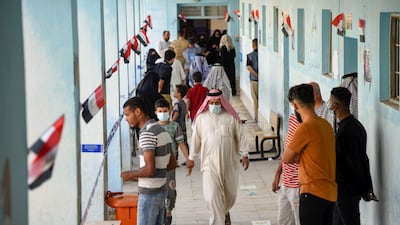
  • A man walks through a polling station in Nassiriya, Iraq, on the day of the country’s parliamentary election. Photo: Reuters
    A man walks through a polling station in Nassiriya, Iraq, on the day of the country’s parliamentary election. Photo: Reuters
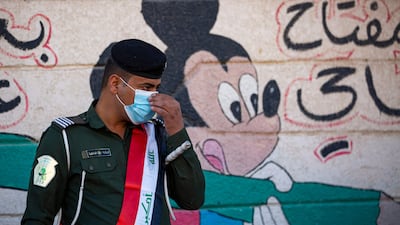
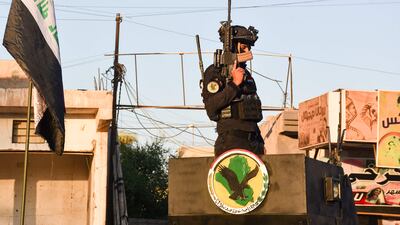
  • A member of the Iraqi security forces stands guard outside a polling station in the southern city of Basra. Photo: AFP
    A member of the Iraqi security forces stands guard outside a polling station in the southern city of Basra. Photo: AFP
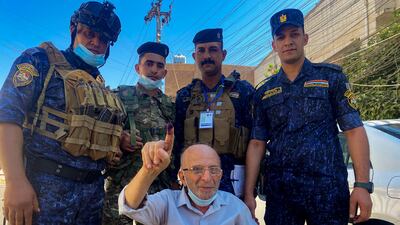
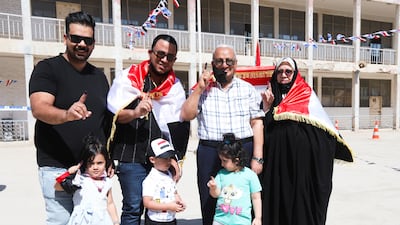
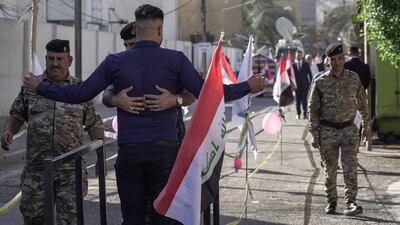
  • Iraqi security forces pose for a photo with an elderly man after he cast his vote in Baghdad. Photo: Reuters
    Iraqi security forces pose for a photo with an elderly man after he cast his vote in Baghdad. Photo: Reuters
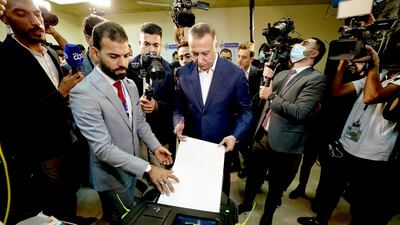
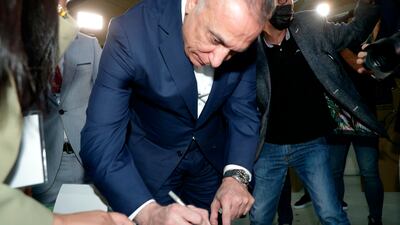
  • Iraqi Prime Minister Mustafa Al Kadhimi casts his vote in the Green Zone, Baghdad. Photo: Reuters
    Iraqi Prime Minister Mustafa Al Kadhimi casts his vote in the Green Zone, Baghdad. Photo: Reuters
  • People show their ink-stained fingers after casting their votes in Najaf. Photo: Reuters
    People show their ink-stained fingers after casting their votes in Najaf. Photo: Reuters
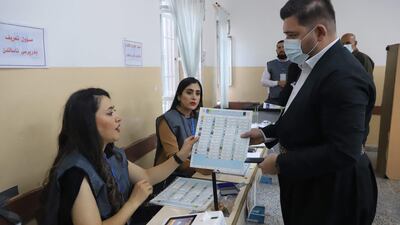
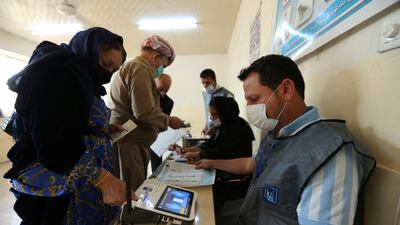
  • An Iraqi Kurdish voter registers to cast his vote in early parliamentary elections at a polling station in Sulaimaniyah, in Iraq’s northern Kurdish autonomous region. Photo: AFP
    An Iraqi Kurdish voter registers to cast his vote in early parliamentary elections at a polling station in Sulaimaniyah, in Iraq’s northern Kurdish autonomous region. Photo: AFP
  • Viola von Cramon-Taubadel, chief observer of the EU Election Observation Mission to Iraq, at a polling station in Baghdad. Photo: AFP
    Viola von Cramon-Taubadel, chief observer of the EU Election Observation Mission to Iraq, at a polling station in Baghdad. Photo: AFP
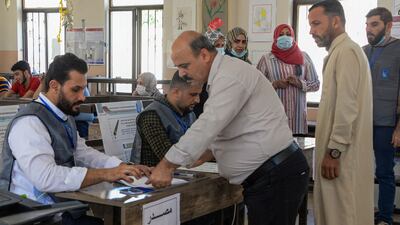
  • A man registers to vote at a polling station in the northern city of Mosul. Photo: AFP
    A man registers to vote at a polling station in the northern city of Mosul. Photo: AFP
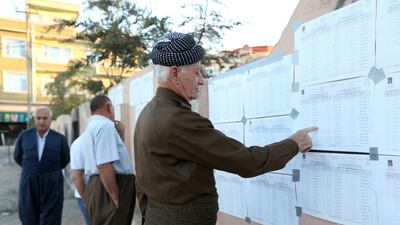
  • Iraqis search for their names on a list at a polling station in Najaf. Photo: AP
    Iraqis search for their names on a list at a polling station in Najaf. Photo: AP
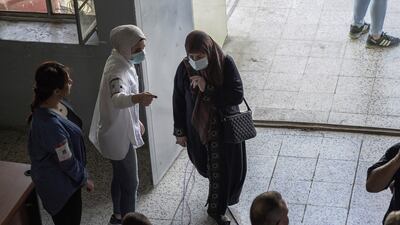
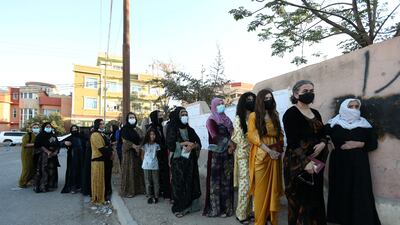
  • A woman makes her way to the polling station to cast her vote. Photo: Haider Husseini / The National
    A woman makes her way to the polling station to cast her vote. Photo: Haider Husseini / The National
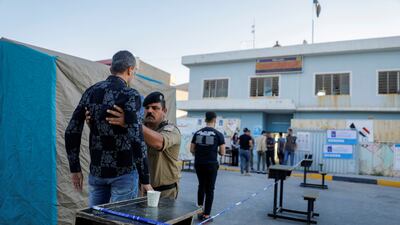
  • Security forces conduct a body search of a voter at the entrance to a polling station. Photo: Haider Husseini / The National
    Security forces conduct a body search of a voter at the entrance to a polling station. Photo: Haider Husseini / The National
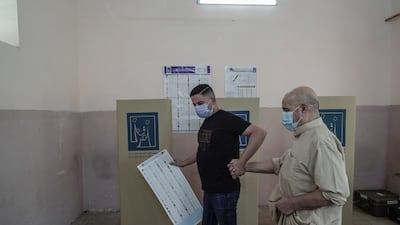
  • A blind man prepares to cast his vote to vote with the help of his son at a polling station in Baghdad. Photo: Haider Husseini / The National
    A blind man prepares to cast his vote to vote with the help of his son at a polling station in Baghdad. Photo: Haider Husseini / The National
  • The first voter to arrive at a polling station in Karadah, central Baghdad, casts his vote. Photo: Haider Husseini / The National
    The first voter to arrive at a polling station in Karadah, central Baghdad, casts his vote. Photo: Haider Husseini / The National
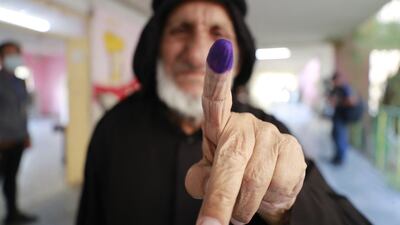
  • An Iraqi voter displays his inked finger after casting his ballot at a polling station in Baghdad, in an early parliamentary election billed as a concession to anti-government protests. It is expected to be boycotted by many voters who distrust official promises of reform. Photo: AFP
    An Iraqi voter displays his inked finger after casting his ballot at a polling station in Baghdad, in an early parliamentary election billed as a concession to anti-government protests. It is expected to be boycotted by many voters who distrust official promises of reform. Photo: AFP
  • Iraqi Prime Minister Mustafa Al Kadhimi, centre, displays his ink-stained finger at a polling station. Photo: AP
    Iraqi Prime Minister Mustafa Al Kadhimi, centre, displays his ink-stained finger at a polling station. Photo: AP
  • A member of the Iraqi security forces stands guard in the city of Tikrit, north of the capital, Baghdad, during the country’s parliamentary elections. Photo: AFP
    A member of the Iraqi security forces stands guard in the city of Tikrit, north of the capital, Baghdad, during the country’s parliamentary elections. Photo: AFP
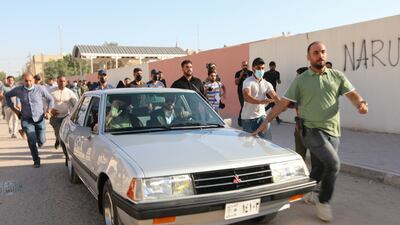
  • Iraqi Shiite cleric Moqtada Al Sadr waves from a car in Najaf. Photo: Reuters
    Iraqi Shiite cleric Moqtada Al Sadr waves from a car in Najaf. Photo: Reuters
  • Mustafa Al Kadhimi casts his vote. Photo: AP
    Mustafa Al Kadhimi casts his vote. Photo: AP
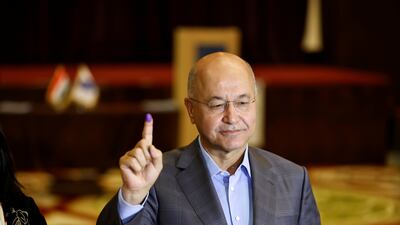
  • President Barham Salih holds up his inked finger at a polling station in Baghdad. Photo: Reuters
    President Barham Salih holds up his inked finger at a polling station in Baghdad. Photo: Reuters
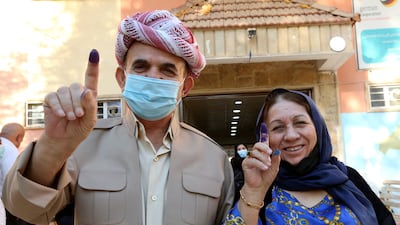
  • Voters display their inked fingers outside a polling station in Duhok. Photo: Reuters
    Voters display their inked fingers outside a polling station in Duhok. Photo: Reuters
  • A woman casts her vote in Duhok. Photo: Reuters
    A woman casts her vote in Duhok. Photo: Reuters
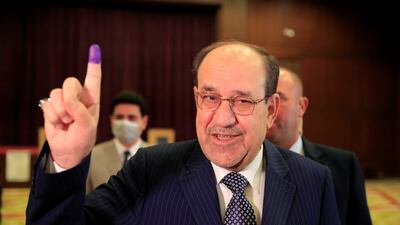
  • Former Iraqi prime minister Nouri Al Maliki shows his inked finger at a polling station in Baghdad. Photo: Reuters
    Former Iraqi prime minister Nouri Al Maliki shows his inked finger at a polling station in Baghdad. Photo: Reuters
  • Voters queue at a polling station in Duhok. Photo: Reuters
    Voters queue at a polling station in Duhok. Photo: Reuters
  • Voters look for their names on a list at a polling station in Duhok. Photo: Reuters
    Voters look for their names on a list at a polling station in Duhok. Photo: Reuters
  • People undergo security checks before gaining entry to a polling station in Qaraqosh, Nineveh governorate. Photo: Reuters
    People undergo security checks before gaining entry to a polling station in Qaraqosh, Nineveh governorate. Photo: Reuters
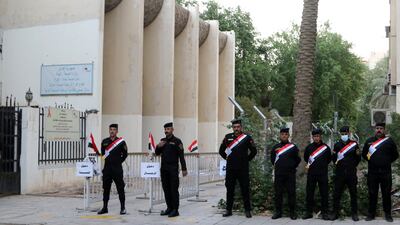
  • Iraqi security forces stand guard outside a polling station in the Green Zone, Baghdad. Photo: Reuters
    Iraqi security forces stand guard outside a polling station in the Green Zone, Baghdad. Photo: Reuters

The elections are not expected to change the country’s political landscape because the established parties, mainly those with links to militias, are likely to hold the balance of power after the vote.

“We only hope to have peace and stability in this country,” Ali Al Greywit, 40, who works at a medical lab, told The National after casting his vote in Baghdad's Karrada district.

“We need nothing more than peace and stability.”

Few people trickled to polling stations in Baghdad's western Karkh side.

“I feel something different in these elections,” Rihab Mohammed Ali, 49, told The National after casting her ballot in Baghdad's Mansour district. “I'm optimistic that we can see some change.”

“I voted for an independent candidate because all those we elected before sought only their interests. The independent candidate seeks reforms to the country.”

Walking slowly with a cane and clutching prayer beads, Tariq Hassan reached the polling station in nearby Al Jamiaa.

“We hope that we can get an honest person who can salvage us from the gang of corrupt people,” Mr Hassan, 75, said, wearing his face mask under his chin.

“May God protect us and the country.”

The picture was different in Baghdad's eastern district of Sadr City, the stronghold of the Shiite firebrand cleric Moqtada Al Sadr, where a festive mood prevailed.

Men and women flocked to the polling stations with their children, who held Iraqi flags and the logo of the Sadrist Movement.

It features a fist wrapped with the Iraqi flag and holding a cane, a reference to Mr Al Sadr's father, a revered cleric who was killed by Saddam Hussein.

An Iraqi man flashes the V for victory sign as he arrives at a polling station at the southern city of Mosul, on October 10, 2021. AFP

“We will not abandon Abu Hashim,” Mousa Shaghati, 45, a carpenter, said, emerging from a polling station in Sadr City with his wife and son, using the nickname for Mr Al Sadr.

“We all voted for the Sadrist bloc,” Mr Shagati said, wearing a T-shirt with Mr Al Sadr's picture.

Tight security measures have been put in place to protect voters.

Roads leading to polling centres have been closed off with razor wire and security forces are on patrol.

Authorities closed airports and land crossings from 9am on Sunday until 6am on Monday. Lorries with capacity of more than two tonnes, motorcycles and auto rickshaws were not allowed on the streets.

Movement between the provinces was also prohibited. All shops and restaurants have been ordered to remain closed until Monday morning, excluding pharmacies, bakeries, supermarkets and grocers.

Besides allowing independent candidates to contest, the new electoral law has divided the country into constituencies, with seats to be allotted to whoever gets the most votes in each electoral district.

In previous elections, political parties were awarded seats based on their share of the national vote.

The new law and an eagerness for change have encouraged independent candidates to compete against major Shiite, Sunni and Kurdish political parties.

The main Shiite groups are the Sadrist Movement, the Fatah Alliance made up of Iran-backed Shiite militias, and the National State Forces Alliance created by former prime minister Haider Al Abadi and Shiite cleric Ammar Al Hakim.

Two main Sunni alliances are Taqadum, led by Parliament Speaker Mohamed Al Halbousi, and Azim, led by tycoon Khamis Al Kanjar. Both men are from Anbar province in western Iraq.

In the semi-autonomous Kurdish region, Kurds could choose from among the two main parties, the Kurdistan Democratic Party and the Patriotic Union of Kurdistan, and smaller opposition parties.

Masrour Barzani, Prime Minister of the Kurdish Regional Government, also urged voters to take part.

“I hope today’s federal elections in Iraq succeed peacefully, and I urge every eligible voter to turn up and cast their vote,” he said on Twitter.

Activists of the October 2019 protest movement are divided about the elections. Some called for a boycott while others ran as independents or within newly formed political parties or secular alliances.

The main activist party is the Imtidad Movement, formed in the southern city of Nassiriya, which put 38 candidates in nine provinces.


RESULT

Bayern Munich 5 Eintrracht Frankfurt 2
Bayern:
 Goretzka (17'), Müller (41'), Lewandowski (46'), Davies (61'), Hinteregger (74' og)    
Frankfurt: Hinteregger (52', 55')

SQUAD

Ali Khaseif, Fahad Al Dhanhani, Adel Al Hosani, Mohammed Al Shamsi, Bandar Al Ahbabi, Mohammed Barghash, Salem Rashid, Khalifa Al Hammadi, Shaheen Abdulrahman, Hassan Al Mahrami, Walid Abbas, Mahmoud Khamis, Yousef Jaber, Saeed Ahmed, Majed Sorour, Majed Hassan, Ali Salmeen, Abdullah Ramadan, Khalil Al Hammadi, Fabio De Lima, Khalfan Mubarak, Tahnoun Al Zaabi, Ali Saleh, Caio Canedo, Muhammed Jumah, Ali Mabkhout, Sebastian Tagliabue, Zayed Al Ameri

City's slump

L - Juventus, 2-0
D - C Palace, 2-2
W - N Forest, 3-0
L - Liverpool, 2-0
D - Feyenoord, 3-3
L - Tottenham, 4-0
L - Brighton, 2-1
L - Sporting, 4-1
L - Bournemouth, 2-1
L - Tottenham, 2-1

Mercer, the investment consulting arm of US services company Marsh & McLennan, expects its wealth division to at least double its assets under management (AUM) in the Middle East as wealth in the region continues to grow despite economic headwinds, a company official said.

Mercer Wealth, which globally has $160 billion in AUM, plans to boost its AUM in the region to $2-$3bn in the next 2-3 years from the present $1bn, said Yasir AbuShaban, a Dubai-based principal with Mercer Wealth.

Within the next two to three years, we are looking at reaching $2 to $3 billion as a conservative estimate and we do see an opportunity to do so,” said Mr AbuShaban.

Mercer does not directly make investments, but allocates clients’ money they have discretion to, to professional asset managers. They also provide advice to clients.

“We have buying power. We can negotiate on their (client’s) behalf with asset managers to provide them lower fees than they otherwise would have to get on their own,” he added.

Mercer Wealth’s clients include sovereign wealth funds, family offices, and insurance companies among others.

From its office in Dubai, Mercer also looks after Africa, India and Turkey, where they also see opportunity for growth.

Wealth creation in Middle East and Africa (MEA) grew 8.5 per cent to $8.1 trillion last year from $7.5tn in 2015, higher than last year’s global average of 6 per cent and the second-highest growth in a region after Asia-Pacific which grew 9.9 per cent, according to consultancy Boston Consulting Group (BCG). In the region, where wealth grew just 1.9 per cent in 2015 compared with 2014, a pickup in oil prices has helped in wealth generation.

BCG is forecasting MEA wealth will rise to $12tn by 2021, growing at an annual average of 8 per cent.

Drivers of wealth generation in the region will be split evenly between new wealth creation and growth of performance of existing assets, according to BCG.

Another general trend in the region is clients’ looking for a comprehensive approach to investing, according to Mr AbuShaban.

“Institutional investors or some of the families are seeing a slowdown in the available capital they have to invest and in that sense they are looking at optimizing the way they manage their portfolios and making sure they are not investing haphazardly and different parts of their investment are working together,” said Mr AbuShaban.

Some clients also have a higher appetite for risk, given the low interest-rate environment that does not provide enough yield for some institutional investors. These clients are keen to invest in illiquid assets, such as private equity and infrastructure.

“What we have seen is a desire for higher returns in what has been a low-return environment specifically in various fixed income or bonds,” he said.

“In this environment, we have seen a de facto increase in the risk that clients are taking in things like illiquid investments, private equity investments, infrastructure and private debt, those kind of investments were higher illiquidity results in incrementally higher returns.”

The Abu Dhabi Investment Authority, one of the largest sovereign wealth funds, said in its 2016 report that has gradually increased its exposure in direct private equity and private credit transactions, mainly in Asian markets and especially in China and India. The authority’s private equity department focused on structured equities owing to “their defensive characteristics.”

Europe’s rearming plan
  • Suspend strict budget rules to allow member countries to step up defence spending
  • Create new "instrument" providing €150 billion of loans to member countries for defence investment
  • Use the existing EU budget to direct more funds towards defence-related investment
  • Engage the bloc's European Investment Bank to drop limits on lending to defence firms
  • Create a savings and investments union to help companies access capital
Key findings of Jenkins report
  • Founder of the Muslim Brotherhood, Hassan al Banna, "accepted the political utility of violence"
  • Views of key Muslim Brotherhood ideologue, Sayyid Qutb, have “consistently been understood” as permitting “the use of extreme violence in the pursuit of the perfect Islamic society” and “never been institutionally disowned” by the movement.
  • Muslim Brotherhood at all levels has repeatedly defended Hamas attacks against Israel, including the use of suicide bombers and the killing of civilians.
  • Laying out the report in the House of Commons, David Cameron told MPs: "The main findings of the review support the conclusion that membership of, association with, or influence by the Muslim Brotherhood should be considered as a possible indicator of extremism."
Pros%20and%20cons%20of%20BNPL
%3Cp%3E%3Cstrong%3EPros%3C%2Fstrong%3E%0D%3C%2Fp%3E%0A%3Cul%3E%0A%3Cli%3EEasy%20to%20use%20and%20require%20less%20rigorous%20credit%20checks%20than%20traditional%20credit%20options%0D%3C%2Fli%3E%0A%3Cli%3EOffers%20the%20ability%20to%20spread%20the%20cost%20of%20purchases%20over%20time%2C%20often%20interest-free%0D%3C%2Fli%3E%0A%3Cli%3EConvenient%20and%20can%20be%20integrated%20directly%20into%20the%20checkout%20process%2C%20useful%20for%20online%20shopping%0D%3C%2Fli%3E%0A%3Cli%3EHelps%20facilitate%20cash%20flow%20planning%20when%20used%20wisely%0D%3C%2Fli%3E%0A%3C%2Ful%3E%0A%3Cp%3E%3Cstrong%3ECons%3C%2Fstrong%3E%3C%2Fp%3E%0A%3Cul%3E%0A%3Cli%3EThe%20ease%20of%20making%20purchases%20can%20lead%20to%20overspending%20and%20accumulation%20of%20debt%0D%3C%2Fli%3E%0A%3Cli%3EMissing%20payments%20can%20result%20in%20hefty%20fees%20and%2C%20in%20some%20cases%2C%20high%20interest%20rates%20after%20an%20initial%20interest-free%20period%0D%3C%2Fli%3E%0A%3Cli%3EFailure%20to%20make%20payments%20can%20impact%20credit%20score%20negatively%0D%3C%2Fli%3E%0A%3Cli%3ERefunds%20can%20be%20complicated%20and%20delayed%0D%3C%2Fli%3E%0A%3C%2Ful%3E%0A%3Cp%3E%3Cem%3ECourtesy%3A%20Carol%20Glynn%3C%2Fem%3E%3C%2Fp%3E%0A
COMPANY PROFILE
Name: HyperSpace
 
Started: 2020
 
Founders: Alexander Heller, Rama Allen and Desi Gonzalez
 
Based: Dubai, UAE
 
Sector: Entertainment 
 
Number of staff: 210 
 
Investment raised: $75 million from investors including Galaxy Interactive, Riyadh Season, Sega Ventures and Apis Venture Partners
The President's Cake

Director: Hasan Hadi

Starring: Baneen Ahmad Nayyef, Waheed Thabet Khreibat, Sajad Mohamad Qasem 

Rating: 4/5

The specs

Engine: 4.0-litre V8 twin-turbocharged and three electric motors

Power: Combined output 920hp

Torque: 730Nm at 4,000-7,000rpm

Transmission: 8-speed dual-clutch automatic

Fuel consumption: 11.2L/100km

On sale: Now, deliveries expected later in 2025

Price: expected to start at Dh1,432,000

Specs

Engine: Dual-motor all-wheel-drive electric

Range: Up to 610km

Power: 905hp

Torque: 985Nm

Price: From Dh439,000

Available: Now

Our legal advisor

Ahmad El Sayed is Senior Associate at Charles Russell Speechlys, a law firm headquartered in London with offices in the UK, Europe, the Middle East and Hong Kong.

Experience: Commercial litigator who has assisted clients with overseas judgments before UAE courts. His specialties are cases related to banking, real estate, shareholder disputes, company liquidations and criminal matters as well as employment related litigation. 

Education: Sagesse University, Beirut, Lebanon, in 2005.

SPECS

Engine: Two-litre four-cylinder turbo
Power: 235hp
Torque: 350Nm
Transmission: Nine-speed automatic
Price: From Dh167,500 ($45,000)
On sale: Now

MATCH INFO

Uefa Champions League semi-final, second leg result:

Ajax 2-3 Tottenham

Tottenham advance on away goals rule after tie ends 3-3 on aggregate

Final: June 1, Madrid

Small Victories: The True Story of Faith No More by Adrian Harte
Jawbone Press

One-off T20 International: UAE v Australia

When: Monday, October 22, 2pm start

Where: Abu Dhabi Cricket, Oval 1

Tickets: Admission is free

Australia squad: Aaron Finch (captain), Mitch Marsh, Alex Carey, Ashton Agar, Nathan Coulter-Nile, Chris Lynn, Nathan Lyon, Glenn Maxwell, Ben McDermott, Darcy Short, Billy Stanlake, Mitchell Starc, Andrew Tye, Adam Zampa, Peter Siddle

Updated: October 11, 2021, 9:26 AM