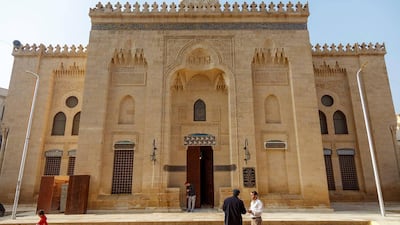

Egypt’s tourism and antiquities minister inaugurated the newly restored dome of the Imam Al Shafi'i Mosque in Old Cairo on Sunday in celebration of World Heritage Day.
A prominent Ayyubid landmark of Islamic Cairo, the Imam Al Shafi’i mosque reopened in November after a three-year renovation.
The dome, which predates the mosque by a few centuries, required more extensive work.
The contract for the extensive restoration of the mosque and the dome, a joint effort by the ministries of tourism and awqaf, or religious endowments, was awarded to the state-owned Arab Contractors Company.
Tourism Minister Khaled El Anany said his ministry oversaw the decorative and cultural restoration while the Awqaf Ministry provided the funding.
The work on the mosque alone cost 13 million Egyptian pounds ($829,000), the Tourism Ministry said.
The dome suffered a great deal of wear and tear over the years because of its location in a densely populated and badly polluted area of Cairo.
Both the interior and exterior of the dome were restored under the supervision of tourism ministry experts in Islamic culture and architecture.
The work was carried by a large crew of technicians working with materials including wood, stucco, coloured marble and metal.
A new drainage system was installed to prevent water damage to the structure, and a new lighting system was added for decorative purposes.
The structural work included treating many cracks in the walls, floors and ceilings, and the replacement of fixtures on the dome, such as its lead cladding, because they were beyond repair.
The dome is inscribed with Quranic text including excerpts from Ayat Al Kursi (Verse of the Throne), one of the holiest verses in the Islamic faith.
Restoration of the inscriptions had to be handled with care because of the age of the structure.
The mosque is named after one of the most important imams of Sunni Islam, Muhammad ibn Idris Al Shafi'i, whose remains are housed in a mausoleum at the dome.
An Islamic scholar and theologian, Al Shafi’i was the first contributor to the principles of Islamic jurisprudence and the founder of the Shafi’i school, or madhab, one of the four most important schools of thought on Islamic law.
Al Shafi’i lived in the 8th and 9th centuries, and the dome was built in 1212 by the Ayyubid Sultan Al Kamil in his honour.
The mosque’s construction came a few centuries later during the reign of Khedive Tawfiq in 1892.
The mosque’s facelift was a cornerstone of the government's renovation for a large section of Cairo for the opening of the nearby National Museum of Egyptian Civilisation this month.
The opening was marked by the transfer of 22 royal mummies to its halls from the Egyptian Museum in Tahrir Square in a grand parade.
The museum is on the banks of the Ain Al Sira lake, which was an entirely different space a few years ago when it was still inhabited by thousands of Cairo’s poorest.
The lake has received one of the most intensive makeovers the Egyptian capital has seen in years, turning it into a clean space with restaurants, cafes, artisanal stores and a walkway.
Mr El Anany has been one of the most outspoken voices for the renovation of Cairo’s Islamic and Coptic districts, most of which are in Old Cairo, also known as Historic Cairo.
He said one of his ministry’s main goals is to highlight Egypt’s non-pharaonic heritage sites, which are often overlooked by tourists eager to visit the pyramids and other ancient attractions for which the country is better known.
______________
Medinet Habu and Colossi of Memnon - Egyptian archaeology in pictures
-
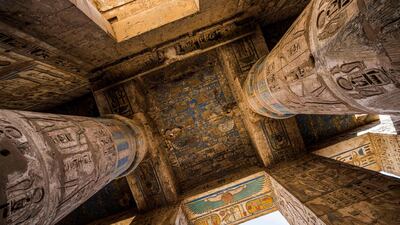
A temple colonnade at Medinet Habu, on the west bank of the Nile outside Egypt's southern city of Luxor, which hit the news in recent days with the discovery of an ancient city, lost in its sands. AFP -
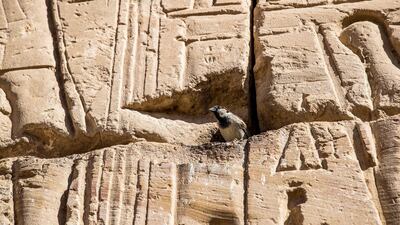
A sparrow perches in a recess in a temple wall at Medinet Habu, on the west bank of the Nile outside Luxor. AFP -
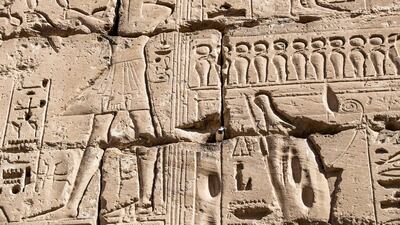
A wall adorned with reliefs at the Mortuary Temple of the 20th dynasty pharaoh Ramesses III (1186-1155 BC) at Medinet Habu, near Egypt's southern city of Luxor. AFP -
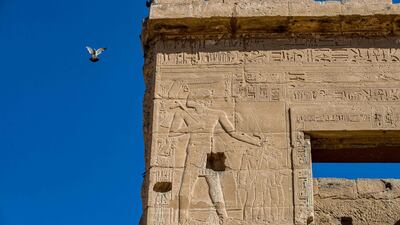
A pigeon flies by the top of the migdol tower at the Mortuary Temple of Ramesses III at Medinet Habu. AFP -
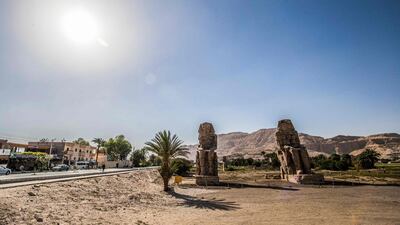
The Colossi of Memnon are two massive stone statues of the 18th dynasty Egyptian pharaoh Amenhotep III (c1391-1351 BC), on the west bank of the Nile outside Luxor. AFP -
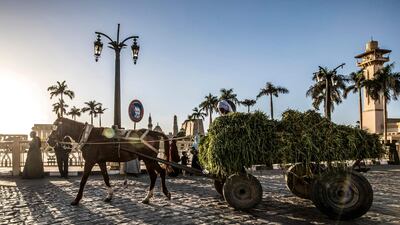
A man drives a horse-drawn cart loaded with alfalfa along a road past the Temple of Luxor and the 13th century Abu Haggag mosque. AFP -
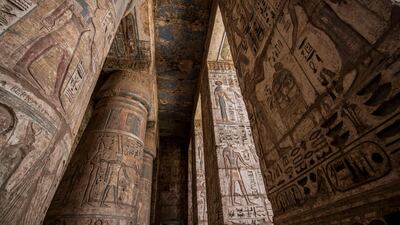
A portico at the Mortuary Temple of Ramesses III at Medinet Habu, on the Nile near Luxor. AFP -
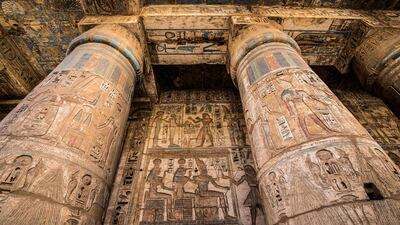
A colonade at the Mortuary Temple of Ramesses III at Medinet Habu, on the Nile near Luxor. AFP -

Tourists pose for pictures before gigantic statues at the Mortuary Temple of Ramesses III near Luxor. AFP -

The Colossi of Memnon, which have sat for 33 centuries on the west bank of the Nile outside Egypt's southern city of Luxor. AFP



