
Two proud public servants, who shaped democratic debate at the Federal National Council, have told of the crucial role the parliamentary body has played in the rise of a nation.
Hilal Ahmed Nasser Lootah, 90, and Saeed Mohammed Algandi, 80, worked to fulfil the will of the people and ensure their voices were heard as two of the ten speakers in the 51-year history of the council.
Mr Lootah was the third person to take on the prominent role, from 1981 to 1991, helping to steer vital discussions and hold ministers to account on behalf of constituents.
Mr Algandi served as an FNC member for 13 years, acting as the speaker from 2003 to 2005.
The two men spoke to The National to chart the development of the council over the decades, as the UAE prepares to go to the polls for the latest council elections next month.
The formation of the council was part of the bold vision for the country set out by the UAE Founding Father, the late Sheikh Zayed bin Sultan Al Nahyan.
Its first session was held on February 12, 1972, only two months on from the birth of a fledging UAE.
“Sheikh Zayed was the council’s support,” Mr Lootah said.
“One of my first recommendations to Zayed was that the first graduates of UAE University be given an award or a prize.”
The inaugural class of 1981 comprised 192 male and 50 female students.
“He gave them Dh50,000 – some students cashed the cheque and spent the money, and others framed it and hung it up.”
Beginnings of a Ramadan tradition
Another suggestion from the speaker helped bring about a noble tradition that continues to this day.
He asked Sheikh Zayed to pardon prisoners during the final ten days of Ramadan, to uphold the generous spirit of the holy month.
“I'll never forget that moment. We had gone to him in Al Khazna during Ramadan, and he asked me what we needed. I said I didn’t want anything, but I wanted him to free the prisoners.
“I'll never forget that day and how he immediately ordered the release of the prisoners and continued to do so until the day he left this world.
“When you are in a position of power or authority, use it to do good.”
Mr Lootah said the decision underlined the significance of the UAE having its own democratic body, serving as a link between society and its leaders.
The FNC through the years - in pictures
-
Sheikh Zayed, the Founding Father, shakes hands with the members of the Federal National Council after opening the First Ordinary Session of the 7th Legislative Chapter at the Cultural Foundation in January 1988. Photo: FNC -
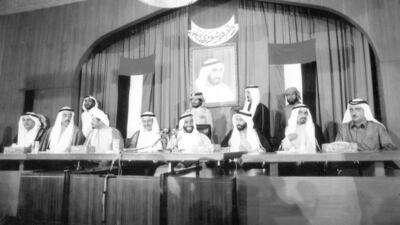
Sheikh Zayed, the Founding Father, opens the Second Ordinary Session of the 5th Legislative Chapter of the Federal National Council in December 1982. Also pictured are Sheikh Dr Sultan bin Muhammad Al Qasimi, Ruler of Sharjah; Sheikh Humaid bin Rashid Al Nuaimi, Ruler of Ajman; Sheikh Rashid Al Mualla, Ruler of Umm Al Quwain; Sheikh Saqr bin Mohammed Al Qasimi, Ruler of Ras Al Khaimah; Sheikh Hamad bin Mohammed Al Sharqi, Ruler of Fujairah; Sheikh Maktoum bin Rashid Al Maktoum, Crown Prince of Dubai; and Hilal Lootah, President of the Federal National Council. Photo: FNC -
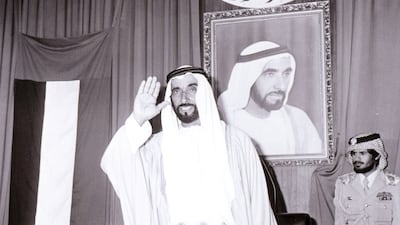
Sheikh Zayed, the Founding Father, opens the Second Ordinary Session of the 5th Legislative Chapter of the Federal National Council in December 1982. Photo: FNC -

The Federal National Council, one of the five federal authorities of the UAE, celebrated its golden jubilee by releasing pictures from throughout its 50-year history. Photo: FNC -
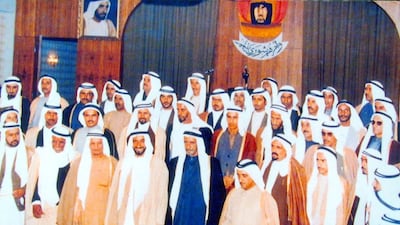
The council contributes to national development, translating the leadership’s vision and citizens’ aspirations, embodying the Shura, or consultation, approach. Photo: FNC -

A council session. Photo: FNC -
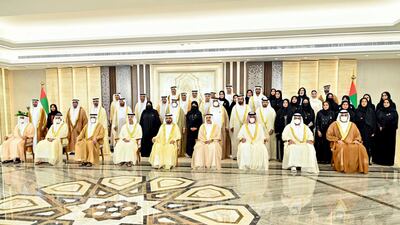
President Sheikh Khalifa has directed that half of the council's seats must be taken by women. Photo: FNC -

Speaker Abdul Aziz Al Ghurair, centre, secretary general Mohammed Al Mazrouei, left, and Sharjah member Obaid Al Muhairi in 2008. Photo: FNC -
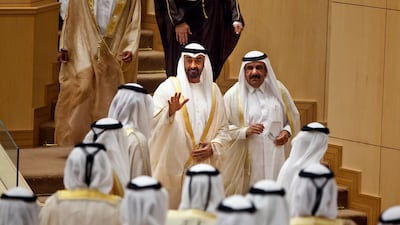
President Sheikh Khalifa and the rulers of the seven emirates were at the opening of the council's session at the FNC building in Abu Dhabi in November 2011. Silvia Razgova / The National -

Sheikh Zayed, the Founding Father, surrounded by the rulers of the emirates and Federal National Council members after opening the First Ordinary Session of the 10th Legislative Chapter in December 1995. Photo: FNC -
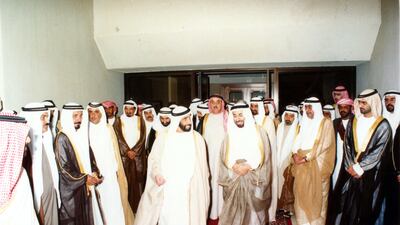
Sheikh Zayed, the Founding Father, leaves the FNC hall in December 1995. Photo: FNC -
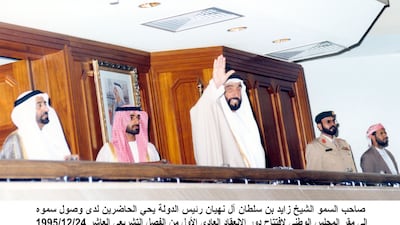
Sheikh Zayed, the Founding Father, greets council members in 1995. Photo: FNC -
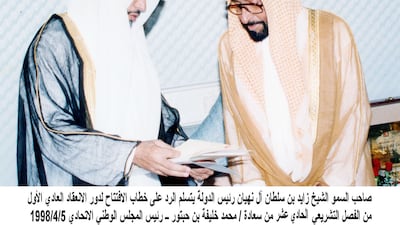
Sheikh Zayed, the Founding Father, receives the reply to the opening speech delivered at the First Ordinary Session of the 11th Legislative Chapter from Mohammed Khalifa bin Habtoor, President of the Federal National Council in April 1998. Photo: FNC -
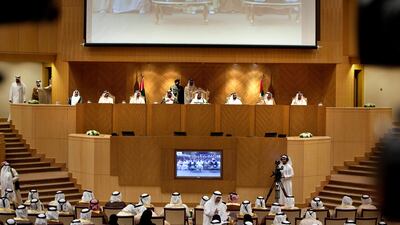
The President Sheikh Khalifa and the rulers of the seven emirates attend the Federal National Council in November 2011. Silvia Razgova / The National -
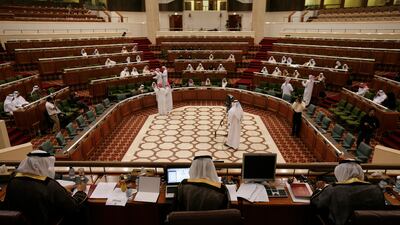
A meeting of the Federal National Council in 2008. Ryan Carter / The National -
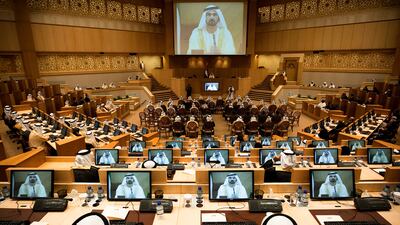
Sheikh Mohammed bin Rashid, Vice President and Ruler of Dubai, delivers a speech at the opening session of the Federal National Council in October 2010. Lee Hoagland / The National -
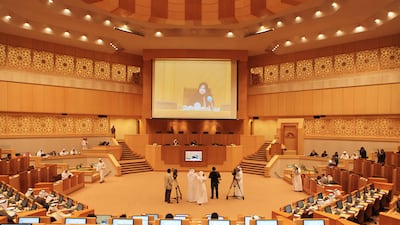
Dr Amal Al Qubaisi was appointed Deputy Speaker in 2011, the first time in the GCC a woman had held such a position. She became Speaker in 2015. Fatima Al Marzooqi / The National.


“This was the importance of the FNC and its members – we were in a position of authority and had access to the leaders,” he said.
“We saw what was missing and needed in the UAE – anything and everything in every Emirate, whether it was in education or infrastructure, and we would make recommendations.”
He recalled a significant moment in the UAE when the council was involved in the process of enshrining a permanent UAE Constitution in law.
It proved a milestone moment for the country, which had a temporary constitution until this stage.
Another significant step forward was the passing of the UAE's penal code by the FNC, with Sheikh Zayed taking a keen interest in the deliberations.
“This took us a long time and went back and forth between us and the Cabinet until Sheikh Zayed called us in one day, asking why we were holding it up,” he said.
The council advises the government on matters of national importance. It can pass, amend and reject federal laws and discuss international treaties, and is also a forum for members to raise the concerns of Emiratis.
In 2014, FNC members passed the country's first children's rights legislation after three days of keen debate, which came into effect in 2016.
Known as Wadeema's Law, it was prompted by the death of an eight-year-old girl called Wadeema in 2012, who was tortured by her father and another adult.
It lays out the legal rights of minors in the country and protects children, defined as anyone aged under 18, from all types of abuse, be it physical, verbal or psychological.
The members represent the UAE population in each emirate. Abu Dhabi and Dubai have eight members each, Sharjah and Ras Al Khaimah six while Ajman, Fujairah and Umm Al Quwain have four.

Representing the public
An important chapter in the council's story was written in 2006 when public voting was introduced. Previously, the 40-member council was selected entirely by the Rulers of the emirates.
In 2018, the late President, Sheikh Khalifa announced Emirati women would occupy 50 per cent of the council's membership after the 2019 elections.
“I believe that what the everyday person doesn’t realise is the importance of the Federal National Council,” said Mr Lootah.
“The laws are drafted by the government, but it is up to us to scrutinise every detail of the law – to find all the cracks and loopholes – until it is a bulletproof law that meets the needs of the people.
“Being a speaker isn’t a burden, but the problem is that people are in a hurry and want quick results.”
Mr Algandi said the council has a major part to play in the future development of the Emirates.
“If you look from Abu Dhabi to Fujairah and examine all the development and services, from hospitals to buildings to infrastructure, you'll see that 50 years ago, we didn’t have all of this,” he said.
“Now we need to think about the next 50 years and do even better. This is all thanks to our national councils like the FNC.”
He said the council has evolved greatly over the years, much like the country it serves.
“Previously, the requirement for a national council member was to know how to read and write, but today our members are doctors, businessmen, and scientists. We are choosing members who will benefit the country and have the foresight to further develop the UAE.
“Our source was in the past was oil, but we have developed so much that today, companies abroad are seeking us.
“We were fortunate to have Zayed – the UAE was fortunate with him. I remember when Zayed died; foreign media said that the union would die too, but what they later saw was a union that Zayed ingrained in his people.”

