


Dozens of Israeli settlers entered the courtyard of Al Aqsa Mosque on Thursday morning under the protection of the Israeli police, local media reported, after officers had earlier prevented Palestinians from entering for fajr prayers.
Israeli police on Wednesday forced their way into the mosque in Jerusalem for a second night in a row as Palestinian worshippers were spending the night, witnesses told Reuters.
Police entered the compound and tried to remove worshippers, using stun grenades and firing rubber bullets, Waqf staff said.
Worshippers threw objects at police, witnesses said.
Global criticism and concern mounted after the clashed between police and Palestinians inside Islam's third-holiest site sparked a military exchange of rockets and air strikes.
Two more rockets were fired late on Wednesday from the Israel-blockaded Gaza Strip towards Israel, the army and witnesses said, in flaring violence during the Jewish Passover and the Muslim Ramadan.
Armed police in riot gear stormed the prayer hall of Al Aqsa Mosque before dawn on Wednesday, aiming to dislodge "law-breaking youths and masked agitators" they said had barricaded themselves inside.
A barrage of rocks and fireworks met the officers, police video showed, and more than 350 people were arrested.
Israeli police attack worshippers at Jerusalem's Al Aqsa Mosque - in pictures
-

Palestinians clean up Al Aqsa Mosque compound after Israeli police stormed the site. Reuters -
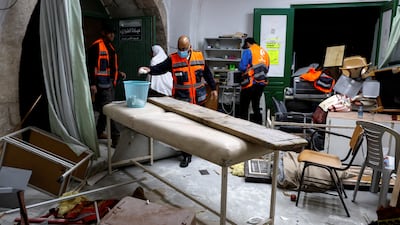
Palestinians clear the damaged furniture from the mosque compound. Reuters -

Israeli police say the attack was in response to rioting. Reuters -
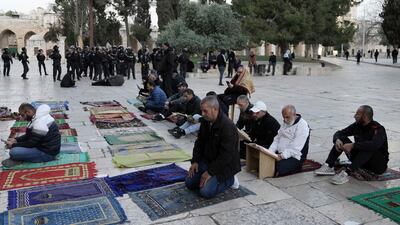
Palestinian worshippers pray as Israeli police officials stand guard at Al Aqsa Mosque compound. AP -
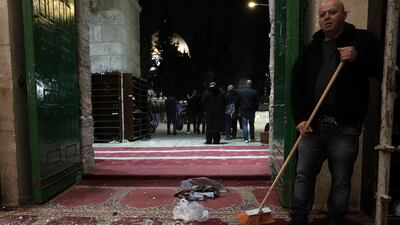
A worshipper sweeps the debris in the aftermath of the attack by Israeli police. AP -
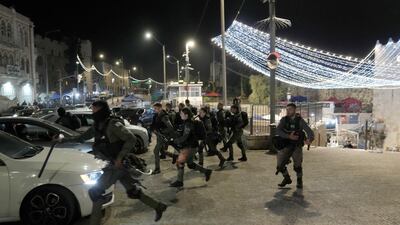
Israeli Border Police near the Damascus Gate. AP -
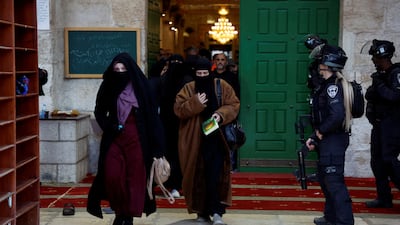
The operation by Israeli police has been condemned across the region. Reuters -

Palestinians pray inside Al Aqsa Mosque compound. Reuters -
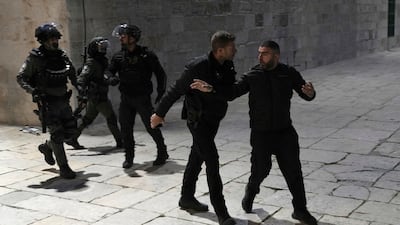
A Palestinian worshipper is led away by Israeli police at Al Aqsa Mosque compound. AP -
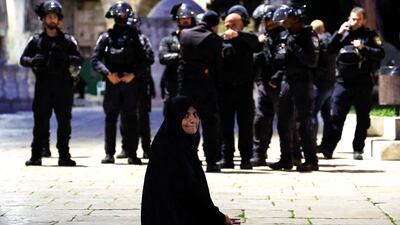
A Palestinian worshipper is surrounded by Israeli policemen at the compound. Reuters


UN Secretary General Antonio Guterres said he was "shocked and appalled" by images he saw of Israeli security forces beating people at the mosque, particularly because it came at a time holy to Jews, Christians and Muslims that should signal a period of peace, his spokesman said.
The Arab League on Wednesday strongly condemned the situation, saying it jeopardised regional stability.
In a statement issued after an emergency meeting on the incident, the League condemned what it called "crimes committed by the Israeli occupation forces against defenceless Muslim worshippers" in the mosque.
The pre-dawn raid could lead to "a spiral of violence that threatens security and stability in the region and the world", it said.
White House National Security Council spokesman John Kirby said the US was "extremely concerned by the continuing violence and we urge all sides to avoid further escalation".
Turkish President Recep Tayyip Erdogan, whose country and Israel have been rebuilding relations, said: "Trampling on Al Aqsa Mosque is our red line."
Violence in the Palestinian-Israeli conflict has intensified since the new government of Prime Minister Benjamin Netanyahu, a coalition with the extreme right and ultra-Orthodox Jewish parties, took power in December.
Palestinian witness Abdel Karim Ikraiem, 74, said Israeli police armed with batons, tear gas grenades and smoke bombs, burst into the mosque "by force" and "beat the women and men" worshipping there.
One video widely circulated on social media showed police clubbing people on the floor inside the mosque.
The Palestinian Red Crescent said it had treated 37 people, including some after their release from custody.
"The safety of civilians is at risk," it said on Wednesday evening, adding it had been prevented from access to the sick and the injured, in a breach of international humanitarian law.
Israeli police attack worshippers in Jerusalem’s Al Aqsa Mosque - video
Israel's far-right National Security Minister Itamar Ben-Gvir voiced "complete backing" for police and their "swift and determined" actions.
Palestinian militant group Hamas, which rules Gaza, called on West Bank Palestinians "to go en masse to Al Aqsa Mosque to defend it".
The mosque has been a frequent flashpoint, and clashes there in May 2021 sparked the latest Gaza war, which raged for 11 days.
On Gaza's streets, protesters burned tyres and swore "to defend and protect Al Aqsa Mosque".
Calm returned to the compound by late morning, when Israeli police escorted a group of Jewish visitors through the site.
An officer told AFP police were allowing only those aged 60 and over.
Israeli police said the Palestinians had barricaded themselves inside the mosque from Tuesday evening, ahead of Passover, which started on Wednesday evening.
Police "were forced to enter the compound in order to get them out with the intentions to allow the fajr [dawn] prayer and to prevent a violent disturbance", after prolonged attempts at talking with the Palestinians failed to get them to leave, police said.
"When the police entered, stones were thrown at them and fireworks were fired from inside the mosque by a large group of agitators," they said.
Mr Netanyahu said "security forces were compelled to act in order to restore order".
Within hours, at least nine rockets were fired from Gaza towards Israel, the army said, adding that "in response" warplanes struck two suspected Hamas weapons factories.
The air strikes were followed by new rocket fire from Gaza and further Israeli strikes, AFP reported.
Later on Wednesday, witnesses reported two more rockets fired from northern Gaza.
Israel said "one launch failed" and fell in Gaza while the other landed "in the area of the security fence" boundary.
Islamic Jihad, another Gaza-based militant group, called the rockets "a first-warning message".
Palestinian Civil Affairs Minister Hussein Al Sheikh condemned the Israeli police action inside Al Aqsa.
"The level of brutality requires urgent Palestinian, Arab and international action," Mr Al Sheikh said.
Germany urged both sides "to do everything possible to calm the situation".
Jordan, which administers the mosque, condemned its "storming", and called on Israeli forces to leave the compound immediately.
The UAE and Morocco, which established ties with Israel in 2020 as part of US-brokered accords, also strongly condemned the Israeli police action.
The UAE Ministry of Foreign Affairs and Co-operation rejected all practices that "threaten to further exacerbate escalation". It also criticised worshippers who "barricade themselves".
Rabat's Foreign Ministry stressed the need "to avoid measures and violations likely to damage chances of peace in the region".
So far this year, the conflict has claimed the lives of at least 91 Palestinians, 15 Israelis and one Ukrainian, according to an AFP tally based on official sources from both sides.

