


Cleric Moqtada Al Sadr has again upended Iraqi politics this week after his followers clashed with rival militias and occupied parliament and key buildings in the Green Zone, the seat of the Iraqi government which hosts foreign embassies.
Mr Al Sadr's long rivalry with former prime minister Nouri Al Maliki led to gun battles on Monday night, when militias in the Co-ordination Framework, which includes Mr Al Maliki, mobilised to break up protests.
The violence, which set Iran-linked groups linked to the Co-ordination Framework against Mr Al Sadr's followers, came after the cleric withdrew from politics for the third time since 2003, protesting what he said was widespread corruption and illegal challenges to his attempt at forming the next government.
He blamed the Co-ordination Framework for using tactics similar to the staging of a coup, but backed down after at least 30 people were killed, asking his forces to retreat.
-
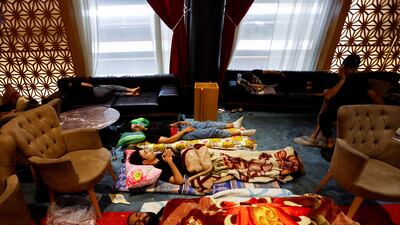
Supporters of Iraqi Shiite cleric Moqtada Al Sadr during a sit-in at a parliament building in Baghdad, Iraq. Reuters -
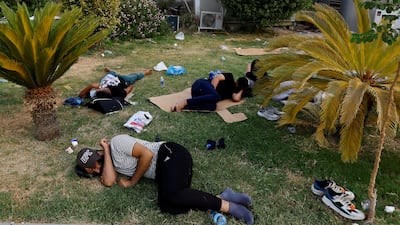
Moqtada Al Sadr supporters sleeping in the grounds of the Iraqi parliament building complex in Baghdad. Reuters -
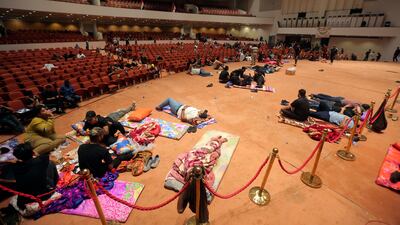
Protesters inside the parliament building in Baghdad. AP Photo -

Protesters at prayer in the parliament building. Reuters -
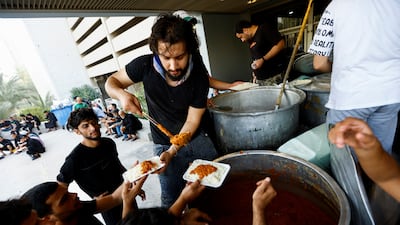
Iraqi men distribute free meals for supporters of Mr Al Sadr during the parliament building sit-in.. Reuters -
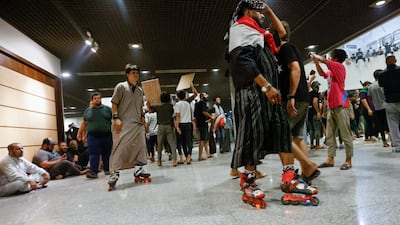
Anti-corruption protesters in the parliament building in Baghdad, Iraq. Reuters -
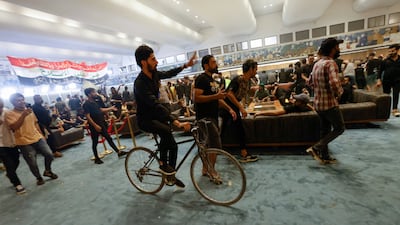
Protesters during their occupation of the Iraqi parliament building in Baghdad. Reuters -

Supporters of Moqtada Al Sadr, head of the Sadrist movement, rest after storming the parliament building in the Green Zone in central Baghdad. EPA -
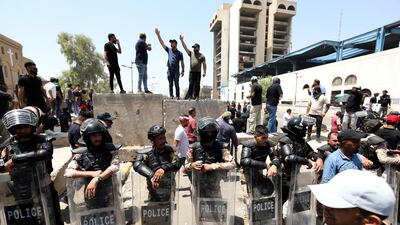
Iraqi security forces were unable to prevent supporters of Mr Al Sadr entering the Green Zone. EPA -
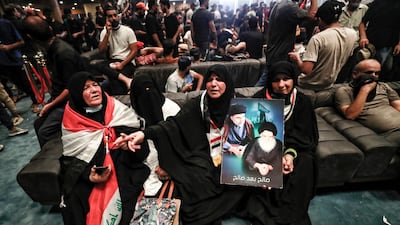
Supporters of cleric Moqtada Al Sadr, protesting against a rival bloc's nomination for prime minister, gather inside Iraq's parliament in Baghdad's high-security Green Zone. AFP -
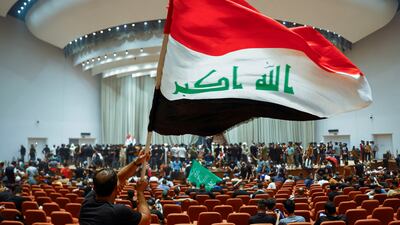
Supporters of Iraqi Shiite cleric Moqtada Al Sadr protest inside the parliament building, in Baghdad. Reuters -
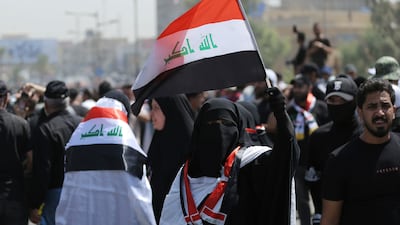
A veiled woman protester holds an Iraqi flag as people gather near the Green Zone area, in Baghdad. AP -
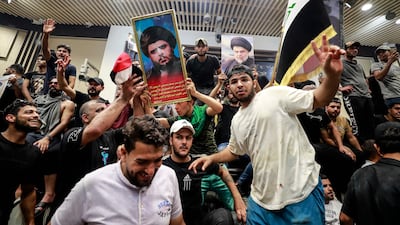
Supporters of Mr Al Sadr on Saturday entered Iraq's parliament, after hundreds breached the building on Wednesday in similar protests. AFP -
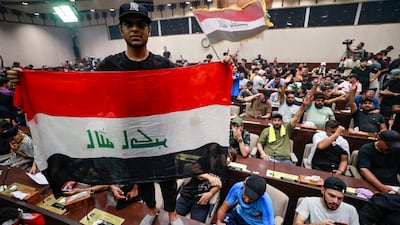
Demonstrators wave Iraqi flags and pictures of Mr Al Sadr inside the legislature. AFP -
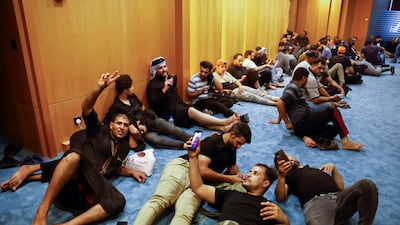
Protesters inside the parliament building. Reuters -
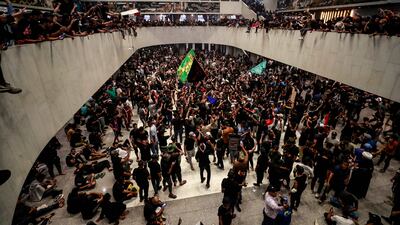
Protesters enter the building after thousands of Sadrists had massed at the end of a bridge leading to Baghdad's Green Zone. AFP -
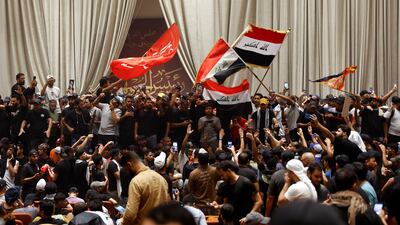
The protests are the latest challenge for Iraq, which remains stuck in a political deadlock. -
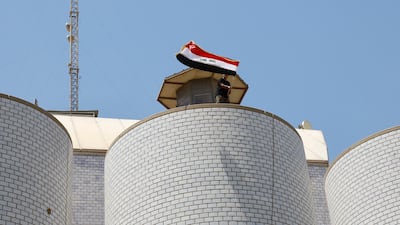
A supporter of Mr Al Sadr waves a flag during the protest at the parliament building. Reuters -
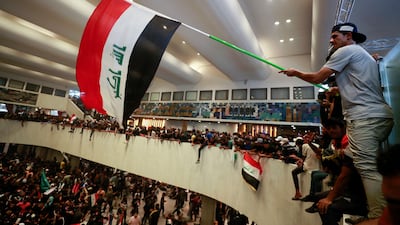
Mr Al Sadr's bloc emerged from elections in October as the biggest parliamentary faction, but was still far short of a majority. AFP -
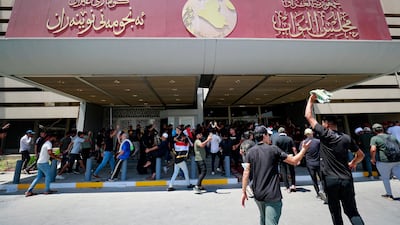
Nearly 10 months on, the stalemate persists over the establishment of a new government. AFP -
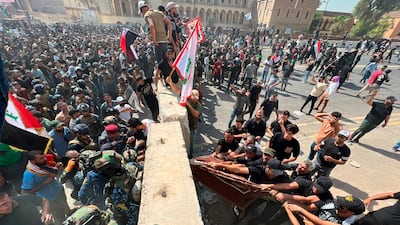
Protesters try to remove concrete barriers, to cross the bridge towards the Green Zone in Baghdad. AP Photo -
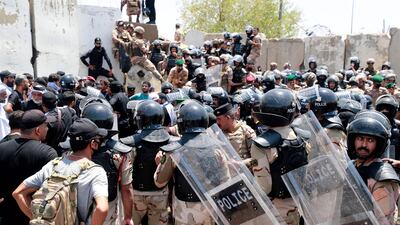
Security forces gather as supporters of Mr Al Sadr bring down concrete barriers leading to the capital Baghdad's high-security Green Zone. AFP


Like militias linked to the Co-ordination Framework, Mr Al Sadr's group is widely accused of kidnapping, torturing and killing civilians during Iraq’s civil war and killing hundreds of protesters in 2019.
The Iran-backed groups, such as Asaib Ahl Al Haq, fought street battles with Mr Al Sadr's militia in Baghdad between 2012 and 2014.
Since then, rivalry has involved assassinations of members from both groups.
The recent standoff has led to fears of another civil war — this time setting Shiite against Shiite.
Who is Moqtada Al Sadr?
The cleric has long claimed to fight corruption and oppression, whether it is that of the Saddam Hussein regime or, after 2003, the US.
Through numerous protests between 2016 and 2020, he aligned his movement with Iraqi Communists and youth protest groups, calling for “a revolution of the oppressed” that could put an end to Iraq’s system of sectarian apportionment in government and usher in public service based on quality rather than identity.
His father-in-law, revered cleric Grand Ayatollah Muhammad Baqir Al Sadr, was murdered along with his wife by Iraq’s Baathists.
His father, Muhammad Sadiq Al Sadr, was shot dead by Baathist agents in 1999, sparking a second Shiite uprising against Saddam.
This heritage of suffering and religious piety gave Moqtada Al Sadr folk hero status among Iraq’s Shiite poor and he inherited a southern network of Sadrists stretching into the slums of Baghdad’s crowded suburban Saddam City (now Sadr City).
Is he really an outsider fighting corruption?
“In the background, Sadrist loyalists have embedded themselves in the bureaucracy. There has been some good reporting on this, on the 'deep state' and Sadrist penetration thereof,” said Nicholas Krohley, author of The Death of the Mehdi Army: The Rise, Fall, and Revival of Iraq's Most Powerful Militia.
Krohley refers to revelations over the years that Mr Al Sadr controls sections of Iraq’s Ministry of Electricity, abusing contracts to raise funds, and controls much of the Ministry of Health, a legacy of when his militia, the Jaish Al Mahdi, took control of it between 2005 and 2007.
The group was widely accused of sectarian murders in hospital wards, selling medicine on the black market and driving away many of Iraq’s talented health workers.
But Mr Al Sadr has tried to distance himself from this period, disbanding the Jaish Al Mahdi, withdrawing ministers and MPs from government on many occasions as an act of protest against what he deems mainstream political groups — mainly his rivals in Mr Al Maliki's Dawa party and their Iran-backed allies in the Badr Organisation.
With the latter group, Mr Al Sadr’s supporters fought a series of gun battles in Karbala in 2007 that left 50 dead.
But analysts said his outsider image is a fiction.
In reality, the cleric has always maintained a strong network of supporters in senior government positions.
When Baghdad’s Ibn Al Khatib hospital caught fire — killing nearly 90 people in a tragedy widely blamed on negligence — Mr Al Sadr’s nominated health minister Hassan Al Tamimi was removed from his post.
A health official told The National that the hospital, along with most health facilities in Rusafa, where Sadr City is located, was run by the movement.
When a similar blaze occurred in July last year, killing 92 people in Nasiriyah, tribal leaders blamed local Sadrists in the health authority, giving them three days to leave the province.
The cleric has also tried to distance himself from militia crimes during Iraq’s sectarian strife between 2003 and 2008.
Sensitive to the fact that he reformed his old militia, renamed Saraya Al Salam during the war on ISIS, Mr Al Sadr said he would disband the group in 2017, but it remains active.
Commander Abu Mustafa Al Hamidawi ordered members to be “prepared for any emergency” in Baghdad on July 24.
Some analysts said Mr Al Sadr only has loose control over this armed group and at least three splinter factions have emerged.
Hakim Al Zamili, former deputy parliament speaker and deputy minister of health — arrested by the US for running sectarian death squads when working in the Health Ministry, last year said the kidnap and murder strategy his militia used had helped to “defeat terrorism”. Mr Al Zamili recently joined protesters in Iraq’s Parliament.
Al Sadr against Iran
To some, Mr Al Sadr is a useful bulwark against increasingly powerful Iranian-backed political parties.
Their power soared after 2014, when Mr Al Maliki formalised Iran-backed militias as part of the security services, wrapping them into an umbrella organisation, the Popular Mobilisation Forces (PMF).
But it meant that two rival sets of militias — US-listed terrorist organisations such as Kataib Hezbollah and Asaib Ahl Al Haq, as well as a host of smaller groups — were now in the same formation as Saraya Al Salam.
Bitter disputes over salaries between the groups ensued, at one point leading to the assassination of a government-appointed PMF auditor.
Now the prize, after 10 months of stalled government formation, is control over Iraqi state resources — Shiite parties lead the competition for everything from PMF salaries and pensions to controlling entire state-owned companies.
Will there be another civil war?
“None of what’s happening is usual. This has been uncharted territory since Sadr pulled his followers [MPs] out of Parliament,” said Omar Al Nidawi, programme director at US NGO Enabling Peace in Iraq Centre.
“Both Sadr and the Co-ordination Framework are taking shots in the dark to see what works. The difference is the Framework seems to be finding it more difficult to agree on a united course of action. This may explain the brief protest on Monday and decision to pull back after 'delivering the message'.”
But Mr Al Nidawi is sceptical of the prospect of full-scale war.
“We’re unlikely to see Co-ordination Framework factions decide they want to take on the Sadrists in an armed conflict.” he said.
Joel Wing, an analyst who has tracked violence in Iraq since 2008, agrees that Iraq’s intra-Shiite competition now extends beyond Iran’s reach.
“The driving force in all this escalation is Maliki, not Iran. Everyone knows Maliki is an autocrat full of conspiracies who will turn on anyone and use the power of the state,” he said, referring to Mr Al Maliki’s considerable influence behind the scenes in Iraq’s politics.
But Mr Wing said there will be no winners.
“Sadr could be just as big a threat to everyone as Maliki was, if he’s in the driver's seat,” he said.
In the long run, “time is on Moqtada’s side”, Krohley said. He notes Iraq’s rapidly growing population which swells the ranks of unemployed with each year of government failure.
This will always boost the appeal of Mr Al Sadr’s populist brand, he said.
“It's demographics. The Sadrist base keeps growing in Iraq, in absolute and relative terms. No other political faction has had any luck in peeling away meaningful numbers of Sadrist followers.
“The 'resistance' IRGC-linked PMF types have utterly failed. So, Moqtada still sits at the head of what is, and seems very likely to remain, the dominant political force in Iraq.”

