


Iran and world powers could be weeks away from reviving the 2015 nuclear accord that could lift punishing trade restrictions in exchange for the resumption of UN nuclear inspections aimed at verifying whether Tehran is restricting its nuclear programmes to civilian research.
EU diplomats said on Monday that 16 months of negotiations had now come to an end and that the text of a potential agreement had been finalised in a 25-page draft document.
All that remained, they said, was for US President Joe Biden and Iranian President Ebrahim Raisi to sign off on the deal, adding that there were “weeks” left to complete this final step.
But several highly contentious issues remain, which have been stumbling blocks in recent months.
Chiefly, these are claims by the UN’s nuclear watchdog, the International Atomic Energy Agency, that Iran has obstructed an investigation into traces of enriched uranium at three sites where Tehran said no nuclear research was being conducted.
There has also been conflicting information from Iranian state media and officials involved in the talks on whether the removal of sanctions on the Islamic Revolutionary Guard Corps should be lifted as part of a deal.
Last week, Iranian negotiators said the demand had been dropped, but have also said they are in favour of separate negotiations on IRGC sanctions, once the current deal is approved.
The US accuses the IRGC of sponsoring a network of terrorist groups across the Middle East, which have attacked energy infrastructure in the Gulf, killed American and coalition soldiers in Iraq and committed numerous human rights abuses in the region.
The organisation is linked to a number of state-owned Iranian companies, which have been placed under sanction by Washington.
On Monday, Iranian Foreign Minister Hossein Amirabdollahian said that “the final text of the agreement must fulfil Iran's interests and guarantee the lifting of the sanctions”.

But there will be concern in Washington that Iran’s interests cannot be met until the outstanding issues are resolved. One of these involves the IAEA’s assertion that Iran is not fulfilling requirements to adhere to what it calls safeguard agreements.
The agency describes such agreements as requiring “activities by which the IAEA can verify that a state is living up to its international commitments not to use nuclear programmes for nuclear-weapons purposes”.
Behrouz Kamalvandi, spokesman for the Atomic Energy Organisation of Iran, said the safeguard issues were discussed in the latest round of talks.
So how serious are the remaining issues?
Uranium particles and cameras
In 2018, the IAEA began investigating four sites where it said particles of enriched uranium had been found. It said Iran had not declared the areas as nuclear research facilities.
As a result, suspicions mounted that Iran was hiding nuclear activity and breaching its commitment to the safeguard agreement. The IAEA gave Iran until March 20 to explain the presence of the uranium in writing.
Amid the initial investigations at the sites, Iran was in the process of stepping up enrichment of uranium beyond limits agreed under the 2015 nuclear deal. Tehran purposely took this action after the Trump administration unilaterally withdrew from the agreement and imposed the toughest sanctions to date on Tehran.
“Iran has not provided explanations that are technically credible in relation to the agency’s findings at those locations,” the IAEA said in March, when the deadline passed.
Meanwhile, a row has escalated over the reactivation and reinstallation of 40 cameras put in place by the agency to monitor Iran’s uranium enrichment at three sensitive sites — an arrangement that began under the previous 2015 deal.
Iran's nuclear sites in pictures
-
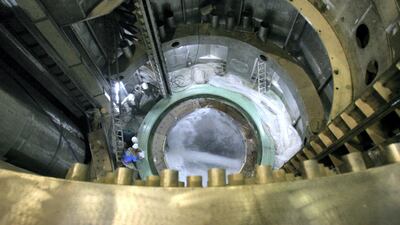
Russian contractors work at the Bushehr nuclear reactor site in 2007. The plant opened four years later. Bloomberg -
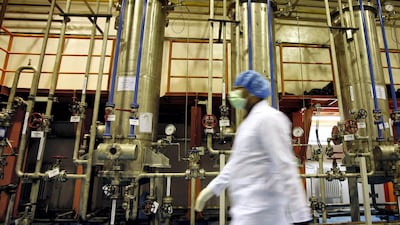
An Iranian technician at the International Atomic Energy Agency inspects the country's Isfahan plant in 2007. Tehran is no longer co-operating with the agency at nuclear sites across the country. EPA -

Workers wait to begin constructing a second reactor at the Bushehr nuclear power plant in 2019. AFP -
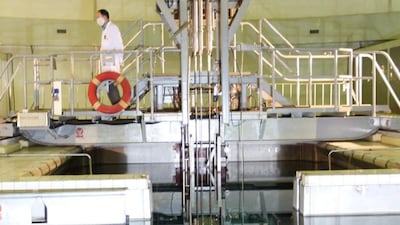
A metal-encased rod with 20 per cent enriched nuclear fuel is inserted into a reactor in Tehran in 2012. AFP -
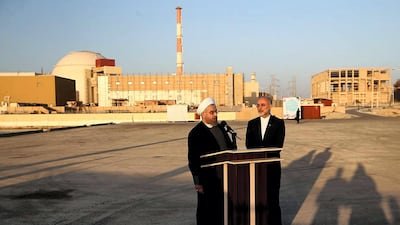
Fomer Iranian President Hassan Rouhani and the country's Atomic Energy Organisation chief Ali Akbar Salehi speak at the Bushehr nuclear site in 2015. AFP -
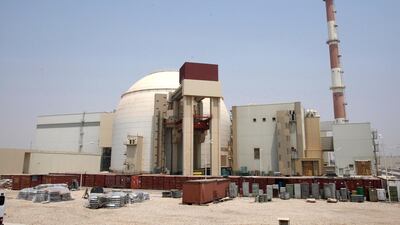
Iran's Bushehr nuclear plant has been restarted. EPA -
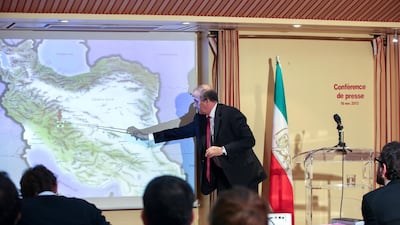
Mehdi Abrichamtchi, chairman of the Peace and Security Committee at the National Council of Resistance of Iran, shows journalists the location of a secret nuclear site in Iran in 2013. AFP -
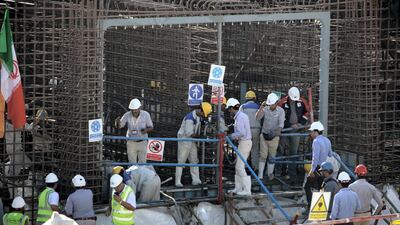
Workers prepare to begin the construction of a second reactor at the Bushehr site. AFP


At several locations, Iran has admitted to using advanced centrifuges, specifically for speeding up uranium enrichment.
The IAEA has requested that Iran hand over data in the cameras, which it said is vital for verifying what Iran is working on. IAEA director general Rafael Grossi has said his organisation had been left “flying blind” in the absence of the footage.
But Iran has also said it has stepped up uranium enrichment to 60 per cent, moving the nuclear programme closer to the 90 per cent level required for a nuclear weapon. Iran has also said it has enough nuclear material for a bomb, but said no decision had been made to start a military atomic programme.
What to do with the existing enriched uranium, which is highly radioactive, has become another technical question in the final draft of the deal. Most likely, it would be shipped out of Iran under a new accord.
Iran’s IRGC terrorist designation
Another potential issue is Iran’s request that sanctions against the IRGC must be dropped before any deal can be reached.
For now, Iranian negotiators say they have put the issue to one side so that the nuclear deal has a better chance of being approved in Washington.
But Mohammad Marandi, who has advised Iran's negotiating team, has claimed delisting was “never was a prerequisite for a deal” and the terrorist designation was a “badge of honour” for the IRGC.
Iran’s state-run Irna news agency reported last week that some members of the country's negotiating team did support delisting the IRGC as part of a deal, but no sources were named for the claim.
The Donald Trump administration designated the IRGC as a Foreign Terrorist Organisation in 2019, meaning that businesses the group are involved in face highly stringent controls on foreign trade.
The EU has also put senior members of the IRGC under sanction, but has done so with a narrow focus, accusing the organisation of human rights abuses during a crackdown on protesters in Iran in 2019.
Mr Biden has ruled out delisting the organisation as part of a renewed accord.

