

The top US Air Force general in the Middle East said on Thursday that the region is in a “period of stasis”, and mentioned the potential for future attacks from militias in Iraq and the Houthis in Yemen against the US and its allies.
Lt Gen Alexus Grynkewich was speaking as he assumed his new role at Al Udeid Air Base in Qatar with responsibility for military operations in Iraq, Syria, Afghanistan, and across the region.
“We’re in this position where we’re not under attack constantly, but we do see planning for attacks ongoing,” the Associated Press quoted Lt Gen Grynkewich as saying.
“Something will occur that unleashes that planning and that preparation against us.”
He said there was a tenuous truce in Yemen, while the ongoing government formation process in Baghdad keeps Iran-backed militias in limbo, waiting for the political chaos to settle before they strike.
Lt Gen Grynkewich also expressed fears about Russian and Chinese influence taking hold as superpowers vie for economic and military influence in the Middle East.
For instance, he said, recent US intelligence that Iran is preparing to send Russia armed and unarmed drones to use in its war on Ukraine “is not a surprise … but it’s concerning”.
Lt Gen Grynkewich, who served as director of operations at Central Command in Tampa, Florida, was speaking as regional tensions remain high because of Iran’s rapidly expanding nuclear programme and talks to revive Tehran’s nuclear deal with world powers at a deadlock.
-
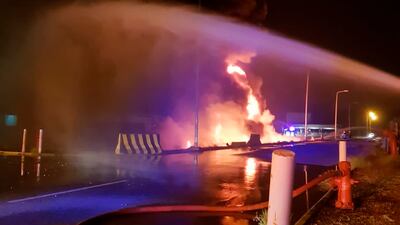
Firefighters tackle a blaze at an Aramco terminal in the southern border town of Jizan after Yemen’s Houthi rebels unleashed a barrage of air strikes on Saudi Arabia, the kingdom’s state-run media reported. All photos: SPA -
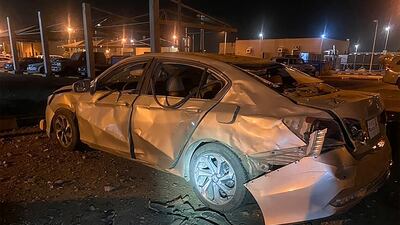
A damaged car at the Aramco oil plant in Jizan. -
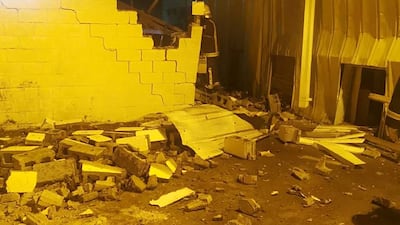
A view of the damage caused by what the Saudi Arabia-led coalition claims were drone attacks by Yemen's Iran-aligned Houthi group that hit the Al-Shaqeeq desalination plant and the Aramco terminal. -
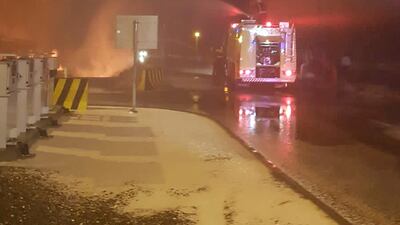
Civil Defence teams at the site in Jizan, Saudi Arabia. -
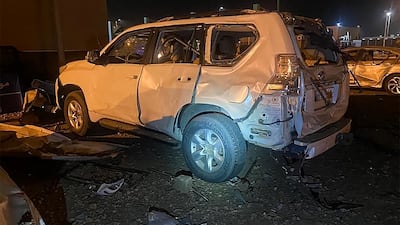
Another damaged car. -
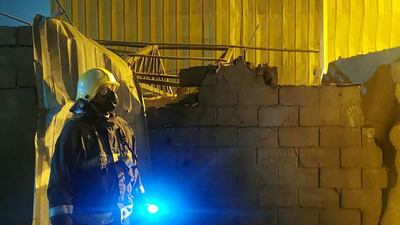
Saudi Arabia said Houthi rebels were responsible for the attacks.


‘Period of stasis’
Iran tested a satellite-carrying rocket last month, prompting the White House to threaten more sanctions against Tehran to prevent it from accelerating its advanced ballistic missile programme.
And last week, as US President Joe Biden toured the region, Iran unveiled armed drones on its warships in the Gulf.
Tehran has rapidly grown its stockpile of near-weapons-grade nuclear fuel in recent months, spreading fears about an escalation.
It has also spun more advanced centrifuges prohibited under the landmark atomic accord, which former president Donald Trump abandoned in 2018.
-

Missiles on display at a Houthi exhibition. The terrorist group has claimed responsibility for a spate of attempted attacks on the UAE leading to global condemnation. Reuters -
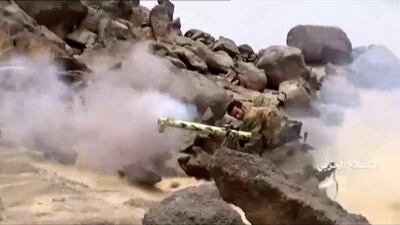
A Houthi fighter fires an anti-tank missile in an August offensive near the south-west Saudi region of Najran along the Yemeni border. AFP -

A Houthi ballistic missile aimed at Saudi Arabia. The kingdom thwarted a bid by Houthi militias to target civilians and civilian sites in the city of Khamis Mushait. Reuters -

A file picture of the Quds cruise missile launch from an unidentified location in Yemen. Reuters -

Missiles and drone aircraft are on display at a Houthi exhibition in Yemen. Reuters


“Everyone in the region is very concerned,” Lt Gen Grynkewich said. “We’re in a bit of a period of stasis.”
As other threats subside, the US has sharpened its focus on containing and countering Russian and Chinese influence in the region, he said, noting that Russia is seeking to maintain the leverage it gained from years of military intervention in the region, such as in Syria where it helped save President Bashar Al Assad’s government and turned the tide of the war in his favour.
The US is not quitting the region
Lt Gen Grynkewich said an apparent reversal of the military relationship between Russia and Iran — with Moscow allegedly interested in procuring drones from a traditional buyer of its own military equipment — “shows a bit more of a relationship than we’d like them to have, given the context of everything going on in Ukraine”.
Earlier this week, Russian President Vladimir Putin visited Tehran on a rare trip abroad and won staunch support from Iran for the war that has plunged the Kremlin deeper into confrontation with the West.
Meanwhile, China’s significant economic inroads in the region raise concerns about the country’s plans “to secure those interests either through arms sales or other means”, Lt Gen Grynkewich said.
Despite appearances to the contrary after the withdrawal from Afghanistan, the US is not quitting the region, he said, a point Mr Biden made repeatedly on his Middle East tour last week.
With tens of thousands of American forces stationed across the Arabian Peninsula and some still in Iraq, as well as America’s superior military power, Lt Gen Grynkewich said, the US is trying to convince its allies that “if you partner with us, you’re getting to get a relationship that’s much more deep and meaningful”.

