


The government of Iraq's semi-autonomous Kurdish region has banned the sale of guns to members of the public after two professors were shot dead at Salahaddin University in Erbil, the capital of the region.
The two men were killed on Tuesday, reportedly by a disgruntled former student who apparently bought the weapon on Facebook.
On Thursday, a husband and wife were shot dead, also in Erbil, after a family dispute, according to Kurdish news outlet Rudaw.
"We will not allow anyone to undermine public peace and security," Masrour Barzani, prime minister of the Kurdish region, said on Twitter.
"Today, I have called on security services to close all weapon dealerships and seize all unlicensed weapons. I urge our citizens to join this national campaign and turn over unlicensed weapons to the government."
The move follows a law passed by the Interior Ministry in Erbil in 2019 giving gun owners six months to register their weapons or face penalties for carrying illegal guns.
The federal government in Baghdad also has some loose gun-control measures in place, including requiring licences from owners and gun sellers, legislation introduced in 2018.
-
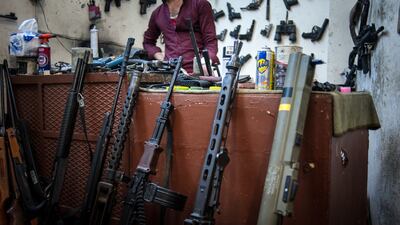
The family-run business sells, repairs and modifies weapons for its customers. Getty -
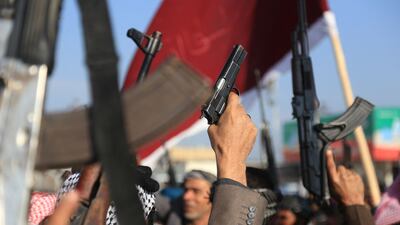
Armed clan members of Karbala clans lift their guns as they take to the streets in a show of force and to keep order amid a spate of anti-government protests, in the southern Iraqi city of Karbala. AFP -

Iraq has one of the highest proportions of gun ownership in the world. AFP -
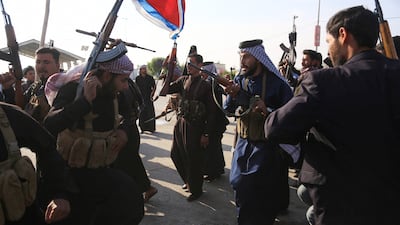
Many firearms were left behind when Saddam Hussein and his forces were ousted in 2003. AFP -

Items on sale at a gun shop in Erbil. Getty -
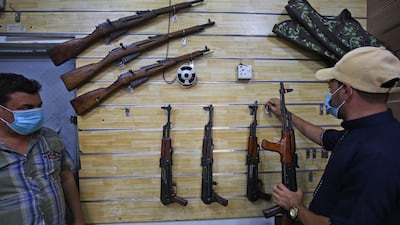
Employees display rifles for sale at a gun shop in the Iraqi capital Baghdad. AFP -
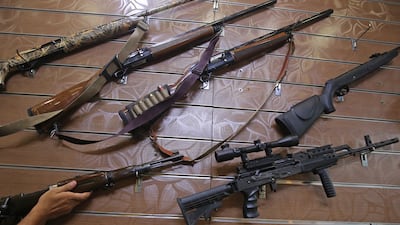
More rifles for sale in Baghdad. AFP -

Employees review customers' authorisation documents at a gun shop in the Iraqi capital. AFP


Iraq has one of the highest rates of gun ownership in the world, a legacy of decades of war, from the rule of Saddam Hussein to the strife that followed the US-led invasion in 2003.
Hundreds of thousands of Iraqi soldiers who served during the Baath regime kept their weapons after the US dissolved the Iraqi army.
Subsequent US and coalition attempts to re-equip a new Iraqi force were stymied by high rates of desertion and cases where soldiers and police sold their weapons on the black market.
This phenomenon was also reported in the Kurdish region during the war against ISIS, when a number of soldiers from the Kurdish Peshmerga security force were investigated after allegedly selling their weapons, following a delay in salary payments.
Before the 2003 invasion, the Kurdish region also suffered a civil war between its two main political parties, the Kurdish Democratic Party and the Patriotic Union of Kurdistan.
The region was allowed to maintain its own security policy in co-ordination with Baghdad, following Iraq's transformation to a federal system after 2003.
Since then, the government in Baghdad has struggled to control weapon ownership, particularly heavy weapons, including rocket launchers and heavy machine guns in the hands of tribes.
Iraqi government "buyback" efforts to limit tribal ownership of weapons in Iraq's south — where tribal feuds frequently lead to fatal gun battles — have had mixed results.

