Rafael Grossi, IAEA director general, right, speaks to Iranian Foreign Minister Hossein Amirabdollahian, left, during a meeting in Tehran in March. AP

US and Iran at loggerheads over nuclear deal despite claims of progress


Ahmed Maher
  • English
  • Arabic

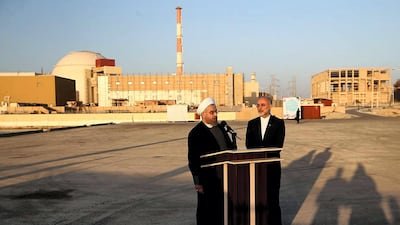
The stalled talks on reviving a 2015 deal to prevent Iran from developing nuclear weapons have revealed tensions between Washington and Tehran as each side attempts to avoid blame if the year-long negotiations collapse.

The talks in Vienna, Austria, stopped last month despite repeated assurances from negotiators including Britain and France that a deal was within reach.

US and Iranian teams voiced mutual mistrust. Iran said any deal should come with a guarantee that a future US leader cannot unilaterally withdraw from it.

Congress appears divided, with many Republicans saying that the deal will not address serious national security concerns including Iran's controversial ballistic missile programme, and what 49 of 50 Republican senators recently called Iran's “ongoing support for terrorism and its gross abuses of human rights".

Tehran says that its nuclear programme is for civilian purposes and its missile strategy or related regional policy should not be part of a nuclear deal.

On Monday, Iranian officials spoke out on social media.

“If there is a pause in the Vienna talks, it is because of the American side has asked for too much,” Iranian Foreign Minister Hossein Amirabdollahian said on his official Twitter account.

“The Ministry of Foreign Affairs acts with power and logic to achieve the highest interests of the nation and to observe the red lines. We will never go overboard with America. If the White House behaves realistically, an agreement is achievable.”

He was referring to US President Joe Biden’s authority to use his veto powers if US politicians block a deal.

Earlier, Saeed Khatibzadeh, Mr Amirabdollahian's spokesman, said that the country's negotiators would not return to Vienna until Washington settles “outstanding issues”.

“If Washington answers the outstanding questions, we can go to Vienna as soon as possible,” he told reporters, without going into detail.

For nearly a year, negotiators from a group of world powers known as the P5+1 — the US, UK, France, China, Russia and Germany — have been working with Iran to restore the deal.

In 2018, it was abandoned by US president Donald Trump, who wanted to negotiate an agreement from scratch.

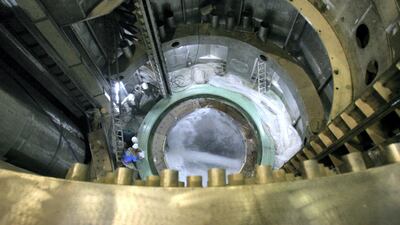
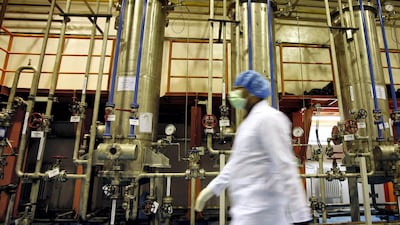
The original deal sought to limit Iran's stockpiles of enriched uranium, including low and medium-enriched varieties. The latter is easier to highly enrich, which could then be turned into weapons grade material.

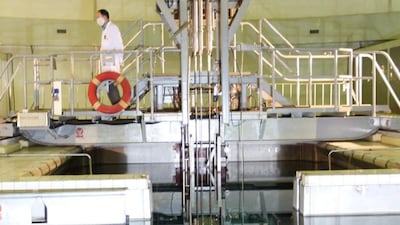
These reduced stockpiles and limited enrichment processes would be inspected and verified by UN analysts.

In return, most economic sanctions, except some relating to Iran's support for terrorist groups, would be lifted.

Time is running out

US State Department spokesman Ned Price suggested it was Tehran that could unravel the deal at any point. He said time was running out.

“Anyone involved in the talks knows precisely who has made constructive proposals, who has introduced demands that are unrelated to the JCPOA, and how we reached this current moment,” Mr Price told reporters, using the acronym of the deal which is officially known as the Joint Comprehensive Plan of Action.

“Iran has been able to shrink that breakout time from where it started to a point where we can measure it in weeks rather than months. To us that is unacceptable as a long-term proposition.”

State Department spokesman Ned Price suggested it was Tehran that could make the deal unravel at any point and warned that time was running out. AFP

But the deal is not dead.

“We still believe there is an opportunity to overcome our remaining differences,” Mr Price said.

It is not just the US-Iran standoff that complicates matters.

Russia, a signatory to the 2015 deal agreed by the Obama administration, complicated the talks last month with a demand for written guarantees to have broad exemptions from the international sanctions imposed on it because of its invasion of Ukraine, so that it can do business with Iran.

Israel and several countries in the Middle East also have concerns about Iran’s long-range missile and drone programmes, and accuse Tehran of supplying proxy militias in Lebanon, Syria, Iraq and Yemen, including Hezbollah and the Houthis.

The Iran-backed militants have launched attacks against countries from Iraq to Saudi Arabia and the UAE.

Last week, Israeli Foreign Minister Yair Lapid hosted a summit with the leading diplomats of four Arab countries and US Foreign Secretary Antony Blinken.

“This new architecture — the shared capabilities we are building — intimidates and deters our common enemies, first and foremost Iran and its proxies,” Mr Lapid said after the talks alongside his US, Emirati, Bahraini, Moroccan and Egyptian counterparts.

Mr Blinken offered Washington's regional allies reassurance in the event that diplomacy with Iran failed.

“As neighbours and, in the case of the United States, as friends, we will also work together to confront common security challenges and threats, including those from Iran and its proxies,” he said.

In 2020, Iran attacked US troops stationed at Ain Al Asad airbase in Iraq with missiles that caused dozens of concussion injuries.

The attack followed a spiral of escalation between Iran-backed militias and US forces that left one US contractor dead. The US then conducted a drone strike near Baghdad airport that killed a senior Iranian military strategist, Gen Qassem Suleimani, leading to the Iranian attack.

Last month, Iran claimed responsibility for a missile barrage that struck near the US consulate complex in the northern city of Irbil in Iraq Kurdistan’s region, saying it was in retaliation for an Israeli strike in Syria that killed two members of its Islamic Revolutionary Guard Corps.


Other workplace saving schemes
  • The UAE government announced a retirement savings plan for private and free zone sector employees in 2023.
  • Dubai’s savings retirement scheme for foreign employees working in the emirate’s government and public sector came into effect in 2022.
  • National Bonds unveiled a Golden Pension Scheme in 2022 to help private-sector foreign employees with their financial planning.
  • In April 2021, Hayah Insurance unveiled a workplace savings plan to help UAE employees save for their retirement.
  • Lunate, an Abu Dhabi-based investment manager, has launched a fund that will allow UAE private companies to offer employees investment returns on end-of-service benefits.
Hurricanes 31-31 Lions

Wellington Hurricanes: 
Tries: Gibbins, Laumape, Goosen, Fifita tries, Barrett
Conversions: Barrett (4)
Penalties: Barrett

British & Irish Lions:
Tries: Seymour (2), North
Conversions: Biggar (2)
Penalties: Biggar (4)

Benefits of first-time home buyers' scheme
  • Priority access to new homes from participating developers
  • Discounts on sales price of off-plan units
  • Flexible payment plans from developers
  • Mortgages with better interest rates, faster approval times and reduced fees
  • DLD registration fee can be paid through banks or credit cards at zero interest rates
Frida%20
%3Cp%3E%3Cstrong%3EDirector%3A%20%3C%2Fstrong%3ECarla%20Gutierrez%3C%2Fp%3E%0A%3Cp%3E%3Cstrong%3EStarring%3A%3C%2Fstrong%3E%20Frida%20Kahlo%3C%2Fp%3E%0A%3Cp%3E%3Cstrong%3ERating%3A%3C%2Fstrong%3E%204%2F5%3C%2Fp%3E%0A
UAE currency: the story behind the money in your pockets
MATCH INFO

Uefa Champions League semi-finals, first leg
Liverpool v Roma

When: April 24, 10.45pm kick-off (UAE)
Where: Anfield, Liverpool
Live: BeIN Sports HD
Second leg: May 2, Stadio Olimpico, Rome

What vitamins do we know are beneficial for living in the UAE

Vitamin D: Highly relevant in the UAE due to limited sun exposure; supports bone health, immunity and mood.Vitamin B12: Important for nerve health and energy production, especially for vegetarians, vegans and individuals with absorption issues.Iron: Useful only when deficiency or anaemia is confirmed; helps reduce fatigue and support immunity.Omega-3 (EPA/DHA): Supports heart health and reduces inflammation, especially for those who consume little fish.

Countries recognising Palestine

France, UK, Canada, Australia, Portugal, Belgium, Malta, Luxembourg, San Marino and Andorra


Who's who in Yemen conflict

Houthis: Iran-backed rebels who occupy Sanaa and run unrecognised government

Yemeni government: Exiled government in Aden led by eight-member Presidential Leadership Council

Southern Transitional Council: Faction in Yemeni government that seeks autonomy for the south

Habrish 'rebels': Tribal-backed forces feuding with STC over control of oil in government territory

GAC GS8 Specs

Engine: 2.0-litre 4cyl turbo

Power: 248hp at 5,200rpm

Torque: 400Nm at 1,750-4,000rpm

Transmission: 8-speed auto

Fuel consumption: 9.1L/100km

On sale: Now

Price: From Dh149,900

BMW M5 specs

Engine: 4.4-litre twin-turbo V-8 petrol enging with additional electric motor

Power: 727hp

Torque: 1,000Nm

Transmission: 8-speed auto

Fuel consumption: 10.6L/100km

On sale: Now

Price: From Dh650,000

Timeline

2012-2015

The company offers payments/bribes to win key contracts in the Middle East

May 2017

The UK SFO officially opens investigation into Petrofac’s use of agents, corruption, and potential bribery to secure contracts

September 2021

Petrofac pleads guilty to seven counts of failing to prevent bribery under the UK Bribery Act

October 2021

Court fines Petrofac £77 million for bribery. Former executive receives a two-year suspended sentence 

December 2024

Petrofac enters into comprehensive restructuring to strengthen the financial position of the group

May 2025

The High Court of England and Wales approves the company’s restructuring plan

July 2025

The Court of Appeal issues a judgment challenging parts of the restructuring plan

August 2025

Petrofac issues a business update to execute the restructuring and confirms it will appeal the Court of Appeal decision

October 2025

Petrofac loses a major TenneT offshore wind contract worth €13 billion. Holding company files for administration in the UK. Petrofac delisted from the London Stock Exchange

November 2025

180 Petrofac employees laid off in the UAE

Mercer, the investment consulting arm of US services company Marsh & McLennan, expects its wealth division to at least double its assets under management (AUM) in the Middle East as wealth in the region continues to grow despite economic headwinds, a company official said.

Mercer Wealth, which globally has $160 billion in AUM, plans to boost its AUM in the region to $2-$3bn in the next 2-3 years from the present $1bn, said Yasir AbuShaban, a Dubai-based principal with Mercer Wealth.

Within the next two to three years, we are looking at reaching $2 to $3 billion as a conservative estimate and we do see an opportunity to do so,” said Mr AbuShaban.

Mercer does not directly make investments, but allocates clients’ money they have discretion to, to professional asset managers. They also provide advice to clients.

“We have buying power. We can negotiate on their (client’s) behalf with asset managers to provide them lower fees than they otherwise would have to get on their own,” he added.

Mercer Wealth’s clients include sovereign wealth funds, family offices, and insurance companies among others.

From its office in Dubai, Mercer also looks after Africa, India and Turkey, where they also see opportunity for growth.

Wealth creation in Middle East and Africa (MEA) grew 8.5 per cent to $8.1 trillion last year from $7.5tn in 2015, higher than last year’s global average of 6 per cent and the second-highest growth in a region after Asia-Pacific which grew 9.9 per cent, according to consultancy Boston Consulting Group (BCG). In the region, where wealth grew just 1.9 per cent in 2015 compared with 2014, a pickup in oil prices has helped in wealth generation.

BCG is forecasting MEA wealth will rise to $12tn by 2021, growing at an annual average of 8 per cent.

Drivers of wealth generation in the region will be split evenly between new wealth creation and growth of performance of existing assets, according to BCG.

Another general trend in the region is clients’ looking for a comprehensive approach to investing, according to Mr AbuShaban.

“Institutional investors or some of the families are seeing a slowdown in the available capital they have to invest and in that sense they are looking at optimizing the way they manage their portfolios and making sure they are not investing haphazardly and different parts of their investment are working together,” said Mr AbuShaban.

Some clients also have a higher appetite for risk, given the low interest-rate environment that does not provide enough yield for some institutional investors. These clients are keen to invest in illiquid assets, such as private equity and infrastructure.

“What we have seen is a desire for higher returns in what has been a low-return environment specifically in various fixed income or bonds,” he said.

“In this environment, we have seen a de facto increase in the risk that clients are taking in things like illiquid investments, private equity investments, infrastructure and private debt, those kind of investments were higher illiquidity results in incrementally higher returns.”

The Abu Dhabi Investment Authority, one of the largest sovereign wealth funds, said in its 2016 report that has gradually increased its exposure in direct private equity and private credit transactions, mainly in Asian markets and especially in China and India. The authority’s private equity department focused on structured equities owing to “their defensive characteristics.”

Opening day UAE Premiership fixtures, Friday, September 22:

  • Dubai Sports City Eagles v Dubai Exiles
  • Dubai Hurricanes v Abu Dhabi Saracens
  • Jebel Ali Dragons v Abu Dhabi Harlequins
Ruwais timeline

1971 Abu Dhabi National Oil Company established

1980 Ruwais Housing Complex built, located 10 kilometres away from industrial plants

1982 120,000 bpd capacity Ruwais refinery complex officially inaugurated by the founder of the UAE Sheikh Zayed

1984 Second phase of Ruwais Housing Complex built. Today the 7,000-unit complex houses some 24,000 people.  

1985 The refinery is expanded with the commissioning of a 27,000 b/d hydro cracker complex

2009 Plans announced to build $1.2 billion fertilizer plant in Ruwais, producing urea

2010 Adnoc awards $10bn contracts for expansion of Ruwais refinery, to double capacity from 415,000 bpd

2014 Ruwais 261-outlet shopping mall opens

2014 Production starts at newly expanded Ruwais refinery, providing jet fuel and diesel and allowing the UAE to be self-sufficient for petrol supplies

2014 Etihad Rail begins transportation of sulphur from Shah and Habshan to Ruwais for export

2017 Aldar Academies to operate Adnoc’s schools including in Ruwais from September. Eight schools operate in total within the housing complex.

2018 Adnoc announces plans to invest $3.1 billion on upgrading its Ruwais refinery 

2018 NMC Healthcare selected to manage operations of Ruwais Hospital

2018 Adnoc announces new downstream strategy at event in Abu Dhabi on May 13

Source: The National

Key figures in the life of the fort

Sheikh Dhiyab bin Isa (ruled 1761-1793) Built Qasr Al Hosn as a watchtower to guard over the only freshwater well on Abu Dhabi island.

Sheikh Shakhbut bin Dhiyab (ruled 1793-1816) Expanded the tower into a small fort and transferred his ruling place of residence from Liwa Oasis to the fort on the island.

Sheikh Tahnoon bin Shakhbut (ruled 1818-1833) Expanded Qasr Al Hosn further as Abu Dhabi grew from a small village of palm huts to a town of more than 5,000 inhabitants.

Sheikh Khalifa bin Shakhbut (ruled 1833-1845) Repaired and fortified the fort.

Sheikh Saeed bin Tahnoon (ruled 1845-1855) Turned Qasr Al Hosn into a strong two-storied structure.

Sheikh Zayed bin Khalifa (ruled 1855-1909) Expanded Qasr Al Hosn further to reflect the emirate's increasing prominence.

Sheikh Shakhbut bin Sultan (ruled 1928-1966) Renovated and enlarged Qasr Al Hosn, adding a decorative arch and two new villas.

Sheikh Zayed bin Sultan (ruled 1966-2004) Moved the royal residence to Al Manhal palace and kept his diwan at Qasr Al Hosn.

Sources: Jayanti Maitra, www.adach.ae

Updated: June 13, 2023, 12:42 PM