


Iraq President, Barham Salih, said the missile attack at Erbil in northern Iraq early on Sunday represented a "terror" act designed to sabotage the country's political process in forming a new government, the state news agency said.
Iraqi Prime Minister Mustafa Al Kadhimi said the attack was designed to "spread fear" in the city.
"Our security forces will investigate and stand firm against any threats towards our people," he said.
US officials, speaking to AFP, said the origin of the missiles was from Iran, echoing a similar ballistic missile attack aimed at US facilities in Iraq in January 2020.
Two men in the vicinity were injured in the attacks with twelve missiles, a farmer and a taxi driver, according to the governor of Erbil, Oumid Khouchnaw.
Several explosions were heard, but Erbil International Airport, where US military forces are stationed, was not believed to be the target, said Hiwa Afandi, Deputy Minister in the Kurdistan Regional Government.
As is consistent with previous attacks instigated by Iranian-backed militias, media channel Sabreen posted videos of the attack moments after its occurrence.
Lawk Ghafuri, head of Kurdistan's Foreign Media Relations, also said Erbil was attacked by 12 missiles at 1am. He also said the missiles were launched from outside Iraq.
The offices of a local media channel, K24, were severely damaged, although the building was unoccupied at the time.
"Tonight’s multiple attacks in Erbil was conducted by missiles, and none of the missiles hit the new US consulate which is still under construction in Erbil, but areas around the compound was hit by the missiles," Mr Ghafuri said.
Mr Afandi tweeted: “The missiles used this time were different, bigger, more accurate and I believe require proper launch systems.”
-
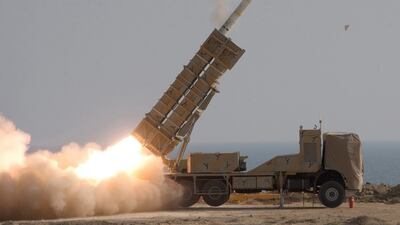
Iranian soldiers fire a missile in Baluchestan, near the shore of the Sea of Oman, during a military exercise on November 8, 2021. Iranian Army via AFP -
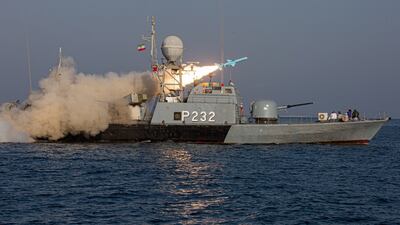
Iranian troops fire a Ghaidr missile during the second day of military exercise in the northern Sea of Oman, on November 8, 2021. Iranian Army via EPA -
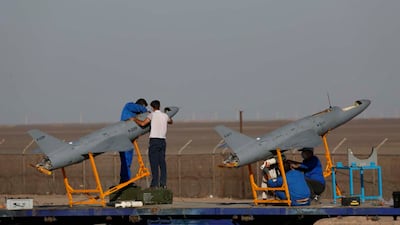
Iranian Army and Air Force personnel work on missile air-defence systems during an exercise at an undisclosed site in Iran on October 21, 2021, when the country began a nationwide air force drill. Iranian Army via EPA -
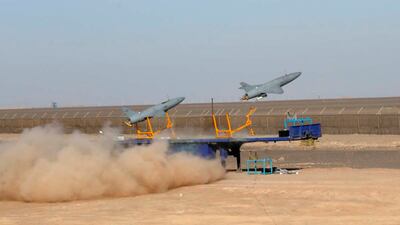
One week earlier, it had conducted a massive air defence exercise, state media reported. Iranian Army via EPA -
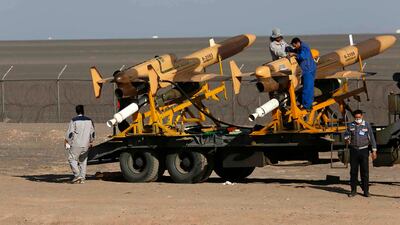
Iranian Air Force personnel work on air defence missiles during a nationwide drill on October 21, 2021. Iranian Army via AP -
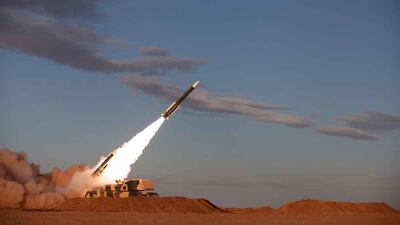
Iran holds a major air defence drill. In this image, made available on October 12, 2021, missiles are launched during a joint exercise between the Iranian Army and the country’s Islamic Revolutionary Guard Corps, in the desert of central Iran. Iranian Army via EPA


"The attacks has a suspicious timing that aims to obstruct the country's constitutional process by forming a capable government," Mr Salih said on Twitter.
"We must stand firmly against attempts to plunge the country into chaos, and we must unite to support our security forces, and combat outlaw terrorists," he said.
The German Embassy in Baghdad also spoke about against the attack.
"Germany strongly condemns the multiple missile attacks on Erbil last night. Perpetrators of this attack must be held accountable. Nothing justifies such a use of force and violence," it said on Twitter.
Erbil, capital of the Kurdish region, has been a repeated target of attacks.
Last year, drones laden with explosives struck close to the capital of the Iraqi Kurdistan region, where a US consulate is under construction.
US interests in Iraq, including installations that house troops serving in an international coalition to fight ISIS, have come under repeated attack.
The use of drones was a relatively new tactic. In April, an explosives-laden drone hit the coalition’s Iraq headquarters in the military part of the airport at Erbil.
In May, a drone with explosives hit the Ain Al Asad airbase housing US troops in western Iraq. Three more struck near Baghdad International Airport, where American soldiers are based, on June 9.
US forces stationed at Erbil International Airport were attacked by two drones on the 20th anniversary of the 9/11 attacks that led to the American invasion of Iraq.
US officials have blamed past attacks on Iran-aligned Shiite militias.
Erbil airport has also been the base for a coalition of anti-extremist forces.

