Sudanese schoolteacher Babiker Mohamed barely covers his family's needs with his meagre income, but since last year's military coup he no longer knows if he can even keep afloat.
Like many in Sudan, Mr Babiker has been grappling with shortages in basic goods, as well as new taxes and steeply rising prices on fuel, electricity and food since a military coup led by army chief Abdel Fattah Al Burhan in October.
"I used to buy 20 loaves of bread at 100 Sudanese pounds before the coup," Mr Babiker, who provides for a family of six, told AFP.
"Bread alone now costs me about 27,000 pounds a month, which is like 90 per cent of my salary" of about 30,000 pounds ($50), he said.
"I don't know if I can afford to send my children to school any more."
Mr Babiker joined teachers who went on strike this week against the worsening living conditions.
Sudan's latest coup upended a transition painstakingly negotiated between civilian and military leaders after president Omar Al Bashir, whose rule was marked by crippling US sanctions and international isolation, was ousted in 2019.
It also triggered international condemnation and punitive measures, with the United States, World Bank and International Monetary Fund suspending badly needed aid to the impoverished country.
Sudanese exports have declined sharply, foreign currency shortages have been reported and efforts by local banks to re-establish ties with international counterparts in the US and the West have come to a screeching halt.
Return to isolation
"It's like the embargo was back since October 25," said economist Sumaya Sayed.
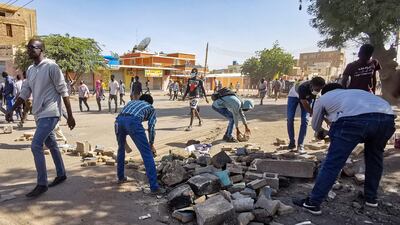
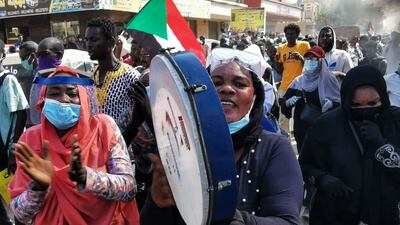
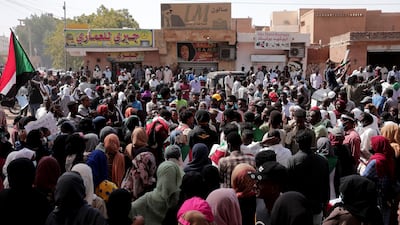
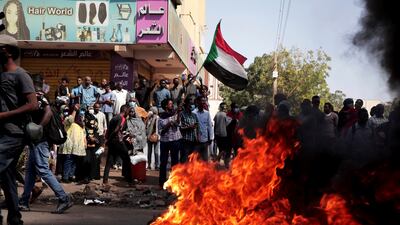
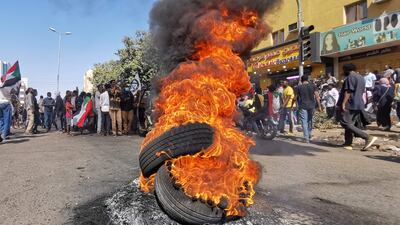
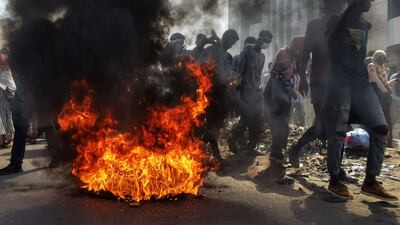
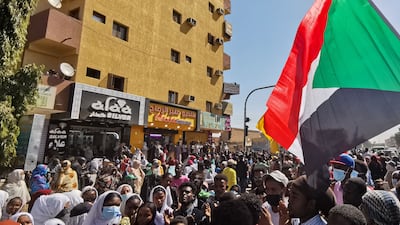
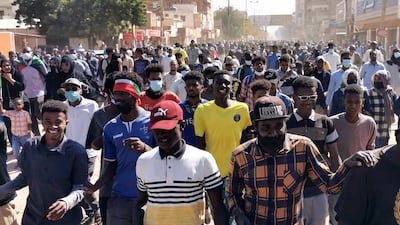
Protesters last week staged several rallies against the decline in living conditions.
Sudanese citizens have for decades endured severe economic hardship due to government mismanagement, internal conflict and the secession in 2011 of the oil-rich south.
Bashir himself was ousted in April 2019 after months of street protests initially triggered by the tripling of bread prices.
Essameddine Okasha, spokesman for the association of bakery owners in Khartoum, said bread prices have now surged "beyond people's reach".
He attributed the rise to increasing operational costs.
Sudan is also especially vulnerable to the effects of global supply shortages after Russia's invasion of Ukraine.
Protesters in northern Sudan have in recent weeks blocked a crucial trade route between Egypt and Sudan after a sharp increase in electricity tariffs.
In January, Sudanese authorities raised electricity prices across sectors, with households hit by an increase of about 500 per cent.
Fuel prices surge
Sudan had already embarked on plans to scrap fuel subsidies under the transition which was derailed by the coup.
Fuel prices have undergone several sharp increases over the past year.
On Saturday, petrol at the pump cost 672 pounds ($1.50) per litre, up from some 320 pounds before the coup.
Many local business owners have been forced to suspend operations.
"I have laid off some 300 employees, mostly women who were the breadwinners of their families," said a food factory owner in North Khartoum, speaking on condition of anonymity.
"I couldn't keep up with electricity and production input price hikes."
Economist Mohamed Al Nayer says Sudan is in "a state of shock".
"The absence of international aid and loans in the 2022 budget is having a negative effect," he said, pointing out that the fiscal plans rely heavily on tax rises.
"Taxes now constitute 58 per cent of the budget, sharply increasing prices and pushing the country into recession."
Sudan has been reeling from triple-digit inflation, which stood at 258 per cent in February.
"It will not be possible for the government to bring down inflation ... instead it will likely jump to 500 per cent," forecast Mr Al Nayer.
Sudan has yet to name a prime minister since the January resignation of UN economist-turned-premier Abdalla Hamdok.
This month, Sudan formed a council to address the economic challenges, led by the deputy head of its Sovereign Council, Mohamed Hamdan Daglo, known as Hemeti.
On March 9, Mr Daglo blamed a "mafia" of dealers responsible for currency and gold speculation on the local market.
Sudan's central bank announced this month it would allow the currency to float as part of measures to stem the black market.
"It was the right decision but at the wrong time," Ms Sayed said.
She said the move would drive up inflation and further weaken the local currency.
In mid-February, the Sudanese pound hovered at 450 to the dollar but now the greenback buys about 600.
"Central bank policies ... have so far failed," Ms Sayed said, in a situation that "requires proper reserves of funds and gold".

The specs
Engine: 2.0-litre 4cyl turbo
Power: 261hp at 5,500rpm
Torque: 405Nm at 1,750-3,500rpm
Transmission: 9-speed auto
Fuel consumption: 6.9L/100km
On sale: Now
Price: From Dh117,059
The specs
Engine: 2-litre or 3-litre 4Motion all-wheel-drive Power: 250Nm (2-litre); 340 (3-litre) Torque: 450Nm Transmission: 8-speed automatic Starting price: From Dh212,000 On sale: Now
Benefits of first-time home buyers' scheme
- Priority access to new homes from participating developers
- Discounts on sales price of off-plan units
- Flexible payment plans from developers
- Mortgages with better interest rates, faster approval times and reduced fees
- DLD registration fee can be paid through banks or credit cards at zero interest rates
Ant-Man and the Wasp
Director: Peyton Reed
Starring: Paul Rudd, Evangeline Lilly, Michael Douglas
Three stars
PULITZER PRIZE 2020 WINNERS
JOURNALISM
Public Service
Anchorage Daily News in collaboration with ProPublica
Breaking News Reporting
Staff of The Courier-Journal, Louisville, Ky.
Investigative Reporting
Brian M. Rosenthal of The New York Times
Explanatory Reporting
Staff of The Washington Post
Local Reporting
Staff of The Baltimore Sun
National Reporting
T. Christian Miller, Megan Rose and Robert Faturechi of ProPublica
and
Dominic Gates, Steve Miletich, Mike Baker and Lewis Kamb of The Seattle Times
International Reporting
Staff of The New York Times
Feature Writing
Ben Taub of The New Yorker
Commentary
Nikole Hannah-Jones of The New York Times
Criticism
Christopher Knight of the Los Angeles Times
Editorial Writing
Jeffery Gerritt of the Palestine (Tx.) Herald-Press
Editorial Cartooning
Barry Blitt, contributor, The New Yorker
Breaking News Photography
Photography Staff of Reuters
Feature Photography
Channi Anand, Mukhtar Khan and Dar Yasin of the Associated Press
Audio Reporting
Staff of This American Life with Molly O’Toole of the Los Angeles Times and Emily Green, freelancer, Vice News for “The Out Crowd”
LETTERS AND DRAMA
Fiction
"The Nickel Boys" by Colson Whitehead (Doubleday)
Drama
"A Strange Loop" by Michael R. Jackson
History
"Sweet Taste of Liberty: A True Story of Slavery and Restitution in America" by W. Caleb McDaniel (Oxford University Press)
Biography
"Sontag: Her Life and Work" by Benjamin Moser (Ecco/HarperCollins)
Poetry
"The Tradition" by Jericho Brown (Copper Canyon Press)
General Nonfiction
"The Undying: Pain, Vulnerability, Mortality, Medicine, Art, Time, Dreams, Data, Exhaustion, Cancer, and Care" by Anne Boyer (Farrar, Straus and Giroux)
and
"The End of the Myth: From the Frontier to the Border Wall in the Mind of America" by Greg Grandin (Metropolitan Books)
Music
"The Central Park Five" by Anthony Davis, premiered by Long Beach Opera on June 15, 2019
Special Citation
Ida B. Wells
Virtual banks explained
What is a virtual bank?
The Hong Kong Monetary Authority defines it as a bank that delivers services through the internet or other electronic channels instead of physical branches. That means not only facilitating payments but accepting deposits and making loans, just like traditional ones. Other terms used interchangeably include digital or digital-only banks or neobanks. By contrast, so-called digital wallets or e-wallets such as Apple Pay, PayPal or Google Pay usually serve as intermediaries between a consumer’s traditional account or credit card and a merchant, usually via a smartphone or computer.
What’s the draw in Asia?
Hundreds of millions of people under-served by traditional institutions, for one thing. In China, India and elsewhere, digital wallets such as Alipay, WeChat Pay and Paytm have already become ubiquitous, offering millions of people an easy way to store and spend their money via mobile phone. Indonesia, Vietnam and the Philippines are also among the world’s biggest under-banked countries; together they have almost half a billion people.
Is Hong Kong short of banks?
No, but the city is among the most cash-reliant major economies, leaving room for newcomers to disrupt the entrenched industry. Ant Financial, an Alibaba Group Holding affiliate that runs Alipay and MYBank, and Tencent Holdings, the company behind WeBank and WeChat Pay, are among the owners of the eight ventures licensed to create virtual banks in Hong Kong, with operations expected to start as early as the end of the year.
Company profile
Name: Steppi
Founders: Joe Franklin and Milos Savic
Launched: February 2020
Size: 10,000 users by the end of July and a goal of 200,000 users by the end of the year
Employees: Five
Based: Jumeirah Lakes Towers, Dubai
Financing stage: Two seed rounds – the first sourced from angel investors and the founders' personal savings
Second round raised Dh720,000 from silent investors in June this year
Last 10 winners of African Footballer of the Year
2006: Didier Drogba (Chelsea and Ivory Coast)
2007: Frederic Kanoute (Sevilla and Mali)
2008: Emmanuel Adebayor (Arsenal and Togo)
2009: Didier Drogba (Chelsea and Ivory Coast)
2010: Samuel Eto’o (Inter Milan and Cameroon)
2011: Yaya Toure (Manchester City and Ivory Coast)
2012: Yaya Toure (Manchester City and Ivory Coast)
2013: Yaya Toure (Manchester City and Ivory Coast)
2014: Yaya Toure (Manchester City and Ivory Coast)
2015: Pierre-Emerick Aubameyang (Borussia Dortmund and Gabon)
2016: Riyad Mahrez (Leicester City and Algeria)
The specs
Engine: 3.0-litre twin-turbo flat-six
Power: 480hp at 6,500rpm
Torque: 570Nm from 2,300-5,000rpm
Transmission: 8-speed dual-clutch auto
Fuel consumption: 10.4L/100km
Price: from Dh547,600
On sale: now
The bio
Who inspires you?
I am in awe of the remarkable women in the Arab region, both big and small, pushing boundaries and becoming role models for generations. Emily Nasrallah was a writer, journalist, teacher and women’s rights activist
How do you relax?
Yoga relaxes me and helps me relieve tension, especially now when we’re practically chained to laptops and desks. I enjoy learning more about music and the history of famous music bands and genres.
What is favourite book?
The Perks of Being a Wallflower - I think I've read it more than 7 times
What is your favourite Arabic film?
Hala2 Lawen (Translation: Where Do We Go Now?) by Nadine Labaki
What is favourite English film?
Mamma Mia
Best piece of advice to someone looking for a career at Google?
If you’re interested in a career at Google, deep dive into the different career paths and pinpoint the space you want to join. When you know your space, you’re likely to identify the skills you need to develop.
If%20you%20go
%3Cp%3EThere%20are%20regular%20flights%20from%20Dubai%20to%20Kathmandu.%20Fares%20with%20Air%20Arabia%20and%20flydubai%20start%20at%20Dh1%2C265.%3Cbr%3EIn%20Kathmandu%2C%20rooms%20at%20the%20Oasis%20Kathmandu%20Hotel%20start%20at%20Dh195%20and%20Dh120%20at%20Hotel%20Ganesh%20Himal.%3Cbr%3EThird%20Rock%20Adventures%20offers%20professionally%20run%20group%20and%20individual%20treks%20and%20tours%20using%20highly%20experienced%20guides%20throughout%20Nepal%2C%20Bhutan%20and%20other%20parts%20of%20the%20Himalayas.%3C%2Fp%3E%0A
Living in...
This article is part of a guide on where to live in the UAE. Our reporters will profile some of the country’s most desirable districts, provide an estimate of rental prices and introduce you to some of the residents who call each area home.
Killing of Qassem Suleimani