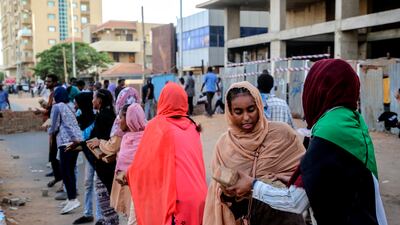
Sudan's ousted Prime Minister Abdalla Hamdok has agreed to a conditional return as the head of a new government. EPA

Sudan's ousted PM Abdalla Hamdok agrees to conditional return


  • English
  • Arabic

Sudan's Abdalla Hamdok has agreed to a conditional return as the head of a new government, a senior adviser to the ousted prime minister told The National.

Mr Hamdok's return is dependent on terms set by him, including the release of all political detainees and the reinstatement of the constitutional declaration, the adviser said.

Those detained include Khaled Omar Youssef, the Minister of Cabinet Affairs, Hashim Hasab Al Rasol, Communications Minister and Mr Hamdok's media adviser Faisal Mohamed Saleh.

Mr Hamdok's potential return comes as protests in several cities in Sudan have continued for more than a week and a civil disobedience campaign gains momentum.

Protesters in the capital Khartoum have flatly rejected any power-sharing agreement with the military.

"The army stabbed us in the back. We will protest against Hamdok himself if he shakes hands again with the generals," Mai Hassan, 49, a protester, told The National.

"There's a huge gap now between the 44 million Sudanese, who are completely against any military representation in the new government. We gave them a chance and will never be fooled again. The more they push us into accepting such deals, the more unstable the country and the region become."

On October 25, army head Gen Abdel Fattah Al Burhan dissolved the government and declared a state of emergency.

A deadly crackdown on the mass rallies in the capital, Khartoum, ensued and at least 12 people have been killed.

The takeover has sparked a chorus of international condemnation and punitive aid cuts, with world powers demanding a swift return to civilian rule.

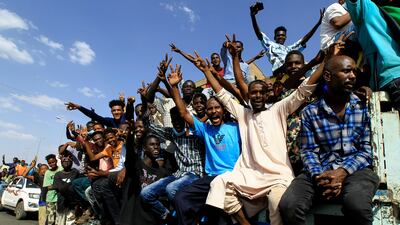
  • Protesters demonstrate against the Sudanese military's seizure of power and removal of the civilian government, in the capital Khartoum. Reuters
    Protesters demonstrate against the Sudanese military's seizure of power and removal of the civilian government, in the capital Khartoum. Reuters
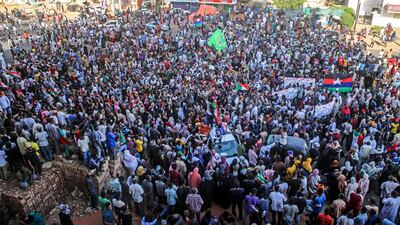
  • Thousands of Sudanese people took to the streets in the capital of Khartoum, above, and other major cities across the country to demand the country's transition to democratic rule be put back on track. EPA
    Thousands of Sudanese people took to the streets in the capital of Khartoum, above, and other major cities across the country to demand the country's transition to democratic rule be put back on track. EPA
  • Protesters carry a barricade as they demonstrate against the Sudanese military, in the capital Khartoum. Reuters
    Protesters carry a barricade as they demonstrate against the Sudanese military, in the capital Khartoum. Reuters
  • A Sudanese protester flashes a victory sign near a burning tyre as thousands of people joined anti-coup protests in Khartoum. EPA
    A Sudanese protester flashes a victory sign near a burning tyre as thousands of people joined anti-coup protests in Khartoum. EPA
  • Thousands of Sudanese people participated in anti-military protests in the capital Khartoum. EPA
    Thousands of Sudanese people participated in anti-military protests in the capital Khartoum. EPA
  • A Sudanese protester dressed up as Spider-Man, stands on car during an anti-coup protest in the capital Khartoum. EPA
    A Sudanese protester dressed up as Spider-Man, stands on car during an anti-coup protest in the capital Khartoum. EPA
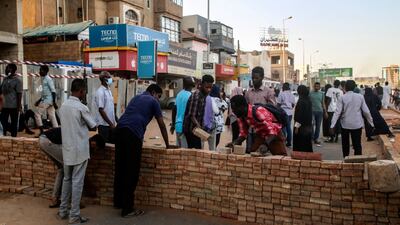
  • Demonstrators build a barricade on a street in the capital Khartoum during an anti-coup protest. EPA
    Demonstrators build a barricade on a street in the capital Khartoum during an anti-coup protest. EPA
  • Sudanese women during anti-coup protests as a part of nationwide demonstrations against the military takeover of the government on October 25, in the capital Khartoum. EPA
    Sudanese women during anti-coup protests as a part of nationwide demonstrations against the military takeover of the government on October 25, in the capital Khartoum. EPA
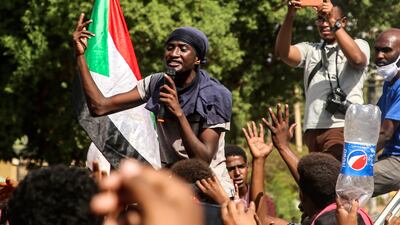
  • Protesters raised slogans demanding the exit of Gen Abdel Fattah Al Burhan, in the capital Khartoum. AP Photo
    Protesters raised slogans demanding the exit of Gen Abdel Fattah Al Burhan, in the capital Khartoum. AP Photo
  • Protesters declared 'the revolution will continue' during a demonstration in Khartoum. AP
    Protesters declared 'the revolution will continue' during a demonstration in Khartoum. AP
  • 'Going back is impossible' was among slogans raised by Sudanese protesters in the capital Khartoum. AP
    'Going back is impossible' was among slogans raised by Sudanese protesters in the capital Khartoum. AP

Mr Hamdok has asked for the Forces of Freedom and Change to be involved in any negotiations, the adviser said.

The FFC is an alliance of political parties and representatives of armed militias in Darfur and other regions, which led the protests in 2019 against long-time dictator Omar Al Bashir.

In September, the group divided in two, with the splinter group supporting the military.

The breakaway group also accused other parties within the alliance of having antagonised the army.

The power-sharing negotiations have been fraught with problems from the start.

A day after Gen Al Burhan removed Mr Hamdok from office, the military head said he agreed with several of the ousted prime minister's initiatives but ultimately removed him because he was unable to work freely.

The general's main criticism was reserved for the FFC.

He claimed that the takeover was necessary to prevent a civil war, citing what he said were growing divisions among political groups.

Still under house arrest

Mr Hamdok is under arrest in his house in the suburb of Kafouri in northern Khartoum, and has not been allowed to speak to the media.

Over the past week, there have been several initiatives and mediation efforts by Sudanese politicians and industry leaders, the country's neighbours and the UN.

"The talks are being led by politicians from both factions of the FCC, a delegation of businessmen led by Foad Ahmed Mekki Abdi and Anees Hajjar," Mr Hamdok's adviser said. "There's also an initiative from Al Mahjoub Mohamed Saleh," the adviser said, referring to a veteran journalist.

Gen Mohamed Dagolo, the deputy head of the ruling military council, visited Mr Hamdok on Monday, the adviser said.

The escalating crisis comes as Sudan grapples with several national security problems.

It has a border dispute with its eastern neighbour Ethiopia, which is also building a dam on the Nile that has sparked a regional diplomatic stand-off.

The UN special envoy for Sudan said on Monday that Sudanese and international mediation efforts were expected to bear fruit in coming days.

US Special Envoy for the Horn of Africa Jeffery Feltman said on Tuesday that Gen Al Burhan should allow Mr Hamdok and his Cabinet to resume their work and release government officials and politicians detained in connection with the takeover.

Mr Feltman said the coup “hijacked and betrayed the aspiration of the Sudanese people in a peaceful democratic country”, more than two years after a popular uprising forced the removal of Al Bashir.


Muslim Council of Elders condemns terrorism on religious sites

The Muslim Council of Elders has strongly condemned the criminal attacks on religious sites in Britain.

It firmly rejected “acts of terrorism, which constitute a flagrant violation of the sanctity of houses of worship”.

“Attacking places of worship is a form of terrorism and extremism that threatens peace and stability within societies,” it said.

The council also warned against the rise of hate speech, racism, extremism and Islamophobia. It urged the international community to join efforts to promote tolerance and peaceful coexistence.

How Tesla’s price correction has hit fund managers

Investing in disruptive technology can be a bumpy ride, as investors in Tesla were reminded on Friday, when its stock dropped 7.5 per cent in early trading to $575.

It recovered slightly but still ended the week 15 per cent lower and is down a third from its all-time high of $883 on January 26. The electric car maker’s market cap fell from $834 billion to about $567bn in that time, a drop of an astonishing $267bn, and a blow for those who bought Tesla stock late.

The collapse also hit fund managers that have gone big on Tesla, notably the UK-based Scottish Mortgage Investment Trust and Cathie Wood’s ARK Innovation ETF.

Tesla is the top holding in both funds, making up a hefty 10 per cent of total assets under management. Both funds have fallen by a quarter in the past month.

Matt Weller, global head of market research at GAIN Capital, recently warned that Tesla founder Elon Musk had “flown a bit too close to the sun”, after getting carried away by investing $1.5bn of the company’s money in Bitcoin.

He also predicted Tesla’s sales could struggle as traditional auto manufacturers ramp up electric car production, destroying its first mover advantage.

AJ Bell’s Russ Mould warns that many investors buy tech stocks when earnings forecasts are rising, almost regardless of valuation. “When it works, it really works. But when it goes wrong, elevated valuations leave little or no downside protection.”

A Tesla correction was probably baked in after last year’s astonishing share price surge, and many investors will see this as an opportunity to load up at a reduced price.

Dramatic swings are to be expected when investing in disruptive technology, as Ms Wood at ARK makes clear.

Every week, she sends subscribers a commentary listing “stocks in our strategies that have appreciated or dropped more than 15 per cent in a day” during the week.

Her latest commentary, issued on Friday, showed seven stocks displaying extreme volatility, led by ExOne, a leader in binder jetting 3D printing technology. It jumped 24 per cent, boosted by news that fellow 3D printing specialist Stratasys had beaten fourth-quarter revenues and earnings expectations, seen as good news for the sector.

By contrast, computational drug and material discovery company Schrödinger fell 27 per cent after quarterly and full-year results showed its core software sales and drug development pipeline slowing.

Despite that setback, Ms Wood remains positive, arguing that its “medicinal chemistry platform offers a powerful and unique view into chemical space”.

In her weekly video view, she remains bullish, stating that: “We are on the right side of change, and disruptive innovation is going to deliver exponential growth trajectories for many of our companies, in fact, most of them.”

Ms Wood remains committed to Tesla as she expects global electric car sales to compound at an average annual rate of 82 per cent for the next five years.

She said these are so “enormous that some people find them unbelievable”, and argues that this scepticism, especially among institutional investors, “festers” and creates a great opportunity for ARK.

Only you can decide whether you are a believer or a festering sceptic. If it’s the former, then buckle up.

Updated: November 03, 2021, 1:38 PM