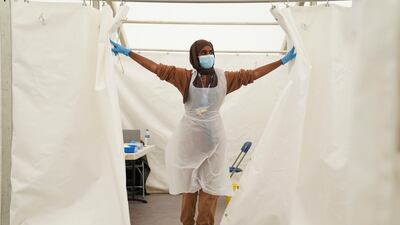
A Tunisian medic provides care for Covid-19 patients at Charles Nicole hospital's emergency room in the capital Tunis. AFP

Delta variant fuels Covid-19 surge in largely unvaccinated Middle East nations


Nada El Sawy
  • English
  • Arabic

Follow the latest updates on the Covid-19 pandemic here

A surge in cases of the Delta variant of Covid-19d, combined with low vaccination rates, is fuelling a public health emergency and a sharp increase in deaths across the Eastern Mediterranean region, the World Health Organisation reported on Monday.

“As we work hard to take steps to control the Covid-19 pandemic, the virus continues to mutate and spread faster and more aggressively across the region, with severe public health consequences,” said Dr Rana Hajjeh, director of programme management at WHO/EMRO.

Among the countries hardest hit are Lebanon and Tunisia, which are embroiled in political and economic upheaval as their health services are under significant strain.

“Both countries are facing a concerning increase in the numbers of cases and deaths, and their health systems have been brought to their knees, leaving health care workers overwhelmed, and critical shortages in medical supplies,” Dr Hajjeh said.

The WHO defines the Eastern Mediterranean as an area of its operations extending through the Middle East and North Africa to include Pakistan and Afghanistan, covering a total population of nearly 679 million people.

The highly infectious Delta variant, first detected in India and now in 132 countries, has been reported in 15 countries in the region.

An average of 363,000 new cases and 4,300 deaths a week were reported across the region over the past four weeks, a 67 per cent and 24 per cent increase on last month.

More than 12.6 million cases and 237,000 deaths have been reported in the region since the pandemic began.

Countries reporting a substantial increase in cases and deaths over the past month include Iran, Iraq, Lebanon, Libya, Morocco, Pakistan, Somalia and Tunisia.

“A few countries in the region are experiencing a significant rise in cases and deaths as a result of the Delta variant, which is being reported mainly among unvaccinated people,” Dr Hajjeh said.

“This makes it even more critical that all countries must receive enough vaccine doses quickly, and that people take the vaccine at the first opportunity they are offered it.”

The Delta variant, which will soon become the dominant variant globally, is almost 60 per cent more transmissible than the original virus, said Dr Abdinasir Abubakar, infectious hazards manager at WHO/EMRO.

Research shows the risk of hospital admission for people infected with the Delta variant is on average 120 per cent higher, and the risk of death 137 per cent higher. Those infected by the Delta variant are on average 287 per cent more likely to be admitted to intensive care.

Emergency rooms have been overwhelmed, ICUs have been saturated beyond 95 per cent and the need for medical oxygen has increased eightfold
Dr Yves Souteyrand,
WHO representative in Tunisia

Across the region, 132 million vaccine doses have been administered and only 44 million people – less than 6 per cent of the population – are fully vaccinated.

In Tunisia, more than 90 per cent of all reported infections are due to the Delta variant, which was detected in the country on June 24.

“This is being fuelled by low adherence to public health and social measures, as well as low vaccination coverage,” Dr Hajjeh said.

About 8 per cent of Tunisia's 11.8 million population is fully vaccinated. It has reported more than 595,000 cases and more than 20,000 deaths.

“Emergency rooms have been overwhelmed, ICUs have been saturated beyond 95 per cent and the need for medical oxygen has increased eightfold,” said Dr Yves Souteyrand, the WHO representative in Tunisia.

“Swift public health measures have been implemented at the national level, including full lockdown in governorates with the highest incident rate."

At the same time, the country is dealing with political uncertainty following the Tunisian President Kais Saied’s decision to suspend Parliament and dismiss his prime minister last week.

Coronavirus around the world - in pictures

  • A National Health Service worker prepares for patients at a pop-up vaccination centre during a four-day Covid-19 vaccine festival in Langdon Park, east London.
    A National Health Service worker prepares for patients at a pop-up vaccination centre during a four-day Covid-19 vaccine festival in Langdon Park, east London.
  • Young people line up to receive shots of Sinovac's Covid-19 vaccine at the Phnom Penh Thmey Health Centre, in Phnom Penh, Cambodia.
    Young people line up to receive shots of Sinovac's Covid-19 vaccine at the Phnom Penh Thmey Health Centre, in Phnom Penh, Cambodia.
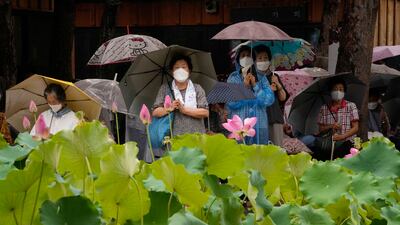
  • People wearing face masks as a precaution against the coronavirus pray during a service at the Chogyesa temple in Seoul, South Korea.
    People wearing face masks as a precaution against the coronavirus pray during a service at the Chogyesa temple in Seoul, South Korea.
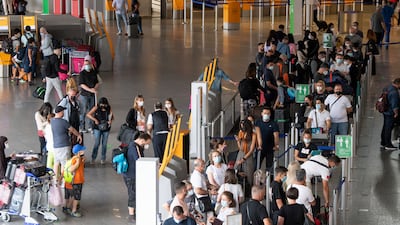
  • Passengers wearing face masks wait in the outbound queue at Frankfurt airport, in Germany.
    Passengers wearing face masks wait in the outbound queue at Frankfurt airport, in Germany.
  • Demonstrators clash with police at the end of a national day of protest against French legislation making a Covid-19 health pass compulsory to visit a cafe, board a plane or travel on an inter-city train, in Paris.
    Demonstrators clash with police at the end of a national day of protest against French legislation making a Covid-19 health pass compulsory to visit a cafe, board a plane or travel on an inter-city train, in Paris.
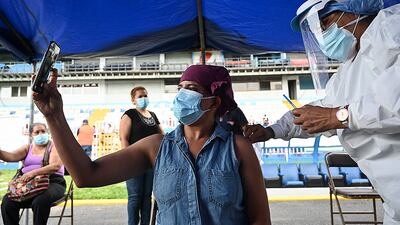
  • A woman takes a selfie while receiving the first dose of the Moderna vaccine against Covid-19, during the vaccination day called 'Vacunaton', which aims to immunise 50,000 Hondurans aged over 35 in the National Stadium, in Tegucigalpa.
    A woman takes a selfie while receiving the first dose of the Moderna vaccine against Covid-19, during the vaccination day called 'Vacunaton', which aims to immunise 50,000 Hondurans aged over 35 in the National Stadium, in Tegucigalpa.
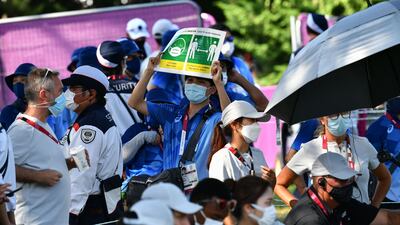
  • A volunteer holds up a sign to remind people to adhere to Covid-19 protocols during round 4 of the men’s golf individual stroke play during the Tokyo 2020 Olympic Games at the Kasumigaseki Country Club in Kawagoe.
    A volunteer holds up a sign to remind people to adhere to Covid-19 protocols during round 4 of the men’s golf individual stroke play during the Tokyo 2020 Olympic Games at the Kasumigaseki Country Club in Kawagoe.
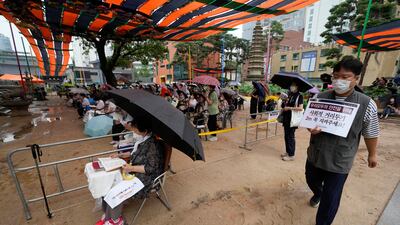
  • A man with a notice walks around people wearing face masks as a precaution against the coronavirus during a service at the Chogyesa temple in Seoul, South Korea.
    A man with a notice walks around people wearing face masks as a precaution against the coronavirus during a service at the Chogyesa temple in Seoul, South Korea.
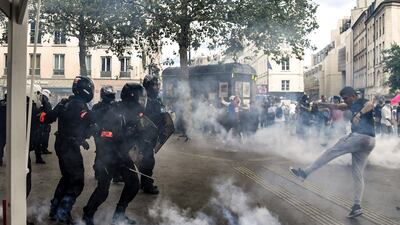
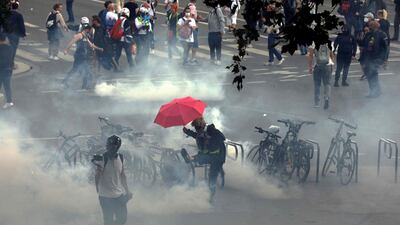
  • A demonstrator kicks away a smoking teargas shell during a national day of protest against compulsory Covid-19 vaccinations for certain workers and the compulsory use of health passes, in Paris.
    A demonstrator kicks away a smoking teargas shell during a national day of protest against compulsory Covid-19 vaccinations for certain workers and the compulsory use of health passes, in Paris.
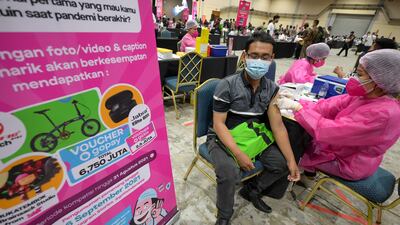
  • A health worker, right, administers the Sinovac vaccine during a mass vaccination drive against the Covid-19 coronavirus outbreak in Jakarta.
    A health worker, right, administers the Sinovac vaccine during a mass vaccination drive against the Covid-19 coronavirus outbreak in Jakarta.

Dr Souteyrand said the political situation was “not ideal for the efforts provided by the Ministry of Health to tackle the Covid-19 crisis”.

However, “the emergency committee that was established by the government a few days ago will reap fruit soon”, he said.

On the positive side, Tunisia received several large shipments of vaccines, including one million doses of the Moderna vaccine from the US on Friday.

In Lebanon, which detected the Delta variant on July 2, about 12 per cent of its population of 6.8 million is fully vaccinated.

The Delta variant is now the dominant strain in the country and the Covid-19 positive test rate is at 5.7 per cent, compared to less than 1 per cent one and a half months ago, said Dr Iman Shankiti, the WHO representative in Lebanon.

About 93 per cent of new cases are people who are either unvaccinated or have received only one dose, she said.

Lebanon’s political and economic crisis is due to decades of corruption and mismanagement, combined with a lack of foreign currency reserves that has left half of the population below the poverty line.

The resulting problems in the health sector include a shortage of medications, a brain drain of health professionals, poor infrastructure and lack of affordability.

Around 2,000 doctors and 1,500 registered nurses have left the country, the medical syndicate said.

“Hospitals are right now at 50 per cent capacity because of the lack of fuel, electricity, water, sanitation and transportation,” Dr Shankiti said.

“I hope we don’t get to a place where we cannot serve those who need an ICU bed.”

Health care hit by Beirut blast

This week also marks one year since the Beirut port blast killed 200 people, injured 6,000 and displaced 300,000.

“The aftermath of the explosion saw cases of Covid-19 skyrocket, including among health care workers, and the impact of this continues to be seen today, as the health system continues to struggle with limited resources amid the worst economic and social crisis in recent history,” Dr Hajjeh said.

She urged wealthier countries to donate vaccine doses to low and middle-income countries, and appealed to individuals to continue using preventative measures.

“Unfortunately, there is still a worrying inequity in the distributions of vaccines, with many countries in our region severely impacted,” she said.


How it works

Booklava works on a subscription model. On signing up you receive a free book as part of a 30-day-trial period, after which you pay US$9.99 (Dh36.70) per month to gain access to a library of books and discounts of up to 30 per cent on selected titles. You can cancel your subscription at any time. For more details go to www.booklava.com

Tickets

Tickets for the 2019 Asian Cup are available online, via www.asiancup2019.com

AS%20WE%20EXIST
%3Cp%3EAuthor%3A%20Kaoutar%20Harchi%C2%A0%3C%2Fp%3E%0A%3Cp%3EPublisher%3A%20Other%20Press%3C%2Fp%3E%0A%3Cp%3EPages%3A%20176%3C%2Fp%3E%0A%3Cp%3EAvailable%3A%20Now%3C%2Fp%3E%0A
Desert Warrior

Starring: Anthony Mackie, Aiysha Hart, Ben Kingsley

Director: Rupert Wyatt

Rating: 3/5

How to help

Send “thenational” to the following numbers or call the hotline on: 0502955999
2289 – Dh10
2252 – Dh 50
6025 – Dh20
6027 – Dh 100
6026 – Dh 200

While you're here
Avatar: Fire and Ash

Director: James Cameron

Starring: Sam Worthington, Sigourney Weaver, Zoe Saldana

Rating: 4.5/5

Brahmastra%3A%20Part%20One%20-%20Shiva
%3Cp%3E%3Cstrong%3EDirector%3A%20%3C%2Fstrong%3EAyan%20Mukerji%3C%2Fp%3E%0A%3Cp%3E%3Cstrong%3EStars%3A%20%3C%2Fstrong%3ERanbir%20Kapoor%2C%20Alia%20Bhatt%20and%20Amitabh%20Bachchan%3C%2Fp%3E%0A%3Cp%3E%3Cstrong%3ERating%3A%3C%2Fstrong%3E%202%2F5%3C%2Fp%3E%0A
Trump v Khan

2016: Feud begins after Khan criticised Trump’s proposed Muslim travel ban to US

2017: Trump criticises Khan’s ‘no reason to be alarmed’ response to London Bridge terror attacks

2019: Trump calls Khan a “stone cold loser” before first state visit

2019: Trump tweets about “Khan’s Londonistan”, calling him “a national disgrace”

2022:  Khan’s office attributes rise in Islamophobic abuse against the major to hostility stoked during Trump’s presidency

July 2025 During a golfing trip to Scotland, Trump calls Khan “a nasty person”

Sept 2025 Trump blames Khan for London’s “stabbings and the dirt and the filth”.

Dec 2025 Trump suggests migrants got Khan elected, calls him a “horrible, vicious, disgusting mayor”

MATCH INFO

Europa League semi-final, second leg
Atletico Madrid (1) v Arsenal (1)

Where: Wanda Metropolitano
When: Thursday, May 3
Live: On BeIN Sports HD

How to keep control of your emotions

If your investment decisions are being dictated by emotions such as fear, greed, hope, frustration and boredom, it is time for a rethink, Chris Beauchamp, chief market analyst at online trading platform IG, says.

Greed

Greedy investors trade beyond their means, open more positions than usual or hold on to positions too long to chase an even greater gain. “All too often, they incur a heavy loss and may even wipe out the profit already made.

Tip: Ignore the short-term hype, noise and froth and invest for the long-term plan, based on sound fundamentals.

Fear

The risk of making a loss can cloud decision-making. “This can cause you to close out a position too early, or miss out on a profit by being too afraid to open a trade,” he says.

Tip: Start with a plan, and stick to it. For added security, consider placing stops to reduce any losses and limits to lock in profits.

Hope

While all traders need hope to start trading, excessive optimism can backfire. Too many traders hold on to a losing trade because they believe that it will reverse its trend and become profitable.

Tip: Set realistic goals. Be happy with what you have earned, rather than frustrated by what you could have earned.

Frustration

Traders can get annoyed when the markets have behaved in unexpected ways and generates losses or fails to deliver anticipated gains.

Tip: Accept in advance that asset price movements are completely unpredictable and you will suffer losses at some point. These can be managed, say, by attaching stops and limits to your trades.

Boredom

Too many investors buy and sell because they want something to do. They are trading as entertainment, rather than in the hope of making money. As well as making bad decisions, the extra dealing charges eat into returns.

Tip: Open an online demo account and get your thrills without risking real money.

Mercer, the investment consulting arm of US services company Marsh & McLennan, expects its wealth division to at least double its assets under management (AUM) in the Middle East as wealth in the region continues to grow despite economic headwinds, a company official said.

Mercer Wealth, which globally has $160 billion in AUM, plans to boost its AUM in the region to $2-$3bn in the next 2-3 years from the present $1bn, said Yasir AbuShaban, a Dubai-based principal with Mercer Wealth.

Within the next two to three years, we are looking at reaching $2 to $3 billion as a conservative estimate and we do see an opportunity to do so,” said Mr AbuShaban.

Mercer does not directly make investments, but allocates clients’ money they have discretion to, to professional asset managers. They also provide advice to clients.

“We have buying power. We can negotiate on their (client’s) behalf with asset managers to provide them lower fees than they otherwise would have to get on their own,” he added.

Mercer Wealth’s clients include sovereign wealth funds, family offices, and insurance companies among others.

From its office in Dubai, Mercer also looks after Africa, India and Turkey, where they also see opportunity for growth.

Wealth creation in Middle East and Africa (MEA) grew 8.5 per cent to $8.1 trillion last year from $7.5tn in 2015, higher than last year’s global average of 6 per cent and the second-highest growth in a region after Asia-Pacific which grew 9.9 per cent, according to consultancy Boston Consulting Group (BCG). In the region, where wealth grew just 1.9 per cent in 2015 compared with 2014, a pickup in oil prices has helped in wealth generation.

BCG is forecasting MEA wealth will rise to $12tn by 2021, growing at an annual average of 8 per cent.

Drivers of wealth generation in the region will be split evenly between new wealth creation and growth of performance of existing assets, according to BCG.

Another general trend in the region is clients’ looking for a comprehensive approach to investing, according to Mr AbuShaban.

“Institutional investors or some of the families are seeing a slowdown in the available capital they have to invest and in that sense they are looking at optimizing the way they manage their portfolios and making sure they are not investing haphazardly and different parts of their investment are working together,” said Mr AbuShaban.

Some clients also have a higher appetite for risk, given the low interest-rate environment that does not provide enough yield for some institutional investors. These clients are keen to invest in illiquid assets, such as private equity and infrastructure.

“What we have seen is a desire for higher returns in what has been a low-return environment specifically in various fixed income or bonds,” he said.

“In this environment, we have seen a de facto increase in the risk that clients are taking in things like illiquid investments, private equity investments, infrastructure and private debt, those kind of investments were higher illiquidity results in incrementally higher returns.”

The Abu Dhabi Investment Authority, one of the largest sovereign wealth funds, said in its 2016 report that has gradually increased its exposure in direct private equity and private credit transactions, mainly in Asian markets and especially in China and India. The authority’s private equity department focused on structured equities owing to “their defensive characteristics.”

THE TWIN BIO

Their favourite city: Dubai

Their favourite food: Khaleeji

Their favourite past-time : walking on the beach

Their favorite quote: ‘we rise by lifting others’ by Robert Ingersoll

The%20specs
%3Cp%3E%3Cstrong%3EEngine%3A%3C%2Fstrong%3E%201.5-litre%204-cylinder%3Cbr%3E%3Cstrong%3ETransmission%3A%20%3C%2Fstrong%3ECVT%3Cbr%3E%3Cstrong%3EPower%3A%20%3C%2Fstrong%3E119bhp%3Cbr%3E%3Cstrong%3ETorque%3A%20%3C%2Fstrong%3E145Nm%3Cbr%3E%3Cstrong%3EPrice%3A%20%3C%2Fstrong%3EDh%2C89%2C900%20(%2424%2C230)%3Cbr%3E%3Cstrong%3EOn%20sale%3A%20%3C%2Fstrong%3Enow%3C%2Fp%3E%0A

W.
Wael Kfoury
(Rotana)

COMPANY PROFILE
Name: Kumulus Water
 
Started: 2021
 
Founders: Iheb Triki and Mohamed Ali Abid
 
Based: Tunisia 
 
Sector: Water technology 
 
Number of staff: 22 
 
Investment raised: $4 million 
The specs

Engine: 4.0-litre, six-cylinder

Transmission: six-speed manual

Power: 395bhp

Torque: 420Nm

Price: from Dh321,200

On sale: now

MATCH RESULT

Al Jazira 3 Persepolis 2
Jazira:
Mabkhout (52'), Romarinho (77'), Al Hammadi (90' 6)
Persepolis: Alipour (42'), Mensha (84')

How to report a beggar

Abu Dhabi – Call 999 or 8002626 (Aman Service)

Dubai – Call 800243

Sharjah – Call 065632222

Ras Al Khaimah - Call 072053372

Ajman – Call 067401616

Umm Al Quwain – Call 999

Fujairah - Call 092051100 or 092224411

A cheaper choice

Vanuatu: $130,000

Why on earth pick Vanuatu? Easy. The South Pacific country has no income tax, wealth tax, capital gains or inheritance tax. And in 2015, when it was hit by Cyclone Pam, it signed an agreement with the EU that gave it some serious passport power.

Cost: A minimum investment of $130,000 for a family of up to four, plus $25,000 in fees.

Criteria: Applicants must have a minimum net worth of $250,000. The process take six to eight weeks, after which the investor must travel to Vanuatu or Hong Kong to take the oath of allegiance. Citizenship and passport are normally provided on the same day.

Benefits:  No tax, no restrictions on dual citizenship, no requirement to visit or reside to retain a passport. Visa-free access to 129 countries.

F1 The Movie

Starring: Brad Pitt, Damson Idris, Kerry Condon, Javier Bardem

Director: Joseph Kosinski

Rating: 4/5

Updated: August 03, 2021, 6:54 AM