

For much of his career in the UAE, chef Gregoire Berger has been associated with Dubai's fine dining scene.
The French chef is best known for his time at Michelin-starred Ossiano at Atlantis The Palm, where his intricate approach to cooking resulted in international recognition and accolades.
After leaving Ossiano at the end of 2024, he opened Kraken Dubai, a refined seafood restaurant with a multi-course menu. His latest project takes him in a different direction – geographically and creatively.

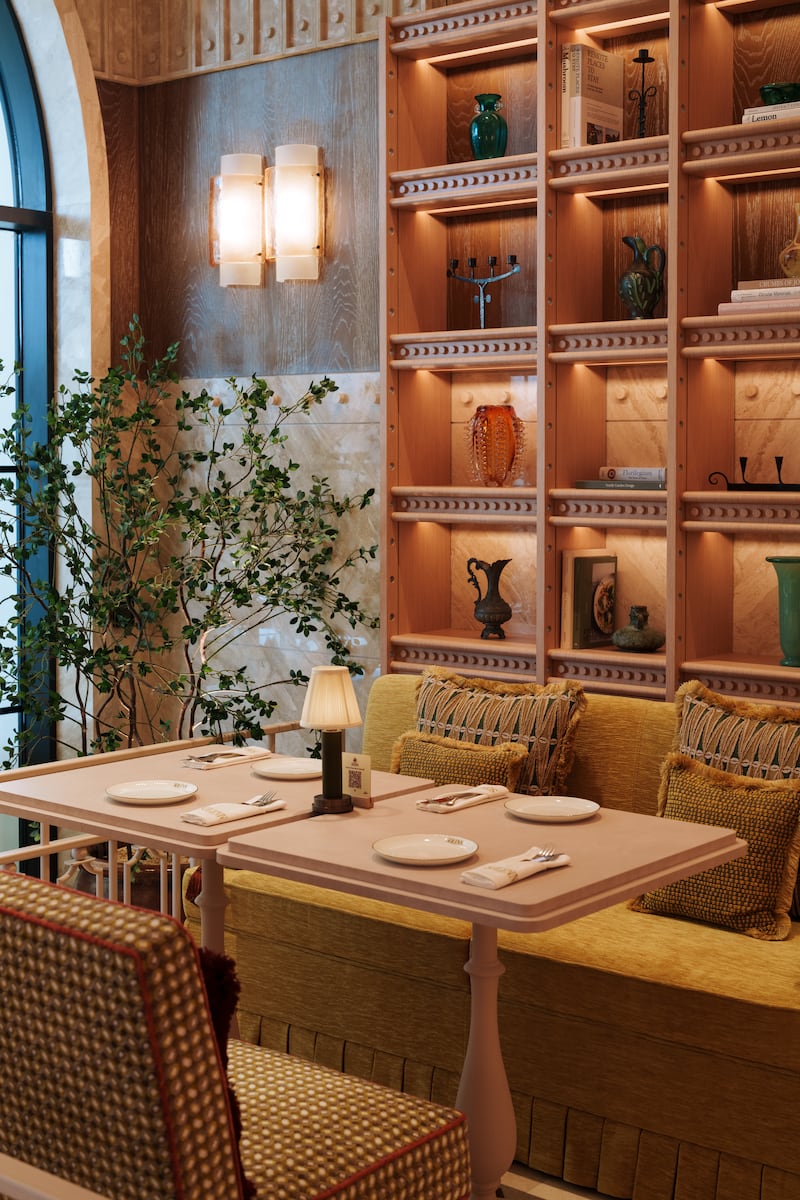
Solenn, which opened at The Arcades at Al Khail Square in August and overlooks Abu Dhabi Equestrian Club, marks Berger's first restaurant in the capital. Conceived as a relaxed Mediterranean eatery, it is built around the idea of long lunches, quality produce and a distinctly slower pace.
For Berger, there is something about the emirate that feels familiar. “What I love about Abu Dhabi is it reminds me of Dubai 14 years ago,” he tells The National. “I will not say behind, because Abu Dhabi is not behind Dubai,” he is quick to add. “It has its own pace.”
But there is an important distinction between similarity and comparison. Having watched Dubai's restaurant scene evolve through different eras – from international imports to the rise of home-grown restaurants and chefs – Berger believes Abu Dhabi is developing a dining identity on its own terms.

That distinction appealed to Berger when he began developing Solenn with The Creative House, a UAE hospitality group led by Adnan Alzarooni. Following an earlier collaboration between the two, Solenn came together in about four months.
Spending more time in Abu Dhabi has also given Berger a better sense of its diners. “What surprises me is that people stick with their culture, and I love that,” he says. “But people also know what they want. They know food.”
Beyond fine dining
Solenn arrives at a transitional point in Berger's career.
It takes a more relaxed approach compared to the lengthy, multi-course experiences often associated with fine dining. Instead, Berger imagines Solenn as a place for leisurely meals where diners are encouraged to linger.
“Solenn, is for me, the Mediterranean flair. Imagine it's beautiful springtime in the South of France, there's great music outside and an amazing fragrance of lemon trees, and you just chill over a long lunch,” he says. “It's a place where the time has a sense of place.”
The format also reflects a broader shift in what Berger wants to create. Having spent years working at the highest levels of fine dining, he believes diners increasingly want ambitious cooking in a simpler set-up.
“There are very few people who want to sit down and eat 20 dishes,” he says.
That does not mean Berger believes fine dining is disappearing. There will always be chefs who want to create those experiences and diners who seek them out, he says, but Solenn belongs to a different moment.
“It's different eras, different times, and I don't like to do the same thing over and again.”

While Solenn may be more relaxed, Berger's haute cuisine background still finds its way on to the plate.
He singles out the Illusion of a Tomato dish as perhaps the clearest example. Adapted from one of his signature creations, it features a delicate shell of white chocolate and cocoa butter filled with a tomato salad and locally made burrata.
“This is an introduction to my world through Solenn's vision,” he says.
Despite the technique behind such dishes, Berger insists the restaurant is not intended to feel overly complicated.
“We just do the dishes we love, that people love,” he says. “Amazing products, tasty food: there is nothing pretentious here.”
From the kitchen to entrepreneurship
Berger's changing approach to restaurants reflects a broader shift in his career. At 40, his interests stretch across several businesses and projects, including plans for a restaurant in Turkey as well as a potential return to fine dining when the timing feels right.
“I see myself more as an entrepreneur now with a very high creative input,” he says. “I'd love to open a fine dining in Abu Dhabi, but it's not going to be now.”

Berger wants to remain closely involved in the direction of his restaurants, but no longer wants every project to depend upon him being physically stationed in the kitchen.
“I need to give the next generation the opportunity,” he says.
Currently, Berger's attention remains on Solenn, where his priority is to turn its promising start into something more lasting by maintaining consistency and standards.
'It's time to be happy'
Success also means something different to Berger than it once did. He remembers arriving in the UAE in 2014 as a chef with something to prove. More than a decade later, he describes himself as more confident, relaxed and deliberate about the projects he chooses.
“I came as a young chef, very eager to be successful,” he says. “Thankfully, I have been successful.”
But rather than looking at his future as a succession of awards still to be won, Berger recalls a recent conversation with one of his business partners.
“I was telling him that it's time to be happy,” he says. “Humans in general have always had the need of ‘I want more’. Or: 'I have this, I need this. I have a great car, I want a better car.'
“Me, I'm happy. Right now, I have what I could not even have dreamt of.”
He acknowledges that professional success has helped him reach that conclusion. “Maybe if I weren't successful at all, my view on things would be very different.”
His outlook also owes something to the idea of maktoob, an Arabic term Berger knows through his Moroccan wife and interprets as destiny.
“I just let the flow of life go,” he says, “and I don't care where I go if I'm happy.”
That is perhaps why Abu Dhabi feels suited to Berger at this point in his career. While he still enjoys Dubai's energy and pace, he has found himself impressed with the different rhythm the capital offers.
For a chef who arrived in the UAE determined to prove himself, slowing down might once have seemed counterintuitive. At 40, though, it seems to be the point.
“Being happy, just being at peace, healthy, and with people you love,” he says. “The rest doesn't really matter.”

