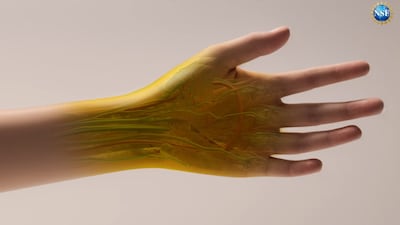

Scientists have discovered a way to see inside the body by making skin appear invisible, paving the way for medics to be able to detect skin cancer earlier and make drawing blood easier.
By using common food dye, researchers found they could penetrate skin and view its inner workings, making conditions like cancer and digestive issues easier to spot.
The revolutionary technique renders the body’s overlying tissues transparent to visible light enabling the organs inside to be seen.
Stanford University researchers used food-safe dyes, which were reversible in tests, on mice. It has not yet been tested on humans.
The US National Science Foundation described the development as creating "a window into the body" through a technique "which makes skin invisible".
In research published on Thursday in publication Science, called Achieving optical transparency in live animals with absorbing molecule, the scientists hope it could ultimately be applied to a wide range of medical diagnostics, from locating injuries to monitoring digestive disorders to identifying cancers.

Guosong Hong, assistant professor of materials science and engineering at Stanford, and senior author on the paper, told The National it will improve several procedures.
"Looking forward, this technology could make veins more visible, easing the process of venepuncture - the procedure of drawing blood or administering fluids via a needle - especially for elderly patients with veins that are difficult to locate," he said.
"Moreover, this innovation could assist in the early detection of skin cancer, improve light penetration for deep tissue treatments like photodynamic and photothermal therapies, and make laser-based tattoo removal more straightforward."
To master the new technique, the researchers developed a way to predict how light interacts with dyed biological tissues.
Using refraction, the process by which light changes speed and bends as it travels from one material into another, and knowledge of the way light scatters, the researchers examined how they could find a way to enable light to travel through the body unimpeded.
Due to fats, fluids within cells and proteins having different refractive properties effecting how significantly a light wave will bend, it has not been possible to transparently see the body’s organs.
So they set about finding a way to match the different refractive indices so light could travel through unimpeded.
They realised that dyes that are effective at absorbing light could also be highly effective at directing light uniformly through a wide range of refractive indices.
The team dissolved yellow food dye tartrazine, also known as FD & C Yellow 5, into water, then let tissues absorb it and discovered it prevented light from scattering and resulted in transparency.

The researchers first successfully tested their theory on thin slices of chicken breast and then used the solution on the scalps of mice, which rendered the skin transparent to reveal blood vessels criss-crossing the brain.
Using the same techniques on mice's abdomens, it allowed them to see the contractions of the intestine and movements caused by heartbeats and breathing.
The researchers suspect that injecting the dye should lead to even deeper views within organisms, with implications for both biology and medicine.
They began to research how microwave radiation interacts with biological tissues and by exploring historic optics textbooks, they found a mathematical equation called Kramers-Kronig and a phenomenon called Lorentz oscillation, where electrons and atoms resonate within molecules as photons pass through, and looked at how they could be applied to medicine.

They found these tools proved ideal for predicting how a given dye can raise the refractive index of biological fluids to perfectly match surrounding fats and proteins.
Using an ellipsometry, which is an optical technique used in industry to measure the thickness of a thin film, they applied the science to biology in a medical first to predict the optical properties of their target dyes.
″While a basic workhorse such as an ellipsometer would rarely make headlines, it nevertheless can play a crucial role when deployed for atypical uses like the case here," said NSF Program Officer Richard Nash, who oversees the NSF NNCI.
"Open access to such instrumentation is foundational for making groundbreaking discoveries, as those instruments can be deployed in new ways to generate fundamental insights about scientific phenomena.″
The researchers hope their approach will launch a new field of study matching dyes to biological tissues based on optical properties, potentially leading to a wide range of medical applications.
″As an optics person, I’m amazed at how they got so much from exploiting the Kramers-Konig relationship,″ said NSF Program Officer Adam Wax.
″Every optics student learns about them, but this team has used the equations to figure out how a strongly absorbing dye can make skin transparent. Using an NSF EAGER grant, Mr Hong was able to step out in a bold new direction, a great example of how fundamental optics knowledge can be used to create new technologies, including in biomedicine.″

