• Egyptian Mohammed Alatar, 31, tries on Ihram clothing, simple garments worn by pilgrims performing Hajj, at a store in Riyadh, Saudi Arabia.
    Egyptian Mohammed Alatar, 31, tries on Ihram clothing, simple garments worn by pilgrims performing Hajj, at a store in Riyadh, Saudi Arabia.
  • Men embroider Islamic calligraphy to prepare a drape, or Kiswa, that covers the Kaaba, the cube-shaped structure at the heart of the Grand Mosque in Mecca, Saudi Arabia.
    Men embroider Islamic calligraphy to prepare a drape, or Kiswa, that covers the Kaaba, the cube-shaped structure at the heart of the Grand Mosque in Mecca, Saudi Arabia.
  • A woman fields calls at the National Centre for Security Operations in Mecca, Saudi Arabia, days before the annual Hajj pilgrimage.
    A woman fields calls at the National Centre for Security Operations in Mecca, Saudi Arabia, days before the annual Hajj pilgrimage.
  • The centre is responsible for security patrols, road safety, traffic and civil defence during Hajj.
    The centre is responsible for security patrols, road safety, traffic and civil defence during Hajj.
  • A camp is set up for pilgrims in Mina, near Mecca, ahead of this year's pilgrimage.
    A camp is set up for pilgrims in Mina, near Mecca, ahead of this year's pilgrimage.
  • A major disinfection drive is under way in Mecca, in preparation for this year's Hajj.
    A major disinfection drive is under way in Mecca, in preparation for this year's Hajj.
  • A Bengali worker cleans the streets in Mina.
    A Bengali worker cleans the streets in Mina.
  • Saudi Arabian police officer Abeer Abdullah on guard during a press conference featuring the head of the Hajj security forces in Mecca. The annual pilgrimage used to draw more than 2 million people but for the second straight year it is curtailed by the coronavirus with only vaccinated people in Saudi Arabia allowed to participate.
    Saudi Arabian police officer Abeer Abdullah on guard during a press conference featuring the head of the Hajj security forces in Mecca. The annual pilgrimage used to draw more than 2 million people but for the second straight year it is curtailed by the coronavirus with only vaccinated people in Saudi Arabia allowed to participate.
  • Saudi security staff watch smart screens, which identify passing pilgrim's authorisation to participate in Hajj, at al Zaidy reception centre in Mecca.
    Saudi security staff watch smart screens, which identify passing pilgrim's authorisation to participate in Hajj, at al Zaidy reception centre in Mecca.
  • A camp for pilgrims is set up in Mina, near Mecca. The Hajj pilgrimage is required of every Muslim who can afford it and is physically able to make it, at least once in a lifetime.
    A camp for pilgrims is set up in Mina, near Mecca. The Hajj pilgrimage is required of every Muslim who can afford it and is physically able to make it, at least once in a lifetime.
  • .Workers set up accommodation for pilgrims in Mina.
    .Workers set up accommodation for pilgrims in Mina.
  • A police vehicle patrols the tented camp in Mina before the Hajj pilgrimage, which is due to start on Saturday and run until July 22 but for limited numbers.
    A police vehicle patrols the tented camp in Mina before the Hajj pilgrimage, which is due to start on Saturday and run until July 22 but for limited numbers.
  • A smart robot used for the first time at the Grand Mosque in Saudi Arabia's holy city of Mecca, supplying worshippers with bottles of Zamzam water to reduce direct contact with staff as a measure to prevent Covid-19 infections spreading during the yearly Hajj pilgrimage.
    A smart robot used for the first time at the Grand Mosque in Saudi Arabia's holy city of Mecca, supplying worshippers with bottles of Zamzam water to reduce direct contact with staff as a measure to prevent Covid-19 infections spreading during the yearly Hajj pilgrimage.

Saudi Arabia reveals final plans for Hajj 2021


Balquees Basalom
  • English
  • Arabic

Follow the latest updates on Hajj 2021 here

Saudi Arabia’s authorities revealed the final plans for Hajj 2021, which is scheduled to begin on Saturday, July 17.

Pilgrims will begin arriving in Makkah that morning, the authorities said on Wednesday.

"All pilgrims must head to four gathering points, where they will board buses for the holy mosque of Makkah to start their Hajj rituals," said Maj Gen Zayed Al Tuwan, commander of Hajj Security Forces.

To stagger the arrival of the 60,000 pilgrims making the journey this year, some will arrive on July 17 and others the following day.

A fleet of 2,500 buses will be used to make 26,000 trips between the kingdom’s holy sites, officials said.

“No one is allowed to use personal cars to go between the holy sites, even if they have Hajj permits. Everyone must use the assigned buses," Maj Gen Al Tuwan said.

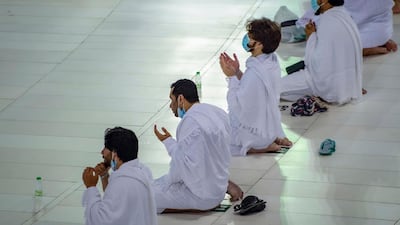
To ensure social distancing, the tawaf circle in the Grand Mosque will have 25 lanes, each 1.5 metres apart.

The ground level can accommodate up to 4,770 worshippers at once, with space for 1,000 more on the second level, and 3,000 on the third.

After the tawaf al qudum - the custom of circling the Kaaba that all pilgrims travelling to Makkah from outside its borders must perform - the pilgrims will leave the Grand Mosque and head by bus to their allotted accommodation in Mina.

Groups of pilgrims will be colour-coded, either red, black, green or yellow, and each group has designated buses and separate accommodation.

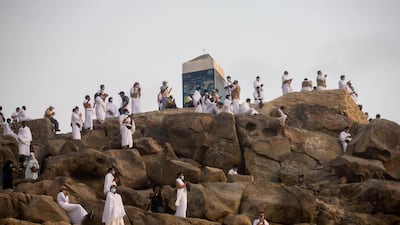
  • Muslim pilgrims pray on Mount Arafat, south-east of Makkah, Saudi Arabia, during the climax of the Hajj pilgrimage in July last year.
    Muslim pilgrims pray on Mount Arafat, south-east of Makkah, Saudi Arabia, during the climax of the Hajj pilgrimage in July last year.
  • Muslims pray on Mount Arafat while on the Hajj pilgrimage during the Covid-19 pandemic last year.
    Muslims pray on Mount Arafat while on the Hajj pilgrimage during the Covid-19 pandemic last year.
  • Muslim pilgrims pray at the Namira Mosque on Arafat Day last year, the climax of the Hajj pilgrimage.
    Muslim pilgrims pray at the Namira Mosque on Arafat Day last year, the climax of the Hajj pilgrimage.
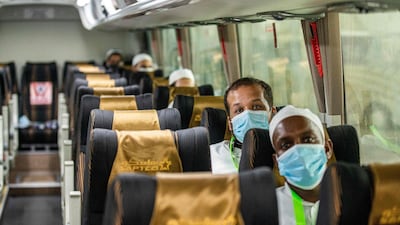
  • Arrivals for last year's Hajj pilgrimage travel to Makkah from Jeddah. Last year's Hajj was scaled back considerably to include just 1,000 Muslim pilgrims as Saudi Arabia battled a coronavirus surge.
    Arrivals for last year's Hajj pilgrimage travel to Makkah from Jeddah. Last year's Hajj was scaled back considerably to include just 1,000 Muslim pilgrims as Saudi Arabia battled a coronavirus surge.
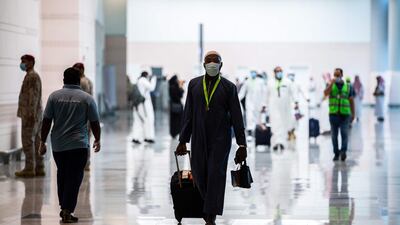
  • A traveller walking with his luggage as part of the first group of arrivals for last year's Hajj pilgrimage in Saudi Arabia.
    A traveller walking with his luggage as part of the first group of arrivals for last year's Hajj pilgrimage in Saudi Arabia.
  • Muslim pilgrims attend prayers at Namira Mosque on Arafat Day last year, the climax of the Hajj pilgrimage in Makkah.
    Muslim pilgrims attend prayers at Namira Mosque on Arafat Day last year, the climax of the Hajj pilgrimage in Makkah.
  • Muslim pilgrims attend prayers at Namira Mosque on Arafat Day last year, the climax of the Hajj pilgrimage in Makkah, Saudi Arabia.
    Muslim pilgrims attend prayers at Namira Mosque on Arafat Day last year, the climax of the Hajj pilgrimage in Makkah, Saudi Arabia.
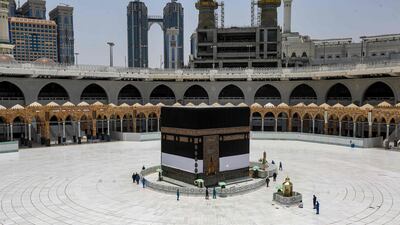
  • Workers at the Grand Mosque complex in Makkah work around the Kaaba before last year's Hajj pilgrimage.
    Workers at the Grand Mosque complex in Makkah work around the Kaaba before last year's Hajj pilgrimage.
  • Pilgrims in the Grand Mosque complex in Makkah pictured around the Kaaba during last year's Hajj.
    Pilgrims in the Grand Mosque complex in Makkah pictured around the Kaaba during last year's Hajj.

In previous years, people could walk from Mina to Arafat then to Muzalifa while performing Hajj, but buses will be the only way to get around Makkah this year.

The authorities are working to ensure no trespassers can get into the Grand Mosque or the other holy sites.

"All entry points are secured with police cars and police officers. Even locations far from main streets and residential areas such as valleys and deserted mountains and other sites are secured," Maj Gen Al Tuwan said.

"Thermal cameras and surveillance cameras have been located in all the holy sites as well,” he said.

The fine for trespassing is 10,000 riyals. Jail time is possible.

Besides security points inside Makkah and at the entry points for the sites, members of a special security unit will be on duty at more than 100 locations around the city.

People are still allowed to enter Makkah if they are in not the state of Ihram - a state of spiritual purity which the faithful must enter before they embark on Hajj.

New technologies are also being used to confirm the identity of pilgrims this year. If an identity card is lost, a fingerprint machine will be used to confirm if a person is a registered pilgrim or not.

While electronic Hajj permits have been issued to pilgrims for several years, for those working to facilitate the pilgrimage, this is the first year they will also use an electronic permit, officials said.


Updated: July 18, 2021, 6:23 AM