


Live updates: Follow the latest news on Israel-Gaza
The sinking of the Rubymar ship in the Red Sea after an attack by Yemen's Houthi rebels could pose a long-term threat to the region's marine life as environmental groups struggle to tackle the crisis.
It went down off the coast of Yemen in the early hours of Saturday. It is the first vessel struck by the Houthis to sink since the Iran-backed group began launching attacks on commercial ships in November.
Experts told The National that failure to recover the ship could lead to an environmental disaster as its cargo includes tens of thousands of tonnes of fertiliser.
Julien Jreissati, programme director at Greenpeace Mena, said the crisis was exacerbated by conflicting reports over the amount and types of fertiliser the ship was carrying to its destination in Bulgaria.
“We have been monitoring the situation via satellite imagery. But the main problem we are facing right now is the lack of definitive information on the contents and types of fertiliser and other types of cargo that may have been on the ship,” he said.
“Lack of access to the ship to assess the situation at the shipwreck is hindering the movement towards setting a plan to curtail the ecological disaster."
The most trusted reports suggest the vessel was carrying 41,000 tonnes of ammonium nitrate, he said. But the US military said 21,000 tonnes of ammonium phosphate sulphate fertiliser was on board the Rubymar.
Mr Jreissati said the release of that much fertiliser into the Red Sea could result in a localised acidification event, which would affect the pH balance of the seawater and cause a major algae bloom.
That would produce a massive influx of nitrogen that would affect the ecosystem of the Red Sea, Mr Jreissati warned. A major increase in algae production also posed a threat to corals.
Yemeni Prime Minister Ahmed Awad bin Mubarak described the sinking of the Rubymar as an “environmental catastrophe that Yemen and the region have never experienced before”.
Hans Grundberg, the UN envoy to Yemen, told Al Arabiya on Sunday that UN experts planned to inspect the vessel and assess what impact it could have on the environment.
-

UN Patron of the Oceans Lewis Pugh will swim 160 kilometres across the Red Sea from Saudi Arabia to Egypt. Photo: Steve Benjamin/Lewis Pugh Foundation -

In 2007, Pugh swam across the North Pole to highlight the rapid melting of the Arctic sea ice. Photo: Olle Nordell/Lewis Pugh Foundation -
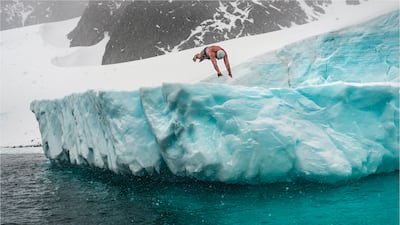
Pugh says he has seen the biggest effects of climate change on the polar regions and coral reefs. Photo: Olle Nordell/Lewis Pugh Foundation -
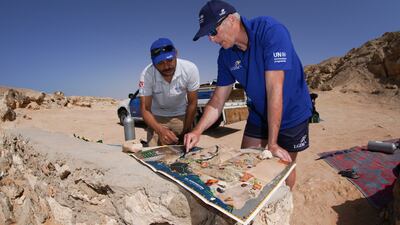
Pugh mapping out his Red Sea swim, which begins at Saudi Arabia's Tiran Island on October 11 and ends in Egypt's Hurghada on October 25. Photo: Steve Benjamin/Lewis Pugh Foundation -
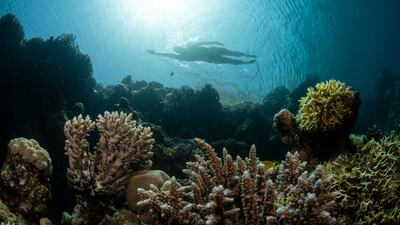
Pugh will swim approximately 10 kilometres per day during the two-week expedition. Photo: Steve Benjamin/Lewis Pugh Foundation -

Scientists warn that if the planet warms by more than 1.5°C, the world will lose at least 70 per cent of its coral reefs. Photo: Steve Benjamin/Lewis Pugh Foundation -

Pugh's goal at Cop27 is to encourage more countries to commit to the 30x30 campaign, a global target of protecting 30 per cent of the world's oceans by 2030. Photo: Steve Benjamin/Lewis Pugh Foundation -

By encouraging the creation of Marine Protected Areas, Pugh hopes to help make oceans more resilient to climate change. Photo: Steve Benjamin/Lewis Pugh Foundation -

Pugh became the first person to complete a long-distance swim in all five oceans of the world in 2006. Photo: Steve Benjamin/Lewis Pugh Foundation -

Pugh was appointed the UN Patron of Oceans in 2013. Photo: Steve Benjamin/Lewis Pugh Foundation -
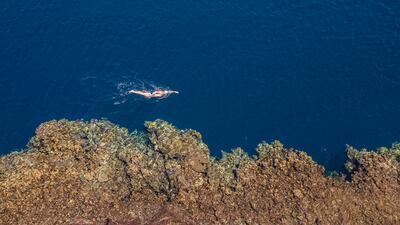
Pugh has helped protect over 2 million square kilometres of vulnerable ocean, an area the size of Western Europe. Photo: Steve Benjamin/Lewis Pugh Foundation -

The Hurghada Environmental Protection and Conservation Association (Hepca) has called for the Egyptian Red Sea's Great Fringing Reef to be declared a protected area. Photo: Steve Benjamin/Lewis Pugh Foundation -

Even in the world's coldest waters, Pugh swims in just a pair of Speedo swimming trunks, cap and goggles. Photo: Steve Benjamin/Lewis Pugh Foundation


“Nitrate is also toxic and harmful to several marine species,” Mr Jreissati added.
The effect on corals is a significant concern, he said. “These corals hold the key to saving other corals that have suffered in the face of climate change,” he added.
The Gaza war will also have long-term effects on the livelihoods of Yemenis, if attacks on ships continue. “Fishing is regarded as the Yemeni economy's third sector in order of importance,” he said.
Yemenis have struggled economically since civil war broke out in 2014, when the Houthis took over the capital Sanaa. But fishermen in Hodeidah, which is under the control of the rebels, say they have been hard hit since December 18, when the US launched an international maritime task force to defend shipping in the Red Sea and Gulf of Aden from Houthi attacks.
Greenpeace has called for the immediate ceasefire in Gaza and de-escalation in the region. "Prolonging this war will result in both a humanitarian and environmental catastrophe, in terms of loss of crops, food, water quality and loss of marine life endemic to the highly biodiverse Red Sea,” Mr Jreissati said.

