

As the Muslim world prepares for the Hajj season that takes place annually in Saudi Arabia, many questions about the importance of the ihram have surfaced over the past month.
Pilgrims enter what is known as a state of ihram, whereby they prepare their bodies and mind for the rituals ahead. This requires them to recite an intention and adhere to a certain dress code.
Before setting off on their pilgrimage, Muslims must first purify and declare their Niyyah, or intention, to God. Their Niyyah for Hajj should be sincere and for the sake of Allah only, not other worldly matters.
The word ihram is derived from the Arabic verb harama, which means “to be forbidden”.
Interpretations of the word
Ihram is used to describe three things:
1. The two pieces of cloth worn by male pilgrims.
2. The very act of starting Hajj, or Umrah.
3. The state of consecration in which the pilgrims are in during Hajj or Umrah. After putting on the ihram (first meaning) and making the intention of ihram (second meaning), the pilgrims enter automatically the state of ihram.
What is the ihram?
Stripping yourself of anything that could indicate your social standing is key to Hajj. While on the pilgrimage, everybody, regardless of financial or social status, is seen as equal in God's eyes.
The ihram attire – two pieces of white, unstitched cloth – removes all indicators of social, cultural and political differences for the sake of equality before God.
It is for this reason that a simple wardrobe has been prescribed to Muslims during this time.
Kings, princes and sheikhs have all performed Hajj, donning the same clothing as the common man.
The attire must be worn when they are in a state of ihram while performing the Hajj rituals.
One piece of cloth is wrapped round the upper part of the body, but not the head. It is normally draped over both shoulders but at certain times it is draped over one shoulder.
The other is wrapped round the lower part of the body, which can be kept in place by a belt or pin.
For women, the ihram is ordinary loose-fitting clothes that cover all of the body except the face and hands. In some countries, the tradition is for women to wear special clothes such as white dresses or black abayas but when it comes to the ihram, that is not required.
Pilgrims should not use any perfumes, deodorants or cosmetics while in the state of ihram.
Where to wear the ihram
Ihram clothes are obligatory beyond a certain geographical boundary called miqat.
Pilgrims should wear the ihram before or at the time of entering the miqat. Once pilgrims enter the miqat, they cannot remove the attire until the pilgrimage is completed. The four important miqats in Umrah are:
1. Miqat Qarn Al Manazil: This is situated 80km north-east of Masjid Al-haram and 40km from the city of Ta’if.
2. Miqat Yalamlam: This is 100km south-west of Makkah and 90km north of the city of Al Lith.
3. Miqat Dhu Al Hulayfah: This is located 7km south-west of Masjid-an-Nabawi and was defined by the Prophet Mohammed as a miqat for pilgrims from Madinah.
4. Miqat Al Juhfah: This is 182km north-west of Makkah, 17km south-east of Rabigh and 15km east of the Red Sea.
Dos and dont's when in a state of ihram
The ihram is a sacred state which Muslims must enter before performing Hajj, or Umrah, an optional, minor pilgrimage.
A pilgrim must enter this state by performing the cleansing rituals and wearing the previously described attire.
While in a state of ihram, these are the acts forbidden to pilgrims:
- Having sex
- Obscene or immoral speech and committing sinful acts
- Cutting their hair and nails or wearing perfume
- Hunting
- Wearing gloves
- Getting married or arranging a marriage for someone else
- Men wearing anything on their heads
- Women covering their faces
-

Convoys of Muslim pilgrims travel from all over the world to Makkah to undertake Hajj. -
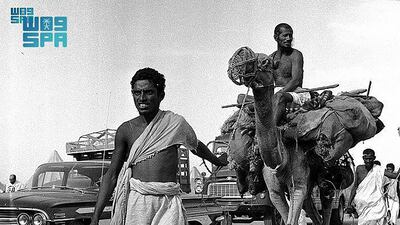
Pilgrims drive cars alongside others riding camels toward Makkah during Hajj. -
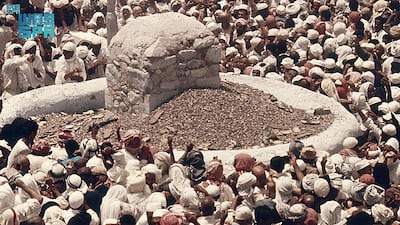
Jamarat - the stoning of the devil - sees pilgrims cast stones at three pillars in Mina, just outside Makkah, as part of Hajj. -
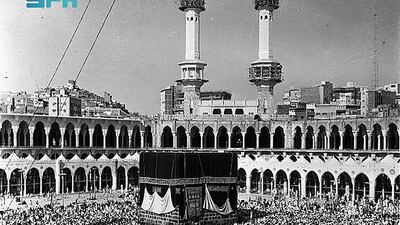
On the ninth day of Dhu Al Hijjah - the last month of the Islamic calendar - the Kaaba at the Grand Mosque in Makkah is covered by a cloth called the Kiswa. -
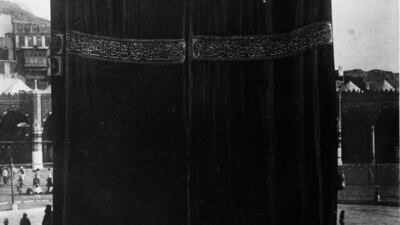
The Kaaba at the Grand Mosque in Makkah in March 1933. According to Muslim tradition, pilgrims who can gain access to the Kaaba's black stone stop to kiss it while performing Hajj. -
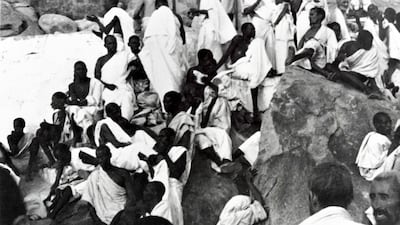
Hajj pilgrims gather in Makkah in November 1948. -
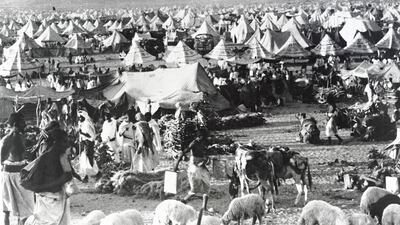
Crowds of pilgrims near Makkah prepare for Hajj in November 1948. -

Tents provide shelter to Hajj pilgrims near Makkah in 1948. -
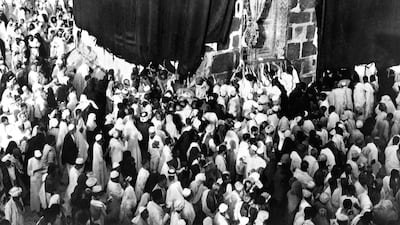
Pilgrims gather around the Grand Mosque in Makkah in November 1948. -

Worshippers reach the Kaaba during Hajj in 1953. -
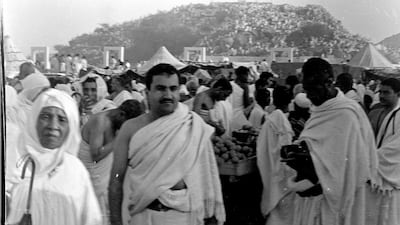
Hajj pilgrim Fouad Al Darkzli in Arafat. -
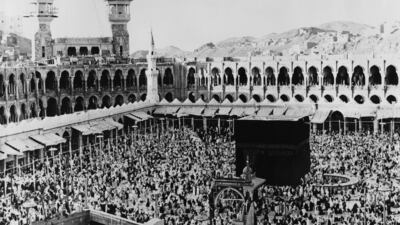
The Kaaba is surrounded by pilgrims in March 1967, with the entrance to the Zamzam Well on the left. -
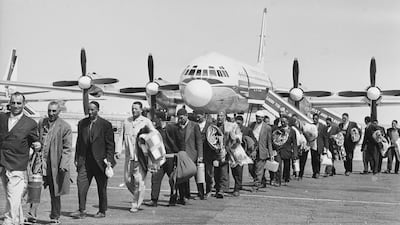
Pilgrims arrive at Makkah airport in August 1968. -
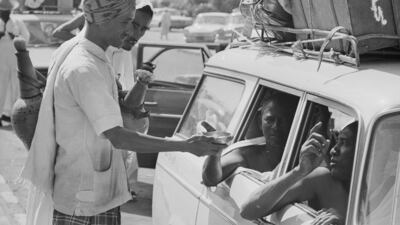
Street traders sell drinks to Hajj pilgrims in Makkah in August 1968. -
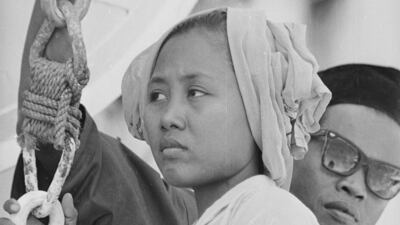
Pilgrims arrive in Saudi Arabia by ship in August 1968. -
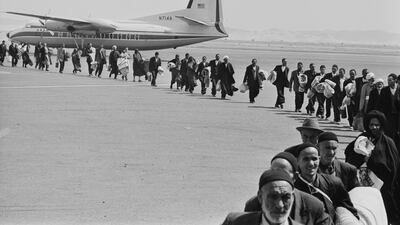
Muslims arrive at Makkah airport for Hajj in August 1968. -
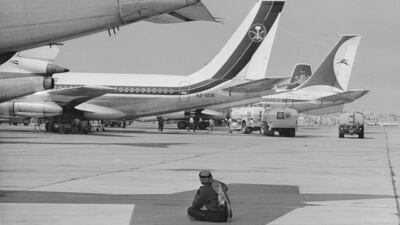
Muslims arrive at Makkah airport to participate in the pilgrimage in August 1968. -
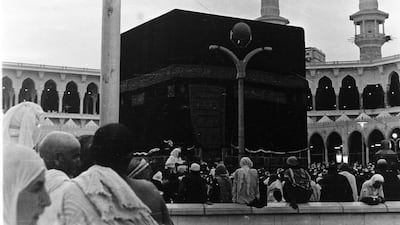
The scene inside the Grand Mosque in Makkah during Hajj in 1968. -

Muslims gather around the Kaaba as they participate in the Hajj pilgrimage in 1979. -
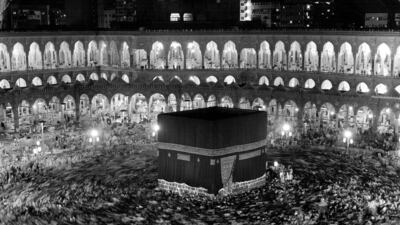
Pilgrims perform the Tawaf, the circumambulation of the Kaaba, during Hajj. -

The Kaaba at the centre of the Grand Mosque in Makkah during the Hajj pilgrimage in 1979. -

Thousands of pilgrims cross the Iraq-Saudi Arabia border near Arar in March 1999 after Riyadh said it would issue them visas to participate in Hajj. -
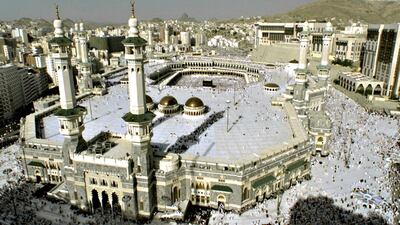
Pilgrims arrive at the Grand Mosque in Makkah in March 2000, when more than one million Muslims travelled to the city. -
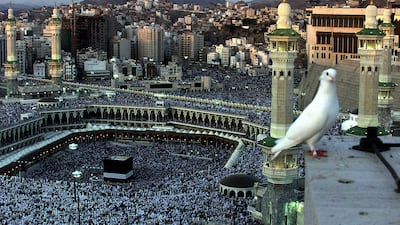
About 1.3 million people participated in the Hajj pilgrimage in February 2001. -
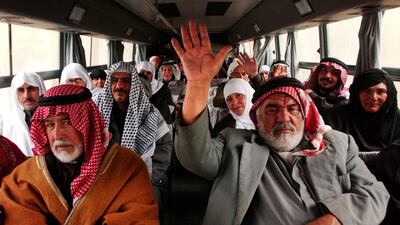
Iraqis travel to Makkah by bus in 2004, after the ousting of Saddam Hussein led to the removal of restrictions on who could make the pilgrimage. -
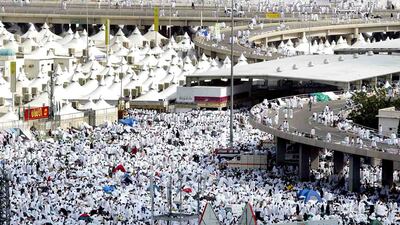
Millions of pilgrims participating in Hajj in 2004 arrive in Mina to camp in what was called the largest tent city in the world. -
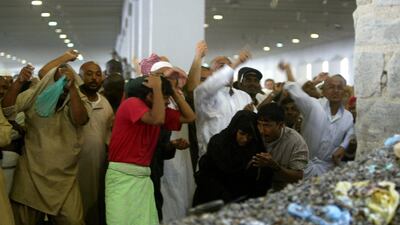
Pilgrims participating in Hajj in 2004 perform the Jamarat ritual, when Muslims must throw 21 stones at three pillars in Mina. -
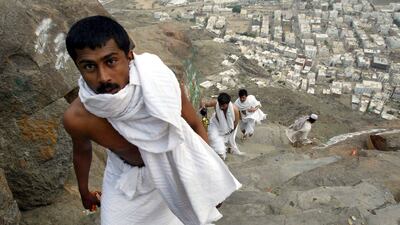
Muslims performing Hajj in 2004 make their way to the summit of Jabal Al Nour near Makkah. -
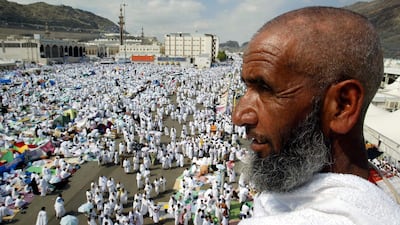
A pilgrim stands on a bridge overlooking Mina, where about two million Muslims camped during Hajj in January 2004. -
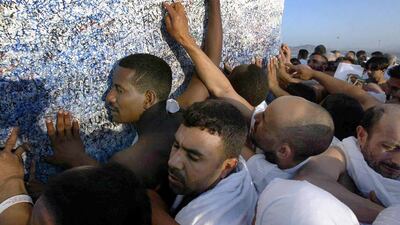
Pilgrims performing Hajj in January 2004 touch the monument at the summit of Jabal Arafat, where the Prophet Mohammed gave his last sermon. -
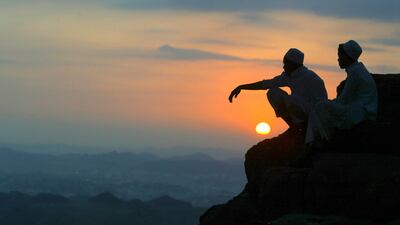
Two Saudi boys sit at the summit of Jabal Al Nour in 2004. -
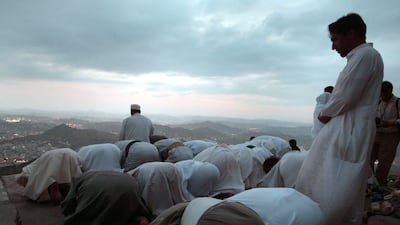
Pilgrims pray at the top of Jabal Al Nour in January 2004. Although climbing the mountain is not part of the pilgrimage, many Muslims make their way to the summit each year. -
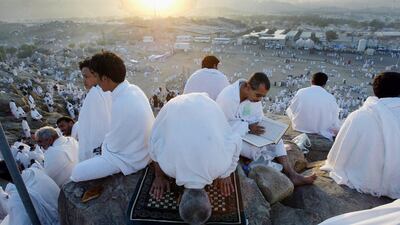
A Hajj pilgrim prays on Jabal Arafat in 2004. -
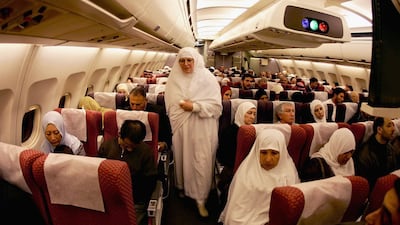
Pilgrims from Jordan are flown to Makkah from Amman in 2005. -
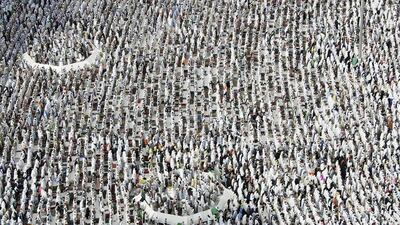
Pilgrims gather at the Kabba to pray in 2005. -
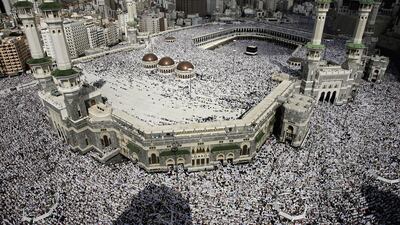
About two million pilgrims from around the world attend the Friday prayer at the Grand Mosque during Hajj in 2005. -
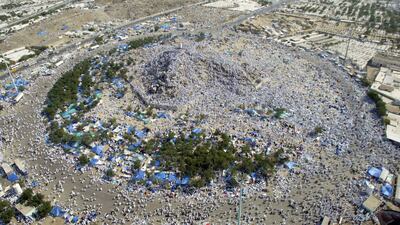
Pilgrims gather at Jabal Arafat, south-east of Makkah, in January 2006. -
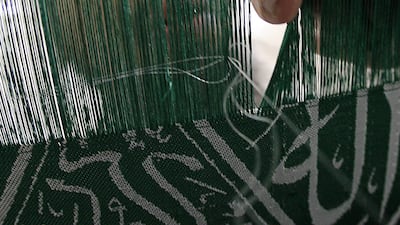
A Saudi man at the Kiswa factory in Makkah creates a drape bearing Islamic calligraphy to cover the Kaaba in 2008. The Kiswa is changed every year. -
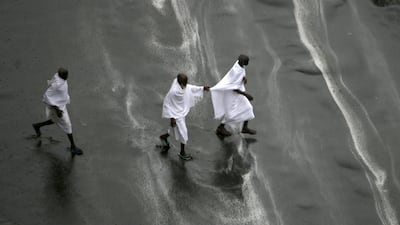
Hajj pilgrims seek shelter during heavy rain in Makkah in 2009. -

A pilgrim prays on top of Jabal Al Noor in Makkah in November 2010. Reuters -

Pilgrims gather at the base of Mount Mercy, on the plains of Arafat, in October 2013. Reuters -

A Muslim girl touches the Kaaba at the Grand Mosque in Makkah in September 2015. Reuters -
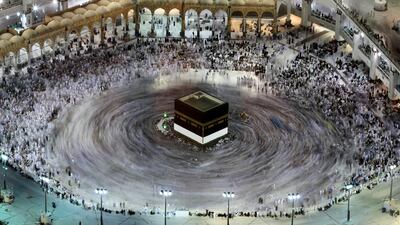
Hajj pilgrims circle the Kaaba in August 2017. AFP -

Pilgrims hold coloured umbrellas along matching coloured rings separating them, part of a Covid-19 safety measure, as they circle the Kaaba in July 2020. AFP -
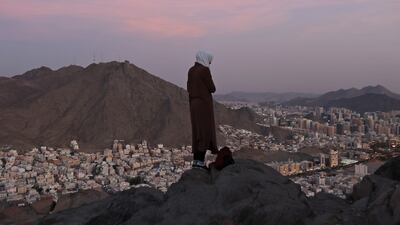
A pilgrim looks over Makkah from on top Jabal Al Noor in July 2022. AFP


Hajj is expected to begin on July 7, with Eid Al Adha expected to begin on July 9 in most Islamic countries.
Foreign worshippers will make up the bulk of the one million pilgrims allowed to perform Hajj this year, the Saudi Ministry of Hajj and Umrah said last month.
Hajj pilgrims travelling from overseas are expected to account for 85 per cent of the total number attending.
All Muslims who are able to are required to make the pilgrimage at least once in their lifetime.
Hajj is one of the five pillars of Islam.
This article was originally published in 2022.

